Enrique Vila-Matas - Montano's Malady
Здесь есть возможность читать онлайн «Enrique Vila-Matas - Montano's Malady» весь текст электронной книги совершенно бесплатно (целиком полную версию без сокращений). В некоторых случаях можно слушать аудио, скачать через торрент в формате fb2 и присутствует краткое содержание. Год выпуска: 2007, Издательство: New Directions, Жанр: Современная проза, на английском языке. Описание произведения, (предисловие) а так же отзывы посетителей доступны на портале библиотеки ЛибКат.
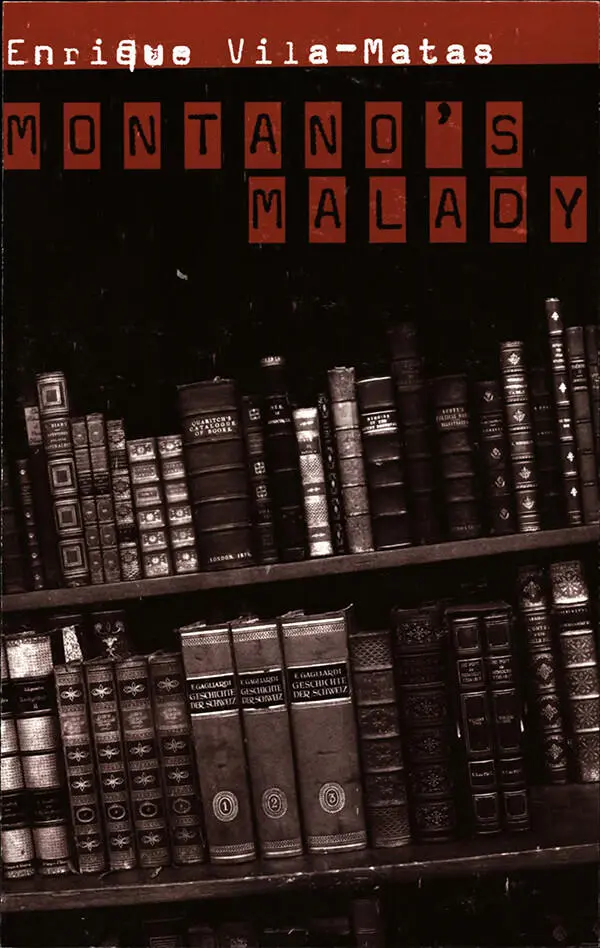
- Название:Montano's Malady
- Автор:
- Издательство:New Directions
- Жанр:
- Год:2007
- ISBN:нет данных
- Рейтинг книги:5 / 5. Голосов: 1
-
Избранное:Добавить в избранное
- Отзывы:
-
Ваша оценка:
Montano's Malady: краткое содержание, описание и аннотация
Предлагаем к чтению аннотацию, описание, краткое содержание или предисловие (зависит от того, что написал сам автор книги «Montano's Malady»). Если вы не нашли необходимую информацию о книге — напишите в комментариях, мы постараемся отыскать её.
is a writer named Jose who is so obsessed with literature that he finds it impossible to distinguish between real life and fictional reality. Part picaresque novel, part intimate diary, part memoir and philosophical musings, Enrique Vila-Matas has created a labyrinth in which writers as various as Cervantes, Sterne, Kafka, Musil, Bolano, Coetzee, and Sebald cross endlessly surprising paths. Trying to piece together his life of loss and pain, Jose leads the reader on an unsettling journey from European cities such as Nantes, Barcelona, Lisbon, Prague and Budapest to the Azores and the Chilean port of Valparaiso. Exquisitely witty and erudite, it confirms the opinion of Bernardo Axtaga that Vila-Matas is "the most important living Spanish writer."
Montano's Malady — читать онлайн бесплатно полную книгу (весь текст) целиком
Ниже представлен текст книги, разбитый по страницам. Система сохранения места последней прочитанной страницы, позволяет с удобством читать онлайн бесплатно книгу «Montano's Malady», без необходимости каждый раз заново искать на чём Вы остановились. Поставьте закладку, и сможете в любой момент перейти на страницу, на которой закончили чтение.
Интервал:
Закладка:
FROM JOHN CHEEVER’S JOURNALS
“In the middle age there is mystery, there is mystification. The most I can make out of this hour is a kind of loneliness. Even the beauty of the visible world seems to crumble, yes even love. I feel that there has been
some miscarriage, some wrong turning
, but I do not know when it took place and I have no hope of finding it.”
IDENTITY
The diary that I abandoned in Barcelona and that I go on writing here is a little like a clinical report that seems only to pay attention to the stealthy expressiveness of an illness: my suffering from literature sickness. My diary is full of detailed observations on the evolution of this illness. In the same way as other diarists, I do not write to know who I am, but to know what I am turning into, what is the unforeseeable direction — to disappear would be the ideal, though perhaps not — in which catastrophe is taking me. It is not, therefore, the revelation of some truth that my diary pursues, but the crude, clinical account of a mutation. I began my diary as a narrator who longed to be a literary critic; I then went about building up a diarist’s personality thanks to some of my favorite diarists — I kept others back, like Cheever and Barnabooth, for this lecture, as I also kept fragments of autobiography — and now I see that I am starving myself of my own volition: I have turned into a proper vagrant, whom I see moving away, governed by his uneasiness, or rather by an uneasiness that isn’t necessarily his, but in which he partakes in some way. Who knows, ladies and gentlemen, distinguished Hungarian public, it may be my own uneasiness that is invading him.
STRANGE HELPLESSNESS
In Detour , a gray man called Al is content every night to play the piano for his girlfriend, a singer in a bar in New York. When she decides to be more ambitious and to head for Los Angeles, poor Al, the man without qualities, is left sad and defeated and, without knowing it, at the mercy of destiny’s darkest forces. One day he phones his girlfriend in Los Angeles and, when she tells him to come and visit her, our pianist decides to hitch all the way to the West Coast. He is picked up by a guy named Haskell, a fake with money, who drives a convertible and promises to take him as far as Los Angeles. It seems like a stroke of luck for Al, but when they make a detour on the road to fill up at a gas station, this turning — almost imperceptibly at first — will be the beginning of a series of endless fatalities, of continuous nightmarish setbacks that will change the life of Al the nondescript. When they stop again, Haskell dies of a heart attack and Al is forced to usurp his personality to keep going and falls into the clutches of a hitchhiker, an evil, disturbed femme fatale who knows the convertible’s previous owner and blackmails him. When she also dies accidentally — although the police will always believe that she has been murdered, killed by Al — she will leave our gray man with his nondescript character with two unexplained deaths on his shoulders, a fugitive from the law, a man without a credible identity, who has lost his way on some byroad.
On leaving the cinema, I did not fail to notice that the humbug Haskell was a little like Monsieur Tongoy, who sometimes, without having anything, boasts of having something: “cabins,” wine, interest in cinema, and a bit of money. Nor did I fail to notice certain similarities between the disturbed femme fatale and Rosa. And I could not help noticing that I resembled the nondescript without an identity, the man without qualities, who in the end wanders along the byroad.
A strange film, probably the oddest and best film that I have ever seen, but one I soon realized brought with it fatality and a strange helplessness, which I feel this evening, lacking shelter and food, on life’s byroad.
Final fatality: destiny turned its back on Tom Neal, the actor who plays Al, as soon as he finished shooting the film. He fell into perpetual disgrace in Hollywood when he fought with Franchot Tone for the love of a woman, for the love of Barbara Payton. Expelled from Los Angeles and from life, pariah on somber destiny’s road, Tom Neal in 1965 murdered his third wife. He spent years in prison and, when he got out, he led the life of a vagrant in the family of the defeated and one day he was found dead on a byroad south of Boston.
DIARY OF A RECENTLY MARRIED POET
There is Rosa, ladies and gentlemen, distinguished Hungarian public, there is Rosa, impassive in the front row, calm as anything when I call her a femme fatale. I’m not planning to do away with her as poor Tom Neal did. After all, in her capacity as vamp — this alone qualifies her to sit next to her partner in the front row, the vampire — it is some time since my wife gave up her corrosive activity at the end of the 1960s, when she would induce the young poets who crossed her path to commit suicide or else, if she saw that they were not up to it, she would annihilate them from a creative point of view. I never saw anyone with such a hatred of poetry. Today Rosa is a peaceful mendicant, calmly seated in the front row of this room, but when I met her she destroyed poets. She was worse than Calamity Jane, that legendary and disastrous woman of the West. Rosa chased poetry and poets to death, she believed that prose should be written instead of poetry and that verse had lost its raison d’être with the invention of writing, a few years after Homer. She was always quoting Leopardi: “Everything has been brought to perfection since Homer, except poetry.” For Rosa only prose existed and poetry deceived only fools, since it was really prose with a high opinion of itself. As soon as she spotted a poet, especially if he was young, she would do everything in her power to humiliate him and, if possible, to eliminate him. At best, she would send him back to the world of prose. She saw off more than one, more than one fragile poet, singer of the moon and cemeteries. She would wrap them all in the intimacy of her dark love nest and then ask them if it was true that they hailed from the land of sweet poets, and, if the poor, innocent souls fell into the trap and admitted being sweet and being poets, Rosa would lash them with a whiplike sentence: “You’re all poets, and yet I’m on the side of death.”
Rosa for a long time morally assassinated poets. She wanted to go beyond poetry, beyond the prestige of this discipline that got on her nerves and that struck her as fundamentally prosaic and above all opportunistic, a refuge for the mediocre. Rosa attracted young poets, seduced them thoroughly, and then threatened to leave them if they continued to believe in poetry or if they did not take it to its limits and place themselves on the side of death. She undermined lyrical morale with all kinds of devilish tricks. And more than one despaired, was annihilated, even committed suicide.
“Are you a poet?” she asked me the night we met. I was a novelist by then, although I had yet to publish anything, but I was also a poet, albeit secretly out of respect for and in honor of my mother, who had written poetry all her life without confessing to it. Around that time I was writing secret verses about the moon and the stars. But I didn’t tell Rosa anything. Fortunately. I felt good being a secret poet. I didn’t tell her anything, and at that stage I had no idea that she hated poetry in this way. I simply told her that I was a novelist and this probably saved my life. A few months later, we moved in together and, though no paperwork was involved, we felt that we had married. My poems have remained hidden until now, until today when I reveal my secret to Rosa. Shortly after moving in together, we went on a trip to Venice, which we always considered our honeymoon. There was a lot of talk around that time, in Spain’s literary circles, about a poetic style termed Venetian, the poetry of the novísimos , who were the poets of my generation. Fortunately, however, I made no mention of it during our trip, nor did it occur to me — also fortunately — to say anything about my secret attraction toward poetry; I have guarded the secret very closely until this evening. I don’t know what Rosa would have thought if I had shown signs of interest in the poets of my generation, for example, or if she had suddenly realized that her recently married novelist she was traveling with was also a poet. This, in fact, is what I was, a happy man, still unaware — I would find out on this trip — of Rosa’s hatred for poetry. I found out on a night with a full moon, one frankly poetic. I found out when we were floating along the Grand Canal, past the railway station and Tronchetto Island, out to sea, and Rosa the poet-breaker, no doubt abetted by the large amount of grappa she had imbibed, began to tell me, inserting the occasional sinister detail, how she had cruelly cut short the poetic life, and sometimes even the actual life, of more than one poet. I was horrified, unable to utter a word, there on the Grand Canal. I was dumbstruck as she let out a chilling guffaw that tore up any future attempt to publicize my poetry by the roots.
Читать дальшеИнтервал:
Закладка:
Похожие книги на «Montano's Malady»
Представляем Вашему вниманию похожие книги на «Montano's Malady» списком для выбора. Мы отобрали схожую по названию и смыслу литературу в надежде предоставить читателям больше вариантов отыскать новые, интересные, ещё непрочитанные произведения.





Обсуждение, отзывы о книге «Montano's Malady» и просто собственные мнения читателей. Оставьте ваши комментарии, напишите, что Вы думаете о произведении, его смысле или главных героях. Укажите что конкретно понравилось, а что нет, и почему Вы так считаете.