Enrique Vila-Matas - Montano's Malady
Здесь есть возможность читать онлайн «Enrique Vila-Matas - Montano's Malady» весь текст электронной книги совершенно бесплатно (целиком полную версию без сокращений). В некоторых случаях можно слушать аудио, скачать через торрент в формате fb2 и присутствует краткое содержание. Год выпуска: 2007, Издательство: New Directions, Жанр: Современная проза, на английском языке. Описание произведения, (предисловие) а так же отзывы посетителей доступны на портале библиотеки ЛибКат.
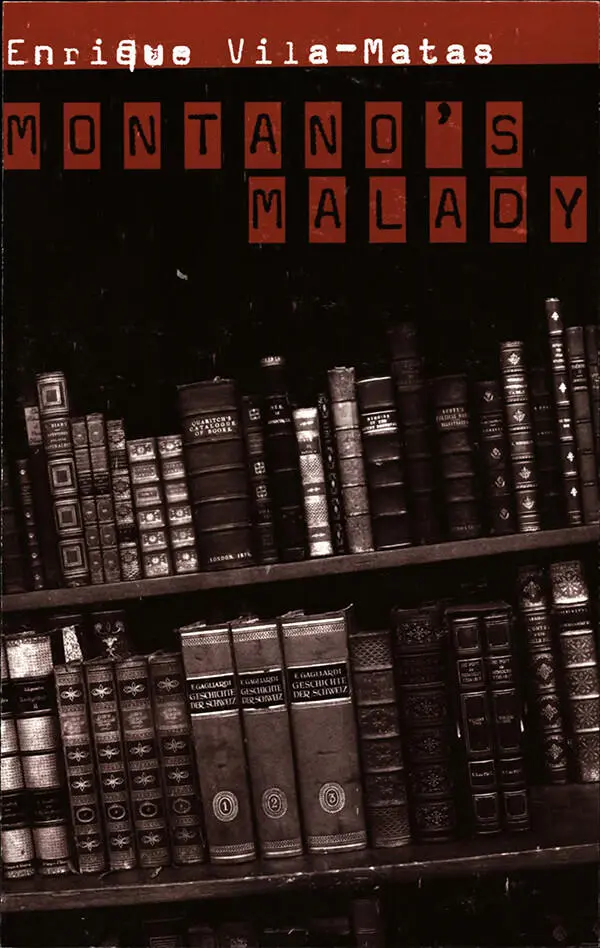
- Название:Montano's Malady
- Автор:
- Издательство:New Directions
- Жанр:
- Год:2007
- ISBN:нет данных
- Рейтинг книги:5 / 5. Голосов: 1
-
Избранное:Добавить в избранное
- Отзывы:
-
Ваша оценка:
Montano's Malady: краткое содержание, описание и аннотация
Предлагаем к чтению аннотацию, описание, краткое содержание или предисловие (зависит от того, что написал сам автор книги «Montano's Malady»). Если вы не нашли необходимую информацию о книге — напишите в комментариях, мы постараемся отыскать её.
is a writer named Jose who is so obsessed with literature that he finds it impossible to distinguish between real life and fictional reality. Part picaresque novel, part intimate diary, part memoir and philosophical musings, Enrique Vila-Matas has created a labyrinth in which writers as various as Cervantes, Sterne, Kafka, Musil, Bolano, Coetzee, and Sebald cross endlessly surprising paths. Trying to piece together his life of loss and pain, Jose leads the reader on an unsettling journey from European cities such as Nantes, Barcelona, Lisbon, Prague and Budapest to the Azores and the Chilean port of Valparaiso. Exquisitely witty and erudite, it confirms the opinion of Bernardo Axtaga that Vila-Matas is "the most important living Spanish writer."
Montano's Malady — читать онлайн бесплатно полную книгу (весь текст) целиком
Ниже представлен текст книги, разбитый по страницам. Система сохранения места последней прочитанной страницы, позволяет с удобством читать онлайн бесплатно книгу «Montano's Malady», без необходимости каждый раз заново искать на чём Вы остановились. Поставьте закладку, и сможете в любой момент перейти на страницу, на которой закончили чтение.
Интервал:
Закладка:
Monsieur would like to think like Valéry and continue Musil’s work, that’s why you’ll see him sometimes looking lost in the streets, searching for Musil. He doesn’t look so lost when he tackles the corridors of the Kakania Grand Hotel, though I don’t think he’ll be tackling anything right now, he’ll probably be sleeping off yesterday’s drinking bout, though, who knows, perhaps he’s already feeling better and is on his way here or opening a private journal. If he’s started to write one, I shall pinch it right away. Though, on reflection, it’s absurd. Why steal his diary if I can already imagine what he writes there: “Rosa likes Rosario because the poor man resembles a lesser Dracula. It would be much more natural for her to be drawn to me, since I am the most classic of Draculas, albeit I do not like to be connected with a vampire at all.”
In short, ladies and gentlemen, distinguished Hungarian public, I believe everybody should keep another’s diary. It’s an enormously healthy exercise.
BASER PASSIONS
You have already seen me improvise from time to time, depart from Monsieur Tongoy’s script, so now I leave these sheets behind and inform you that at the start of the twenty-first century, in February of this year, Rosa, monsieur and I traveled to the Azores. We had met in Chile, in Valparaiso, where we saw monsieur cruelly drown a fly in a pool of dry martini. A bird went by, and we followed it. We deduced that it was heading for the Azores and, two months later, the three of us set foot on those islands. On the island of Pico, inside its imposing volcano, I thought I saw some tireless moles working away day and night, in the service of the enemies of the literary. I thought I saw them, I imagined them, I suspected that they were there, in truth I saw them…. I couldn’t say now exactly what it was that happened, all I know is that I obtained a valuable image for the fictional diary I was, and still am, writing. The image, possibly visionary or simply intuitive or real, burrowed deep inside me. Hijacked as my mind was by the obsession that literature is under threat and runs the risk of extinction, this vision of the moles had a powerful effect on me.
It still does. Allow me to explain that real, true literature has always evolved serenely until reaching the point where it can be classed as lasting. That of the owners of Pico’s moles, on the other hand, is mere appearance, practiced by animals who claim to be writers and whose literature gallops with the noise and shouts of its practitioners, and every year launches thousands of books on to the market, although, as the years go by, one ends up asking where they are and what became of their brief and noisy renown; it is, therefore, a transient literature, unlike real literature, which is permanent, although, at times like this, real literature has to make an increasingly greater effort to withstand the assaults of the moles’ owners.
The day we traveled on the ferry from Fayal to Pico, with bad weather in the channel connecting the islands, I did not know that Monsieur Tongoy was so irritated by what he understood was an exaggerated tendency on my part to think about the dangers threatening real literature. I found out after we had just disembarked in Madalena, Pico’s harbor, with Rosa lagging behind us, and — I admit somewhat inopportunely — I remarked that the tragic, silent, and deserted scene — there was not a soul in sight in Madalena — was like a metaphor for the death of literature. He answered rudely. He got so worked up that he seemed to have gone mad. I shall never forget his reaction, most of all because, shortly afterward, he said something that had quite an impact on me and I had a first, fleeting intuition that there could be something between him and Rosa that I was not noticing.
It was an odd moment. As if he had suddenly revealed both how much my Montano’s malady or sickly obsession with literature infuriated him and the excessive intimacy he shared with Rosa. In fact, it was the prelude to what has finally exploded here in Budapest, where something like a fatality has appeared in our relationship, originating from some miscarriage, some wrong turning, and it is impossible today to know exactly when it took place, but it did take place, and it is dramatic.
I said that Madalena’s silent and deserted scene was like a metaphor for the death of literature, and Monsieur Tongoy, out of Rosa’s hearing, told me that, if I carried on being obsessed with what I was writing and above all obsessed with the death of literature, scarcely able to enjoy the trip and the scenery, he would feel obliged to warn Rosa that I was confusing what I was writing with reality, that I thought I was Don Quixote in the Azores.
At this point Rosa joined us and Monsieur Tongoy and I both fell silent. A little later, we hired a taxi — a taxi driver was the only person we saw in the whole of Madalena — and drove down the gloomy and solitary Lajes road, the road that would take us to a small hill a short distance from the island’s volcano, where a secret writer lived, who turned out to be as invisible as he was secret, but who helped me to create a sinister character — it was in front of his house where I saw, or thought I saw, the tireless moles — which I incorporated into my diary that night in Fayal, after we had returned from Pico and had all drunk a fair amount of gin. It was then that I reached a conclusion and, with the echo of monsieur’s words about Quixote still in my ear, I decided that in my fictional diary, to save it from extinction, I would embody literature itself, which has never been so seriously threatened as at the start of this century.
When, on leaving Café Sport that night, I told Rosa and monsieur that in Pico I had witnessed a battalion of tireless moles in the service of the basest of human passions, Monsieur Tongoy reacted abnormally. “And which is the basest of them all?” he asked obscenely and lasciviously, like an idiot, more drunk than I was, his central European eyes those of a dirty old man.
I thought for a moment. I gazed at the moon, listened to the murmur of the sea, thought how little thought takes place nowadays. The lack of culture, I said to myself, is suffocating thought. As is alcohol, you only have to look at monsieur. I’m not going to talk to him about sex, which is what he expects, I’m going to crush him with the danger posed by the enemies of the literary.
I thought about the merchants and emissaries of nothingness and other enemies of the literary.
“The stink of money and its proud stench,” I answered him, “and the deliberate lack of culture they generate, which goes against life, against real life.”
There was no immediate reply, only surprise. Then I told them both that for my book I had the idea of embodying literature’s complete memory. And this triggered a violent response from the two of them. Monsieur Tongoy looked at me angrily. “Go fuck yourself,” he told me. “You see everything in literature. I’m not surprised you even want to merge with it,” Rosa upbraided me. I tried to explain to them that I wanted to embody literature only in fiction. But they were too drunk to appreciate such subtlety. What bothered me most was that they did not share my concern for the future of real literature. I should have liked to admit to them that I was prepared to organize a movement of world resistance to the masters of Pico’s moles, but, given the circumstances, this would have been almost like putting my life on the line. I began to understand that I was alone on that island and that the only consolation left to me was to think that I was in paradise. I said this to myself so as not to lose heart completely. But their lack of solidarity with me I found so enraging that I could not contain myself. I told them that, if they did not change their attitude, I would abandon them right there on the island. They were stunned at first, but then they began to titter. This was the famous beginning of the end. “At the start of the twenty-first century, I am alone and without direction on some byroad,” I remarked reprovingly, testing to see what would happen. And it happened. First they started to giggle, but they ended up laughing their heads off and losing their balance, the two of them shaking, they thought it was so funny, and then holding on to a boat they had bumped into and trying to catch their breath. This was the limit, especially when their laughter expired and, to my surprise, I discovered that monsieur could read my thoughts.
Читать дальшеИнтервал:
Закладка:
Похожие книги на «Montano's Malady»
Представляем Вашему вниманию похожие книги на «Montano's Malady» списком для выбора. Мы отобрали схожую по названию и смыслу литературу в надежде предоставить читателям больше вариантов отыскать новые, интересные, ещё непрочитанные произведения.




Обсуждение, отзывы о книге «Montano's Malady» и просто собственные мнения читателей. Оставьте ваши комментарии, напишите, что Вы думаете о произведении, его смысле или главных героях. Укажите что конкретно понравилось, а что нет, и почему Вы так считаете.