Enrique Vila-Matas - Montano's Malady
Здесь есть возможность читать онлайн «Enrique Vila-Matas - Montano's Malady» весь текст электронной книги совершенно бесплатно (целиком полную версию без сокращений). В некоторых случаях можно слушать аудио, скачать через торрент в формате fb2 и присутствует краткое содержание. Год выпуска: 2007, Издательство: New Directions, Жанр: Современная проза, на английском языке. Описание произведения, (предисловие) а так же отзывы посетителей доступны на портале библиотеки ЛибКат.
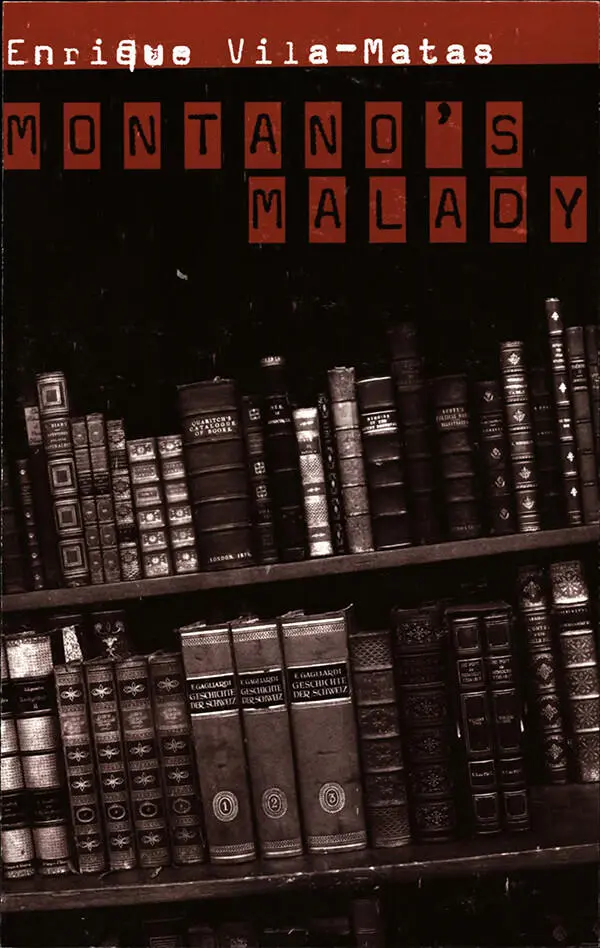
- Название:Montano's Malady
- Автор:
- Издательство:New Directions
- Жанр:
- Год:2007
- ISBN:нет данных
- Рейтинг книги:5 / 5. Голосов: 1
-
Избранное:Добавить в избранное
- Отзывы:
-
Ваша оценка:
Montano's Malady: краткое содержание, описание и аннотация
Предлагаем к чтению аннотацию, описание, краткое содержание или предисловие (зависит от того, что написал сам автор книги «Montano's Malady»). Если вы не нашли необходимую информацию о книге — напишите в комментариях, мы постараемся отыскать её.
is a writer named Jose who is so obsessed with literature that he finds it impossible to distinguish between real life and fictional reality. Part picaresque novel, part intimate diary, part memoir and philosophical musings, Enrique Vila-Matas has created a labyrinth in which writers as various as Cervantes, Sterne, Kafka, Musil, Bolano, Coetzee, and Sebald cross endlessly surprising paths. Trying to piece together his life of loss and pain, Jose leads the reader on an unsettling journey from European cities such as Nantes, Barcelona, Lisbon, Prague and Budapest to the Azores and the Chilean port of Valparaiso. Exquisitely witty and erudite, it confirms the opinion of Bernardo Axtaga that Vila-Matas is "the most important living Spanish writer."
Montano's Malady — читать онлайн бесплатно полную книгу (весь текст) целиком
Ниже представлен текст книги, разбитый по страницам. Система сохранения места последней прочитанной страницы, позволяет с удобством читать онлайн бесплатно книгу «Montano's Malady», без необходимости каждый раз заново искать на чём Вы остановились. Поставьте закладку, и сможете в любой момент перейти на страницу, на которой закончили чтение.
Интервал:
Закладка:
Some of you must be wondering if Barnabooth was really Chilean. Well, I have to say he was always thought of as a South American millionaire of no fixed state. But he can be considered Chilean because, when he was created — when he was “written” by Larbaud — his place of birth was Chile, hence it can be said that he was from Monsieur Tongoy’s country, though in fact Barnabooth was from everywhere, and this was his grace, he was stateless but also Chilean, because he was born in 1883, “in Campamento, Arequipa Province, today Chile , just when a war was being waged between Peru, Chile, and Bolivia over this territory.”
Revenge, Hamlet.
You don’t know how good it makes me feel to talk about this stateless millionaire, so vastly superior to that ghost, Monsieur Tongoy.
Barnabooth wrote an elegant private journal that begins in the Carlton Hotel in Florence and ends in London, where he takes his leave of Europe and decides to abandon the diary: “I shall leave these pages, this book. I shall leave it tomorrow afternoon, in Paris, where it will be published, I don’t care how or when. It is the final whim I permit myself.”
In truth Barnabooth wants the diary to be published so that he can lose sight of it, unburden himself. He says that when the diary reaches the bookshops, that will be the day he ceases to be a writer. Just like that. He wants nothing more to do with writing. And even less with the diary, about which he says, “It is over, I begin. Do not seek me in its pages, I’m somewhere else, I’m in Campamento, in South America.”
How superior is Barnabooth to Monsieur Tongoy! Revenge, Hamlet. And good-bye, Monsieur Tongoy. I use Barnabooth, who was Chilean like you, to send you packing to the Chilean Patagonia from where you mustn’t return. Good-bye, monsieur. I cease to give the lecture following your dictatorial dictation. I choose my own route, a decision as serious as it is in fact trivial, because in fact the difference between following monsieur’s dictation and ceasing to do so is the same as that between repeating the words of your dog and taking it for a walk.
DIARY OF THE CONVENT OF THE PRECIOUS BLOOD
Good-bye, Rosa, good-bye. I knew the day would come when I would have to separate from you and I would write it here. Good-bye, Rosa. You’ll even end up missing those mornings when we ate breakfast together and I saw that the fried eggs were staring at me from the plates you served me sweetly, although sometimes they ended up glaring at me from the floor: plates that broke when you hurled the fried eggs at my head and said you felt weighed down by our lack of intimacy, that wanted to be on your own for a while. Goodbye, Rosa, good-bye. Now you will have all the time to enjoy your precious intimacy. After all, Monsieur Tongoy is a dirty old man with one foot in hell, already the slow Chilean train that will run him down is approaching. Soon, Rosa, you’ll have all the time in the world to miss those wonderful mornings when the fried eggs figured so prominently between us. Soon you’ll be hit by nostalgia even for the morning you spilled your blood over breakfast. It all began when I asked you if I could make some toast and you told me to wait until you had finished making yours, and shortly after saying this you started to cry, and I asked myself out loud what I had done to deserve this, and you called me a pig, and I told you to stop crying, for God’s sake, don’t cry anymore, I just wanted to make some toast, I told you, just some toast for the fried eggs, and you ordered me to make a boiled egg and to go to hell because I had spoiled your day, and then, when I told you that I didn’t want a boiled egg and that this argument was ridiculous, you hurled your plate at my head and started crying again and bent down to pick up the remains of the broken plate and ended up cutting the surface of your hand, you spilled your precious blood.
That’s where I wanted to get to. To the precious blood, which allows me to think about Chile, to recall the Convent of the Precious Blood, in the city of Santiago, where the extremely beautiful writer Teresa Wilms Montt, enclosed against her will, wrote part of her private journal, which today is named after the convent.
Teresa was great and you, Rosa, will never be. Revenge, Hamlet. Teresa was a real woman and you are just a flesh-and-blood character in the tragic novel of my life.
Teresa was born in 1893 in Viña del Mar, she was educated for marriage and for high-society parties, but from an early age this young woman of good family showed a tendency to rebel. She married the first man she met, Gustavo Balmaceda, with whom she shared a passion for the opera. The couple — she was only seventeen — had to leave Viña del Mar’s closed society and settle in Santiago, where Teresa became literature-sick while her husband became sick with jealousy and gave himself up to alcohol. Shouts, fights, blows. They moved to Iquique, where matters became even worse for the couple when she sought out the company of trade unionists and feminists who helped consolidate her Masonic and anarchist thinking.
Teresa had two daughters from her marriage, but was violently separated from them when her husband found out that she was unfaithful. He shut her up in the Convent of the Precious Blood in Santiago, where Teresa began to write her angst-ridden, terrible, bloody diary: “Stupid clock, continue loathsomely! Your black hands like a crow’s wings park on each endless minute. I feel an impulse to throw you far away, to stamp on you! Ironic, biting, impassive enemy of those who suffer, you are without mercy! When you see that we are happy, you become light and your minute hands fly…. You’re perverted, infested with the devil!”
During her angst-ridden enclosure, she clung to her diary, she acted as if she knew these words by John Cheever: “Literature has been the salvation of the damned, literature has inspired and guided lovers, routed despair and can perhaps in this case save the world.”
Teresa escaped from that convent and fled with Vicente Huidobro to Buenos Aires, where she entered the literary circles and became one of the few women who frequented bohemian life in the capital. These words by Huidobro remain as a testament to those Argentinian days and have become an immortal eulogy: “Teresa Wilms is the greatest woman to have come out of America. Perfect in face, perfect in body, perfect in elegance, perfect in education, perfect in intelligence, perfect in spiritual strength, perfect in grace.”
But Teresa Wilms fled from Buenos Aires as well: “I have left Argentina because my destiny is to wander.” New York, Seville, Paris, London, and Valle-Inclán’s Madrid — she was his muse — all saw her go by. Go by and leave. Teresa fled from every city. And ended up fleeing from herself, she began not to eat and to take all kinds of sedatives to dull her overflowing senses. She carried her wandering life, her journey along some byroad, her destiny, to its logical conclusion. At the age of twenty-eight she killed herself with an overdose of barbiturates. Her language reminds me of Alejandra Pizarnik’s, and therefore also of my mother’s. Teresa Wilms killed herself and in her diary left passages like this: “Naked as I was born, I leave, as ignorant of what there was in the world. I suffered and this is the only baggage of the boat that leads to oblivion.”
You who in respectful silence follow the staging of my extensive personal drama will hardly or not be surprised if I tell you that Teresa was a very superior being to Rosa. Revenge, Hamlet. One Chilean millionaire and one poet from the same country have sufficed for me to fulminate against monsieur and Rosa. Thank you, Chile. Thank you, Hamlet. And goodbye, Rosa, good-bye. You are a toad for me this evening, and so is monsieur. Good-bye, both of you. I shan’t say now that the truth for a toad like you is that for another toad, monsieur’s toad. I shan’t say that, Rosa, but I will say that it is a pleasure to lose one toad, and even more, to lose both.
Читать дальшеИнтервал:
Закладка:
Похожие книги на «Montano's Malady»
Представляем Вашему вниманию похожие книги на «Montano's Malady» списком для выбора. Мы отобрали схожую по названию и смыслу литературу в надежде предоставить читателям больше вариантов отыскать новые, интересные, ещё непрочитанные произведения.


Обсуждение, отзывы о книге «Montano's Malady» и просто собственные мнения читателей. Оставьте ваши комментарии, напишите, что Вы думаете о произведении, его смысле или главных героях. Укажите что конкретно понравилось, а что нет, и почему Вы так считаете.