Enrique Vila-Matas - Montano's Malady
Здесь есть возможность читать онлайн «Enrique Vila-Matas - Montano's Malady» весь текст электронной книги совершенно бесплатно (целиком полную версию без сокращений). В некоторых случаях можно слушать аудио, скачать через торрент в формате fb2 и присутствует краткое содержание. Год выпуска: 2007, Издательство: New Directions, Жанр: Современная проза, на английском языке. Описание произведения, (предисловие) а так же отзывы посетителей доступны на портале библиотеки ЛибКат.
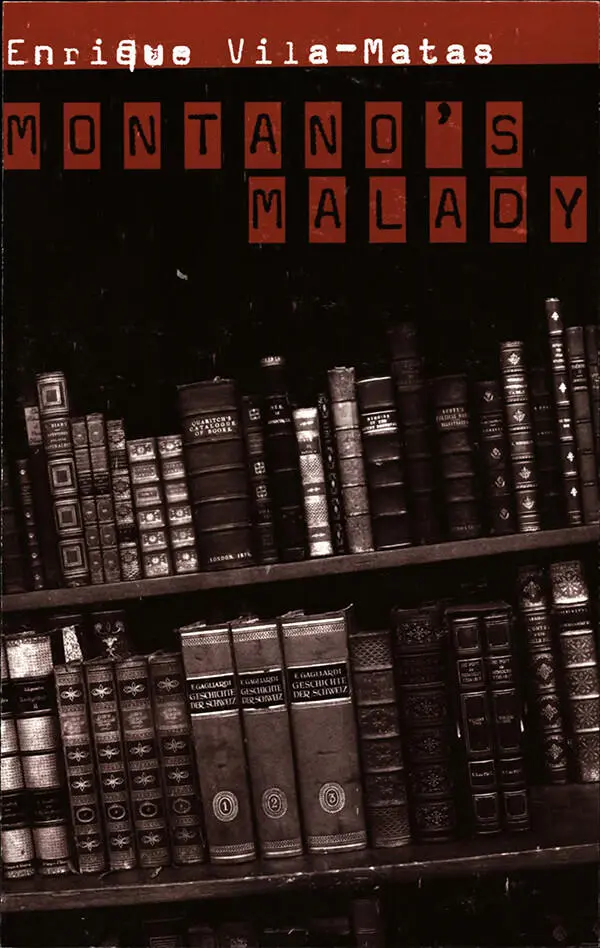
- Название:Montano's Malady
- Автор:
- Издательство:New Directions
- Жанр:
- Год:2007
- ISBN:нет данных
- Рейтинг книги:5 / 5. Голосов: 1
-
Избранное:Добавить в избранное
- Отзывы:
-
Ваша оценка:
Montano's Malady: краткое содержание, описание и аннотация
Предлагаем к чтению аннотацию, описание, краткое содержание или предисловие (зависит от того, что написал сам автор книги «Montano's Malady»). Если вы не нашли необходимую информацию о книге — напишите в комментариях, мы постараемся отыскать её.
is a writer named Jose who is so obsessed with literature that he finds it impossible to distinguish between real life and fictional reality. Part picaresque novel, part intimate diary, part memoir and philosophical musings, Enrique Vila-Matas has created a labyrinth in which writers as various as Cervantes, Sterne, Kafka, Musil, Bolano, Coetzee, and Sebald cross endlessly surprising paths. Trying to piece together his life of loss and pain, Jose leads the reader on an unsettling journey from European cities such as Nantes, Barcelona, Lisbon, Prague and Budapest to the Azores and the Chilean port of Valparaiso. Exquisitely witty and erudite, it confirms the opinion of Bernardo Axtaga that Vila-Matas is "the most important living Spanish writer."
Montano's Malady — читать онлайн бесплатно полную книгу (весь текст) целиком
Ниже представлен текст книги, разбитый по страницам. Система сохранения места последней прочитанной страницы, позволяет с удобством читать онлайн бесплатно книгу «Montano's Malady», без необходимости каждый раз заново искать на чём Вы остановились. Поставьте закладку, и сможете в любой момент перейти на страницу, на которой закончили чтение.
Интервал:
Закладка:
You are abandoned, but told that it’s not like that, it’s absolutely not true that you’ve been left.
“Tongoy? Oh, come on … He’s just a friend, you’re crazy if you think that I’d sleep with a dragonfly,” Rosa tells you.
Then you decide you should be the one who abandons, but you won’t do it in Budapest, you’ll arm yourself with patience and wait until you reach Barcelona.
One morning, you suddenly up and leave, without even writing a note. You take nothing with you, only your private journal. You put on a dark suit and walk along the Catalan streets in the rain: by the trees, the pavement, the odd pedestrian. On reaching a square, you spot a bus. You quicken your pace, run across the avenue and board behind the other passengers. The bus moves off. You sit at the back for a better view of the human panorama. You contemplate the rain on the windows. A few hours later, you are crossing the Seine by Austerlitz Bridge, still on a bus, and at each stop you watch the people boarding. At Orly you pass a small security gate, you don’t even have hand luggage, only your private journal. You board an airplane that cleaves the air and lands in Santiago, where you take a taxi for Valparaiso and, once there, you race toward the Brighton Hotel’s terrace, where you notice that it will rain soon, and in any case you do not commit the idiocy of asking yourself what you are doing there, as you do not ask yourself whether you should put your scarf on the radiator in your room to dry, that is if you had a scarf, a radiator, a room, which you do not.
Later, you recall Tongoy on that very terrace the year before, all that disgusting business with the fly he drowned in alcohol, the end-of-the-century party on this very terrace, deserted today, terribly empty, without anybody. The hotel seems closed. It’s amazing to see a place so alive in your imagination and so dead in the world of reality. But this is not the time to be amazed. After all, you’re the one who sought the tremendous loneliness of this terrace, previously full of joy for you. It would be absurd to complain about anything now. You say this to yourself and suddenly a waiter appears. You’re slightly disappointed, you had begun to like the idea of walking alone through a space that is one of the central axes of your diary, as regards both your real life and your imagination. But, to counteract your disappointment, you realize that interesting possibilities are opening up for you and one of them is to order a pisco sour, which is what you do. A little later, as you are served, you think about life and you feel proud of yourself, you ask yourself what you have turned into since your escape. And you answer, I am a man of leisure, a sleepwalker, an oyster. You play alone, you’re content, with a fugitive’s happiness. You’re far from the world’s uproar: Rosa, extravagant projects, friends. You’ve left it all behind. You tell yourself that there was nothing else you could do and, for everything now to be perfect, all you need do is completely disappear, really disappear. It’s not so simple, you think. You look out over the bay of Valparaiso. What will I do to disappear? you ask yourself. You find no response and change the subject, you tell yourself that there’s a lot of poetry in abandonment and you recall the envy you felt one day when you heard somebody in the street say, “He gave up everything and just cleared off.” Since hearing that, you’ve been obsessed with the idea of escaping and have ended up doing it, you can feel satisfied, even if you’re very alone and before you had so much company. There’s a lot of poetry in abandonment, you think again as you listen to the Pacific’s deep, warlike roar. And you recall some verses by Philip Larkin, where the author says that deep down we all hate home and having to be there, we all detest our rooms, their specially chosen junk, the good books, the good bed, and our lives, in perfect order.
Take that! (you think), you bastards, you can have your nice houses, with the Mediterranean’s tame, miserable murmur, this pisco sour’s damn good.
It is evening on September 25th. In a break from writing this diary, I flicked through a book I bought yesterday by Robert Walser, The Walk and Other Stories , and was surprised to find some lines that inform me that the Swiss writer also wandered in the mist, along some byroad: “Often I wandered of course perplexed in a mist and in a thousand vacillations and dilemmas, and often I felt myself woefully forsaken. […] Proud and gay in the roots of his soul a man becomes only through trial bravely undergone, and through suffering patiently endured.” I told myself that now was a good time to identify with Walser. After all, my grandfather, my mother’s father, was very like Walser, and also his sons, the Girondos, my mother’s three brothers, bore a certain spiritual resemblance to Walser. They spent their lives bravely undergoing the hardships set by life and silently enduring the suffering that continually came their way, they suffered life without fuss, which always struck me as admirable. They were what we call “blessed souls,” and sometimes seemed like people made of wood, functioning automatically (like Felicity, the servant Flaubert wrote about). They possessed an enviable simplicity and, as an example of how they viewed the world, they would gaze at the sea and think that it had no bottom, that it was an image of the infinite, and that next to it one should always be very farsighted and, contemplating it, should say, “So much water, so much water!” They were discreet, extremely modest, simple, kind; I feel very sad but peaceful when I can identify with the Girondos, it’s as if I returned to the land I came from. They understood perfectly that it will always be a fine thing to fight and to know what it is to be gay in the roots of one’s soul, through certain hardships bravely undergone. It’s a fine thing to fight and to be, for example, literature itself, to fight for it, to embody it in your own person when it is in agony and you lead the pleasant existence of a deceived man. It’s a fine thing to fight, to challenge the abyss there in front of the void, to seek Musil.
You literally left with what you had on, with the dark suit and the private journal. On the Brighton’s Victorian terrace, where one day you were with friends, today you are extraordinarily alone, in a space where for you real and invented life meet. You left with what you had on — that said, inside the dark suit, not by chance, was your credit card. Since it’s Sunday, you’ll wait until tomorrow to buy new clothes, including socks and pants, toothpaste and slippers, all that prosaic stuff that ruins your romantic escape and makes you a poor, lonely credit-card holder in a dark suit. So you change your mind and tell yourself that your loneliness is not such an agreeable sensation as it seemed a moment ago. But you mustn’t lose heart. Fortunately you have your diary with you, which can fill the dangerous hole your life as a deceived man has occupied. You instantly smile out of pure pleasure when you tell yourself that, basically, you’re hiding from your many friends — an entire life devoted to the noble nurturing of friendship, and all that now thrown overboard — you’re hiding from your friends and you experience a peculiar delight in this new, lonely lifestyle you have chosen, and you recall Walser when he said he found strange the depravity of secretly rejoicing when one admits that one is hiding a bit.
You have your diary to fill your deceived man’s dangerous hole. You order another pisco sour and ask the waiter if he remembers you, if he remembers the Catalan who came here at the end of last year. “I’m new in Valparaiso,” replies the waiter grudgingly. It may be that, apart from what you’ve written in the diary, there is no human testimony left to corroborate that you were here and you were happy.
Читать дальшеИнтервал:
Закладка:
Похожие книги на «Montano's Malady»
Представляем Вашему вниманию похожие книги на «Montano's Malady» списком для выбора. Мы отобрали схожую по названию и смыслу литературу в надежде предоставить читателям больше вариантов отыскать новые, интересные, ещё непрочитанные произведения.







Обсуждение, отзывы о книге «Montano's Malady» и просто собственные мнения читателей. Оставьте ваши комментарии, напишите, что Вы думаете о произведении, его смысле или главных героях. Укажите что конкретно понравилось, а что нет, и почему Вы так считаете.