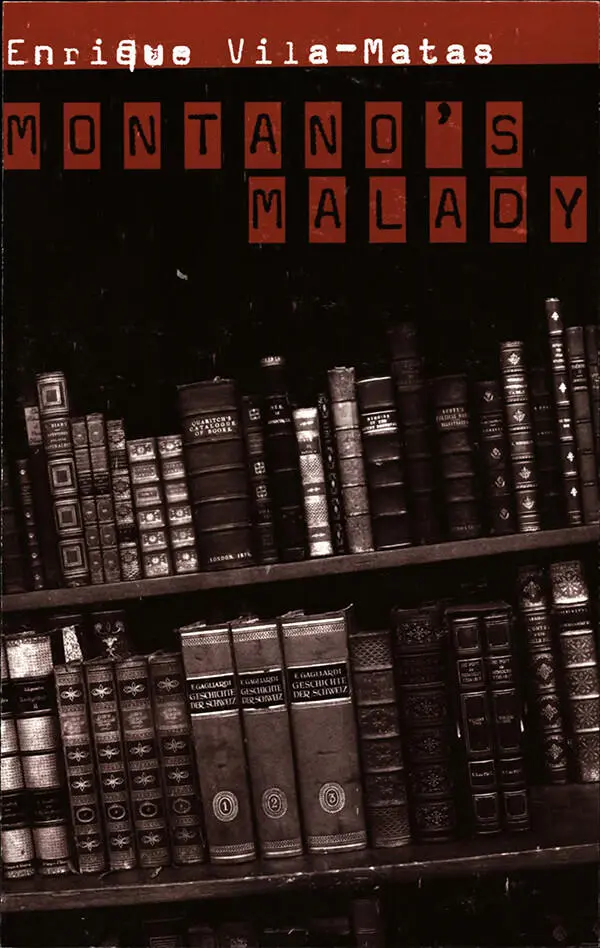
Enrique Vila-Matas - Montano's Malady
Здесь есть возможность читать онлайн «Enrique Vila-Matas - Montano's Malady» весь текст электронной книги совершенно бесплатно (целиком полную версию без сокращений). В некоторых случаях можно слушать аудио, скачать через торрент в формате fb2 и присутствует краткое содержание. Год выпуска: 2007, Издательство: New Directions, Жанр: Современная проза, на английском языке. Описание произведения, (предисловие) а так же отзывы посетителей доступны на портале библиотеки ЛибКат.
- Название:Montano's Malady
- Автор:
- Издательство:New Directions
- Жанр:
- Год:2007
- ISBN:нет данных
- Рейтинг книги:5 / 5. Голосов: 1
-
Избранное:Добавить в избранное
- Отзывы:
-
Ваша оценка:
Montano's Malady: краткое содержание, описание и аннотация
Предлагаем к чтению аннотацию, описание, краткое содержание или предисловие (зависит от того, что написал сам автор книги «Montano's Malady»). Если вы не нашли необходимую информацию о книге — напишите в комментариях, мы постараемся отыскать её.
is a writer named Jose who is so obsessed with literature that he finds it impossible to distinguish between real life and fictional reality. Part picaresque novel, part intimate diary, part memoir and philosophical musings, Enrique Vila-Matas has created a labyrinth in which writers as various as Cervantes, Sterne, Kafka, Musil, Bolano, Coetzee, and Sebald cross endlessly surprising paths. Trying to piece together his life of loss and pain, Jose leads the reader on an unsettling journey from European cities such as Nantes, Barcelona, Lisbon, Prague and Budapest to the Azores and the Chilean port of Valparaiso. Exquisitely witty and erudite, it confirms the opinion of Bernardo Axtaga that Vila-Matas is "the most important living Spanish writer."
Montano's Malady — читать онлайн бесплатно полную книгу (весь текст) целиком
Ниже представлен текст книги, разбитый по страницам. Система сохранения места последней прочитанной страницы, позволяет с удобством читать онлайн бесплатно книгу «Montano's Malady», без необходимости каждый раз заново искать на чём Вы остановились. Поставьте закладку, и сможете в любой момент перейти на страницу, на которой закончили чтение.
Интервал:
Закладка:
The waiter was so unpleasant that, when he brings your second pisco, you ask him if he can offer a fly on the side, a fly to martyr and drown.
“Martyrdom by martini,” you remark.
He thinks you’re mad or drunk and disappears, you are once more alone with your diary, you decide to record in it everything that is happening to you; therefore you decide to be sincere and realistic, that is until you remember that the anti-artistic, naive artists you so detest do something similar. And then you also remember that, in view of the nonsense of the reality of your age, you were going to delve into unreality. You bring all this to mind, pull your diary out of the bag, and propose to renounce stupid sincerity, to describe images and situations, like the landscapes in Italian metaphysical painting, in a very clear, very exact, very accurate, and yet very unreal way. But you soon decide not to be a kind of metaphysical painter, in the same way that you decided not to be a silly and sincere diarist. And you end up writing this: “I think I’ve been on this sumptuous hanging terrace before, but I couldn’t say when. I have the bay of Valparaiso at my feet and tell myself that I should go back through this diary and try to find out when I was here before, supposing it to be certain that I have been in this city with all its winds and all its funiculars, in this city where the customs officer Rubén Darío wrote Azul …”
You interrupt what you were writing, it strikes you as stupidly literary and stupidly false. For this you’d do better to be faithful to reality and tell the truth about your anomalous situation here in Valparaiso, tell how you’re very alone and don’t know what’s going to become of you, and you don’t understand what you’re doing on the Brighton’s terrace, on this terrace so far away from your home in Barcelona, although, that said, it’s also true that you’ve done well to delve into a poetics of abandonment and escape, no doubt you’ve acted correctly in giving up everything and certainly the best thing you can do is not lose heart, since you need to feel very complete if you’re going to devote yourself to the fine fight you’ve gotten into, to the fine gesture of embodying literature in your own person in order to protect it from its desperate situation in front of the abyss.
You are a man of leisure, a sleepwalker, an oyster.
You are literature itself, you embody it this afternoon on this terrace. And you feel proud of your new life.
You have banished every kind of sincerity and any temptation to become poetic or to make literature from the diary. And you discover that, alongside the options the diary was offering you here in the Brighton (to record reality, delve into the unreal, be sincere and confess your anxiety, etc.), alongside the traditional options, a new and very attractive path has opened up, no less traditional even if you hadn’t thought of it before: to transfer what you would like to happen to you right now on this deserted terrace to the diary. And what you would like to happen is really tender, simple, pure filial love: for your mother to revive and be here with you now, to keep you company in your loneliness.
You think that to favor what isn’t happening is also a way to keep a diary. And then your deceived man’s aged hand does not tremble when you write that your late mother is at your side, she is there on the terrace, her eyes open to the void, and quite different from when she was alive.
You would proceed to ask your mother what life is like in the hereafter, you would ask her this, except that you’ve often asked the dead this question in your novels, and all of them have replied that life in the hereafter is like swimming in the pampas at night.
To avoid eliciting the same response from her, you decide to vary the question slightly and you express an interest in how things are with her, meaning that you do not give her any ideas by naming the hereafter, you simply ask her:
“How is everything, mother?”
“How do you think? Bad, son. That’s why things are bad for you as well, and they’ll get worse, you’ll see.”
“What shall I see?”
“You’ll see they call you Eternity, like me.”
Your mother begins to sob and seems to do so in the coarse manner in which Lewis Carroll’s Caterpillar wept. Although the wind starts to blow, you do not ask yourself whether all this will finally help you to disappear, completely disappear, as has been your objective for some time. You do not question any of this because actually you feel wonder-fully well and you don’t want to ask anything, being as you are with your pisco sour next to Eternity, Girondo, your late mother.
You point to the sea and, like someone made of wood, functioning automatically, you feel like a Girondo when you remark:
“Lots of water, lots of water.”
She nods and the wind picks up, and you feel increasingly well, being carried along by the life of your mind.
You leave Valparaiso lonelier than when you arrived and go around the world a few times, you pass through strange cities on various continents and end up returning to Europe, and by train from Munich you arrive in Budapest, where your first impulse — as if you were one of those stupid ghosts in Dickens, which, having the whole of infinite space at their disposal, always want to go back to the exact place where they were unhappy — is to visit the city’s Literature Museum and wander around the room where two months ago you gave a lecture, but at the last moment you withhold the impulse and remind yourself that you are in what was once “the city of the cafés” and you take refuge in the Krúdy, a literary café, and pretend to be Dezşö Kosztolányi, the great Hungarian writer and great sufferer of literature sickness who in the old Sirius, instead of ordering a coffee from the waiter, would ask for ink.
“ Garçon ” he would say, “ink s’il vous plaît !”
You’re in the Krúdy and you write in your diary what you would like to happen now, and your deceived man’s aged hand does not tremble when you write that you have just remembered that Nabokov wrote that “the soul is but a manner of being — not a constant state — that any soul may be yours, if you find and follow its undulations.” You also remember that he wrote that “the hereafter”—something your mother, Eternity, seems to know a lot about—“may be the full ability of consciously living in any number of souls, all of them unconscious of their interchangeable burden.”
Nor does your aged hand tremble when you write that a kind of gray cloud slowly dilutes the darkness inside the Krúdy and a snowy exterior becomes faintly perceptible through the cafés windows, and you feel you have taken possession of the soul of Robert Walser — that eternal walker along roads of fog and snow — and at the same time you think you see Robert Musil outside the café with a thermos of coffee, wearing a metalworker’s overalls that evidently are not sufficient to protect him from the cold, which leads you to rap with your knuckles on the windowpane and invite him in.
Musil comes in, you shake his hand.
“My name is Robert Walser,” you say, “and I’d like you to forget about the thermos so that I can buy you a proper cup of coffee.”
“I’d prefer something solid, a proper steak, for example,” replies Musil. “So your name’s Robert Walser, just like the writer? Funny that. Do you know you even look like him? Though, to tell the truth, with an air of Dracula.”
It being Musil, you allow him to pull your leg, but you ask him why he is dressed in such horrendous fashion, why he is disguised as a metalworker.
“Volume one, chapter twenty. Of my unfinished book. Do you remember that the title of this chapter is “The Touch of Reality”?”
Читать дальшеИнтервал:
Закладка:
Похожие книги на «Montano's Malady»
Представляем Вашему вниманию похожие книги на «Montano's Malady» списком для выбора. Мы отобрали схожую по названию и смыслу литературу в надежде предоставить читателям больше вариантов отыскать новые, интересные, ещё непрочитанные произведения.





Обсуждение, отзывы о книге «Montano's Malady» и просто собственные мнения читателей. Оставьте ваши комментарии, напишите, что Вы думаете о произведении, его смысле или главных героях. Укажите что конкретно понравилось, а что нет, и почему Вы так считаете.