Enrique Vila-Matas - Montano's Malady
Здесь есть возможность читать онлайн «Enrique Vila-Matas - Montano's Malady» весь текст электронной книги совершенно бесплатно (целиком полную версию без сокращений). В некоторых случаях можно слушать аудио, скачать через торрент в формате fb2 и присутствует краткое содержание. Год выпуска: 2007, Издательство: New Directions, Жанр: Современная проза, на английском языке. Описание произведения, (предисловие) а так же отзывы посетителей доступны на портале библиотеки ЛибКат.
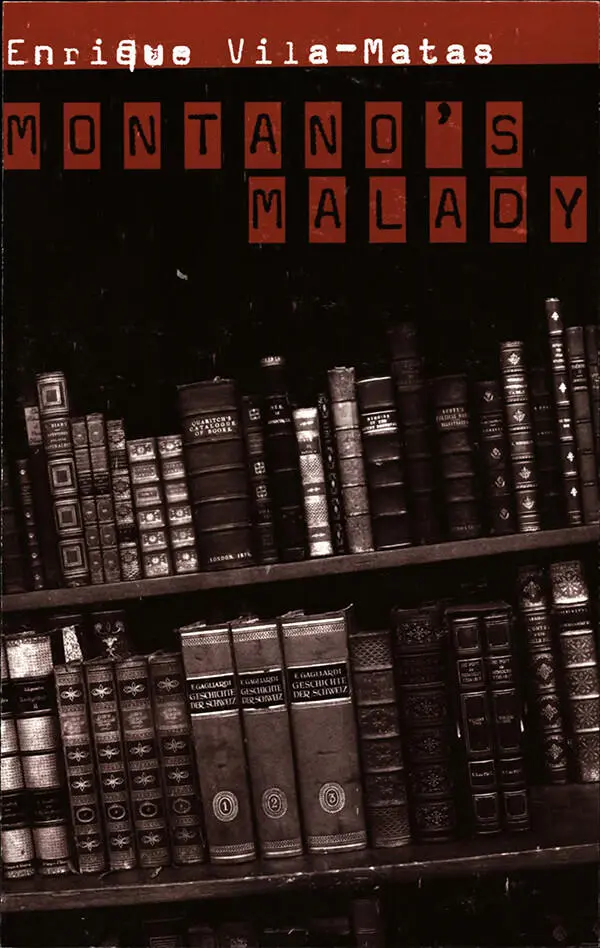
- Название:Montano's Malady
- Автор:
- Издательство:New Directions
- Жанр:
- Год:2007
- ISBN:нет данных
- Рейтинг книги:5 / 5. Голосов: 1
-
Избранное:Добавить в избранное
- Отзывы:
-
Ваша оценка:
Montano's Malady: краткое содержание, описание и аннотация
Предлагаем к чтению аннотацию, описание, краткое содержание или предисловие (зависит от того, что написал сам автор книги «Montano's Malady»). Если вы не нашли необходимую информацию о книге — напишите в комментариях, мы постараемся отыскать её.
is a writer named Jose who is so obsessed with literature that he finds it impossible to distinguish between real life and fictional reality. Part picaresque novel, part intimate diary, part memoir and philosophical musings, Enrique Vila-Matas has created a labyrinth in which writers as various as Cervantes, Sterne, Kafka, Musil, Bolano, Coetzee, and Sebald cross endlessly surprising paths. Trying to piece together his life of loss and pain, Jose leads the reader on an unsettling journey from European cities such as Nantes, Barcelona, Lisbon, Prague and Budapest to the Azores and the Chilean port of Valparaiso. Exquisitely witty and erudite, it confirms the opinion of Bernardo Axtaga that Vila-Matas is "the most important living Spanish writer."
Montano's Malady — читать онлайн бесплатно полную книгу (весь текст) целиком
Ниже представлен текст книги, разбитый по страницам. Система сохранения места последней прочитанной страницы, позволяет с удобством читать онлайн бесплатно книгу «Montano's Malady», без необходимости каждый раз заново искать на чём Вы остановились. Поставьте закладку, и сможете в любой момент перейти на страницу, на которой закончили чтение.
Интервал:
Закладка:
You ask her who Abraham was, you recall having studied him at school, but you don’t remember any of it. She seems surprised that you don’t know who Abraham is, but then she hesitates a little when it comes to explaining who he was, she doesn’t seem to know so much about him:
“He was the father of the present-day Israelites, or the God of the Jews, or something like that. He was Abraham, you must have heard of him. The point is I admire Hawking and everything he says, he’s someone who encourages you to live when you see him like that, overcoming all his physical problems with an iron will.”
You discover that this very pleasant old lady, unlike you, is far removed from any Montano’s malady. And you tell yourself that you wouldn’t mind staying here for a long time, the conversation is agreeable and the tea is excellent. No doubt in a few days you would cease to be seriously literature-sick. That said, of course — the thought comes into your mind — you shouldn’t abandon your underground warrior’s militancy against the enemies of the literary, don’t forget that; even if it’s only out of loyalty to Musil, think that the likeliest outcome is for you to join Action Without Parallel, don’t forget that one mustn’t abandon one’s convictions, or that you’re almost obliged to stand by those who put up a fight against those who try to avoid the triumph of literature.
You look out again at the garden that was the last Kafka saw, and you hear the lady say:
“We live not to live, Mr. Walser, but to have already lived, to be already dead.”
You wonder what she can have meant by that. You can scarcely believe that this room where you are now, with its Marconi radio set and four pieces of petit bourgeois furniture, was once a room in a sanatorium, a room covered in flowers, in which a moribund Kafka was at times delirious: he no longer read, he played with the books, opened them, flicked through them, looked at them and closed them again, with the same old happiness. Pietro Citati relates how, after Kafka read the final proofs of his final book, tears came into his eyes as never before. What was he crying for? Death? The writer he had been? The writer he could have been, that he may have glimpsed in this final fire? He praised wine and beer and asked the others to drink, to swill the liquids — beer, wine, water, tea, fruit juice — he could no longer swallow.
You can scarcely believe that in this room where you are now, with a single vase, there used to be lots of flowers and a doctor and a nurse, and Kafka died here. You wonder what would happen if this room were once again full of flowers, covered in all the world’s flowers. And you tell yourself that you would hardly be able to breathe, like Kafka in his final hours here, in this world.
Kafka, in his final minute in this world, made a brusque, unusual movement and ordered the nurse to leave. All this happened here.
“A little more tea?” the pleasant old lady asks you.
All this happened here. Kafka gave this order, yanked out the catheter he was wearing, threw it in the middle of this room, and said he had put up with enough torture. When the doctor moved away from the bed for a moment to clean a syringe, Kafka told him, “Don’t go.” The doctor said, “No, I’m not going.” In a deep voice, Kafka replied, “I am going.”
1917 was an intense year in Kafka’s life. He began it in January by writing “The Hunter Gracchus,” his best story, in which he wrote a sentence so perfect that he had to finish the narrative with it; it’s not that he couldn’t find an ending to the story, but that the ending was in this perfect, terrible, icy sentence. The burgomaster of Riva asks the wild hunter Gracchus if he intends to remain with them in the town. The hunter has just arrived in his boat and, to make up for his mocking tone, lays a hand on the burgomaster’s knee and says, “I have no intentions. I am here. I don’t know any more than that. There’s nothing more I can do. My boat is without a helm — it journeys with the wind which blows in the deepest regions of death.”
In March that year, he wrote “The Great Wall of China” at the same time as he began to lose himself in a maze of mysterious roads that he journeyed along all his life without ever finding a way out, though now he would always have the hunter Gracchus’ final, perfect sentence.
In July he got engaged for the second time to Felice Bauer. In August he spat blood. On September 4th, he was diagnosed with tuberculosis and on the 12th he was granted sick leave from his office. In October, in his diary, he compared Dickens to Robert Walser and said that they both hid their inhumanity behind styles of overflowing sentiment.
This is a brilhant intuition by Kafka and still today absolutely difficult to accept for those illustrious minds that believe in a warm culture and have always regarded Dickens as the founder of some kind of vital realism, sympathetic to poor humankind. In fact, like Walser, he was someone with a cold, crushing intelligence, which behind closed doors, for all who came into contact with him, made him a terrible, inhuman being, obliged only by the dumb circumstances of the age to hand out false, good sentiments left, right, and center.
On November 10th, Kafka wrote in his diary, “I have yet to record the crux, I’m still flowing in two channels. The work awaiting me is enormous.” At the end of November, he burst into Max Brod’s house reading Walser aloud, reading him and laughing. “Oh, come on, listen to what this man says completely seriously,” he remarked to Brod. In December his second engagement to Felice Bauer was broken off.
That’s about enough for today, night has closed in and this 25th of September is reaching its end, and I — all me Walser — take my leave of the day and also of this recollection of a year in Kafka’s life, this recollection that has turned into a digression diverting me from the narrative of my vagrant steps along the byroad. That’s about enough, but I shall keep going a while longer, I shall continue telling the intimate story of my minimal escape, I shall carry on journeying without moving from home, and at the same time being on the byroad.
“You mustn’t say you understand me.”
— KAFKA in a letter to MAX BROD
Two days after visiting the house in Kierling, after stopping over in Lisbon, you’re on the island of Fayal in the Azores, and your aged left hand does not tremble when in Café Sport you write that you’re back in your favorite bar, opposite the volcano on the island of Pico, in a lively gathering of your favorite authors of private journals; they’re all there except for Musil and Kafka, two forces whose whereabouts are unknown, apparently they’re on a secret mission, or perhaps they’re in reserve should some catastrophe befall the conspiracy in Fayal. In any case Musil and Kafka are not with you as you formulate your initial strategies for halting the advance of Pico’s moles. You call yourselves “the conspirators of the Great Wall” in memory of Kafka’s story that talks about a great wall, a great work involving builders and laborers scattered all over the geography of China: a story that essentially evokes Kafka’s own work, since this also resembles a wall and, like the conspiracy of diarists in Café Sport, has holes and cracks, gaps that other groups seek to fill.
You’re in Café Sport, in your favorite café, and you’re one of the pioneers of the walled plot, you’re on the alert against any movement by the enemy, though you’ve no plans to sit back and wait in some legendary desert for the Tartars to turn up. Like your fellow conspirators, you’re going to take the initiative and tomorrow, after this brief but decisive meeting, without further delay, you will disperse. You’ll disperse as one day the hidden forces of this diary you’re writing today with an already aged hand will disperse.
Читать дальшеИнтервал:
Закладка:
Похожие книги на «Montano's Malady»
Представляем Вашему вниманию похожие книги на «Montano's Malady» списком для выбора. Мы отобрали схожую по названию и смыслу литературу в надежде предоставить читателям больше вариантов отыскать новые, интересные, ещё непрочитанные произведения.




Обсуждение, отзывы о книге «Montano's Malady» и просто собственные мнения читателей. Оставьте ваши комментарии, напишите, что Вы думаете о произведении, его смысле или главных героях. Укажите что конкретно понравилось, а что нет, и почему Вы так считаете.