Enrique Vila-Matas - Montano's Malady
Здесь есть возможность читать онлайн «Enrique Vila-Matas - Montano's Malady» весь текст электронной книги совершенно бесплатно (целиком полную версию без сокращений). В некоторых случаях можно слушать аудио, скачать через торрент в формате fb2 и присутствует краткое содержание. Год выпуска: 2007, Издательство: New Directions, Жанр: Современная проза, на английском языке. Описание произведения, (предисловие) а так же отзывы посетителей доступны на портале библиотеки ЛибКат.
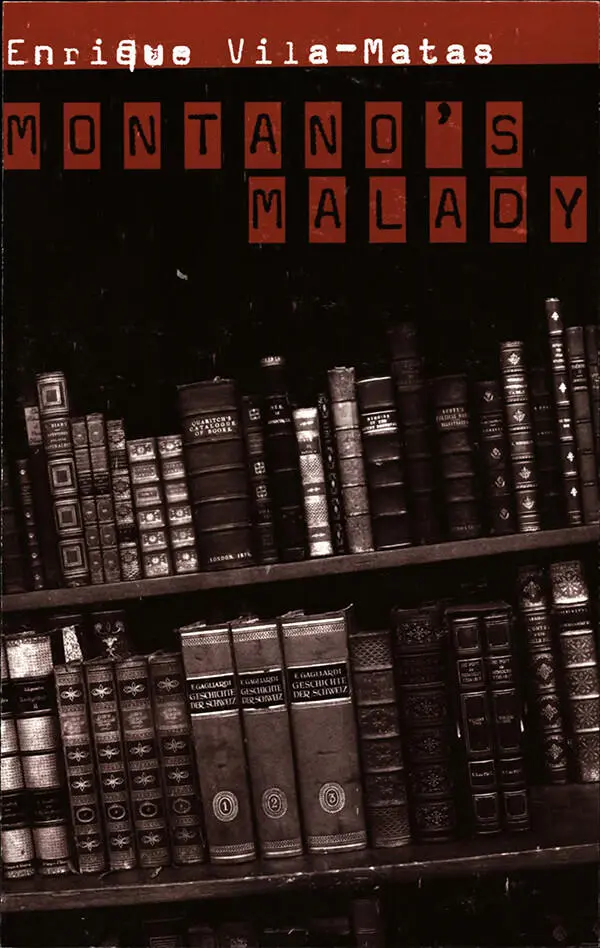
- Название:Montano's Malady
- Автор:
- Издательство:New Directions
- Жанр:
- Год:2007
- ISBN:нет данных
- Рейтинг книги:5 / 5. Голосов: 1
-
Избранное:Добавить в избранное
- Отзывы:
-
Ваша оценка:
Montano's Malady: краткое содержание, описание и аннотация
Предлагаем к чтению аннотацию, описание, краткое содержание или предисловие (зависит от того, что написал сам автор книги «Montano's Malady»). Если вы не нашли необходимую информацию о книге — напишите в комментариях, мы постараемся отыскать её.
is a writer named Jose who is so obsessed with literature that he finds it impossible to distinguish between real life and fictional reality. Part picaresque novel, part intimate diary, part memoir and philosophical musings, Enrique Vila-Matas has created a labyrinth in which writers as various as Cervantes, Sterne, Kafka, Musil, Bolano, Coetzee, and Sebald cross endlessly surprising paths. Trying to piece together his life of loss and pain, Jose leads the reader on an unsettling journey from European cities such as Nantes, Barcelona, Lisbon, Prague and Budapest to the Azores and the Chilean port of Valparaiso. Exquisitely witty and erudite, it confirms the opinion of Bernardo Axtaga that Vila-Matas is "the most important living Spanish writer."
Montano's Malady — читать онлайн бесплатно полную книгу (весь текст) целиком
Ниже представлен текст книги, разбитый по страницам. Система сохранения места последней прочитанной страницы, позволяет с удобством читать онлайн бесплатно книгу «Montano's Malady», без необходимости каждый раз заново искать на чём Вы остановились. Поставьте закладку, и сможете в любой момент перейти на страницу, на которой закончили чтение.
Интервал:
Закладка:
Café Sport appears to have endless galleries, like the whole of Kafka’s work and his Chinese wall. These galleries — of Kafka’s work, of Café Sport — being still under threat, have equally been perfectly articulated as a challenge against the wear and tear of time and, in the case of the conspiracy, against the wear and tear of the literary at the start of the twenty-first century.
You’re gathered here, but tomorrow you’ll disperse all over the world and join other conspirators and recognize one another by means of a simple password for Chinese conspirators that you have read before — it’s in Kafka — and now you can hear it in any part of the world, on the hps of accomplices, it’s a simple password, which Max Brod failed to understand at the time, all you have to say is:
“You mustn’t say you understand me.”
You leave the island of Fayal and your favorite bar behind and return to Lisbon, you sleepwalk through the Baixa and Barrio Alto and visit the British Bar and like Alexandre O’Neill, without ruffling your hair, you ask yourself, “What are we doing here, Lisbon, the two of us, / in the land where you and I were born?” “ Fazer horas ” the people of Lisbon say when they don’t have anything to do. Making time. Bars are ideal for such activity, though, as Cardoso Pires said, time out in bars often becomes time in and can even cease to be waiting time: “In reality only the unsuspecting drinker believes he is deceiving the hours, since it’s often the hours that deceive us, with a firm and steady step marking a time beyond numbers.”
You’re in the British Bar with its clock that goes backward and strikes very punctual hours, you’re drinking right under the clock that advances in the other direction and you also think you’ve deceived the hours and the days, when suddenly, when you’re least expecting it, Alfonso Dumpert, a friend from Barcelona, wanders casually into the bar and is very surprised to see you there, since in your city they think you’ve disappeared, or maybe even died.
Dumpert asks you if you’ve come for tomorrow’s tribute to the ill-fated Manuel Hermínio Monteiro. You weren’t aware of this tribute, you’re lost in the world, in endless flight, and in the British Bar you were only “making time.” You say this to him and suddenly receive the impression that, now you’ve been discovered, from now on everything may be different in your life, and you tell yourself that it’s as if the clock of the future, its hands also turning the other way, had returned with stupid punctuality to an appointment with your life before you escaped.
Perhaps you have made the mistake of going too near Barcelona. You’ve been spotted in Lisbon and your escape has entered a new phase, it may be drawing to a close. You disguise the bad temper this setback has caused you and tell Dumpert you’ll see him at the tribute tomorrow. And in the evening of September 10th, you walk toward Fórum Lisboa, where the tribute is taking place, and embrace your dear friend Manuela Correia, Hermínio’s wife, and witness the recital of music, poems, and images, opened by the actress Germana Tánger with Aniversário by Alvaro de Campos: “At the time they were celebrating my birthday, / I was happy and no one was dead.”
At midday on the following day, in the reasonably pleasant restaurant without a television on the rua das Janelas Verdes, you have lunch with Manuela Correia and your friend Dumpert. One minute before the latter’s cell phone rings and you find out about the attack on Manhattan, a group of noisy, unpleasant, people enters the restaurant and the three of you are dumbstruck, horrified, until Dumpert remarks that the barbarians have just arrived:
“The world does not change.”
You understand that he means that the world can’t be helped. It’s not that the world does not change, the world is like this , as Baroja would say. But isn’t it perhaps the other way around, and the world, with its dizzying succession of images, is changing? You’re wondering about this when Dumpert’s cell rings and in Barcelona they’re surprised that you still don’t know about the attack on Manhattan and the outbreak of the Third World War.
After lunch, when you emerge on to the extremely beautiful and serene rua das Janelas Verdes, you’re surprised by the idea that war has broken out. In the white of the breeze and the light of Lisbon, grays are greens and the world, immersed in the course of time, seems perfect.
The radio of a red convertible abruptly disturbs the calm of the street and an excited announcer speaks of spectacular images that surpass any fiction out of Hollywood.
You think about Franz Kafka.
You see the images of the attack on the television of a bar and you think again about Kafka, who imagined something that in its own way also changed the world: the transformation of a clerk into a beetle. What would he have thought, watching the spectacle of airplanes and fire in Manhattan?
Kafka was an enormously visual person who could not bear the cinema because the speed of movements and the dizzying succession of images subjected him to a continually superficial vision. He said that in the cinema it’s never the look that chooses the images, but the images that choose the look.
You’ve been spotted in Lisbon and the clock of your life advances in the other direction. Somehow you have begun your return to Barcelona. What a shame. You would have liked to go back with your lungs burned clean by the sea air, tanned by distant climates, to go back to your city having swum a lot, having mown the tall grass and having hunted lions and, above all, having smoked like nobody before and having drunk strong liquor like molten metal, and you would also have liked a lot to return with iron limbs, dark skin, and furious eye, Rimbaud of the twenty-first century, you would have liked to return and, because of your sunburn, for all to think you belonged to a strong race and came with a lot of gold, with gold and more gold, transformed into a brutal creature of leisure, whom women would be eager to look after, because women like to look after such fierce cripples back from hot countries. But the reality is other: you won’t return with iron limbs or dark skin or furious eye, you’ll return with a dark suit and a credit card.
You wonder what Kafka — who could not bear the cinema — would have thought about this visual spectacle of the attack on Manhattan. And you ask yourself this in Seville, on the night of the 11th. You ask yourself this as you open Kafka’s diaries to September 11, 1911, exactly ninety years before the attack on the Twin Towers. You’re in Antonio Molina Flores’ home, in the Alameda district. You’re going to sleep on his sofa tonight, until you decide tomorrow whether to return to Barcelona.
You open Kafka’s diaries at this date ninety years ago and see that on this day he wrote a detailed description of the collision between a motor car and a tricycle. It was a minor crash that Kafka had witnessed that same day in the streets of Paris.
You’re in Molina Flores’ home, seeking refuge, before falling asleep, in Kafka’s diaries. On September 11, 1911, in connection with the collision between the motor car and tricycle, he wrote, “The bakery employee, who before that had been pedalling along without a care, wobbling in the way that people on tricycles do, on this vehicle that was company property, dismounts, approaches the motorist, who also dismounts, and begins to launch recriminations at him, lightened by the respect due to a motorist and heightened by the fear of his boss.”
This “pedalling along without a care” reminds you of the people of New York, without a care this morning before the double collision of the airplanes with the Twin Towers. You continue reading.
Читать дальшеИнтервал:
Закладка:
Похожие книги на «Montano's Malady»
Представляем Вашему вниманию похожие книги на «Montano's Malady» списком для выбора. Мы отобрали схожую по названию и смыслу литературу в надежде предоставить читателям больше вариантов отыскать новые, интересные, ещё непрочитанные произведения.






Обсуждение, отзывы о книге «Montano's Malady» и просто собственные мнения читателей. Оставьте ваши комментарии, напишите, что Вы думаете о произведении, его смысле или главных героях. Укажите что конкретно понравилось, а что нет, и почему Вы так считаете.