Enrique Vila-Matas - Montano's Malady
Здесь есть возможность читать онлайн «Enrique Vila-Matas - Montano's Malady» весь текст электронной книги совершенно бесплатно (целиком полную версию без сокращений). В некоторых случаях можно слушать аудио, скачать через торрент в формате fb2 и присутствует краткое содержание. Год выпуска: 2007, Издательство: New Directions, Жанр: Современная проза, на английском языке. Описание произведения, (предисловие) а так же отзывы посетителей доступны на портале библиотеки ЛибКат.
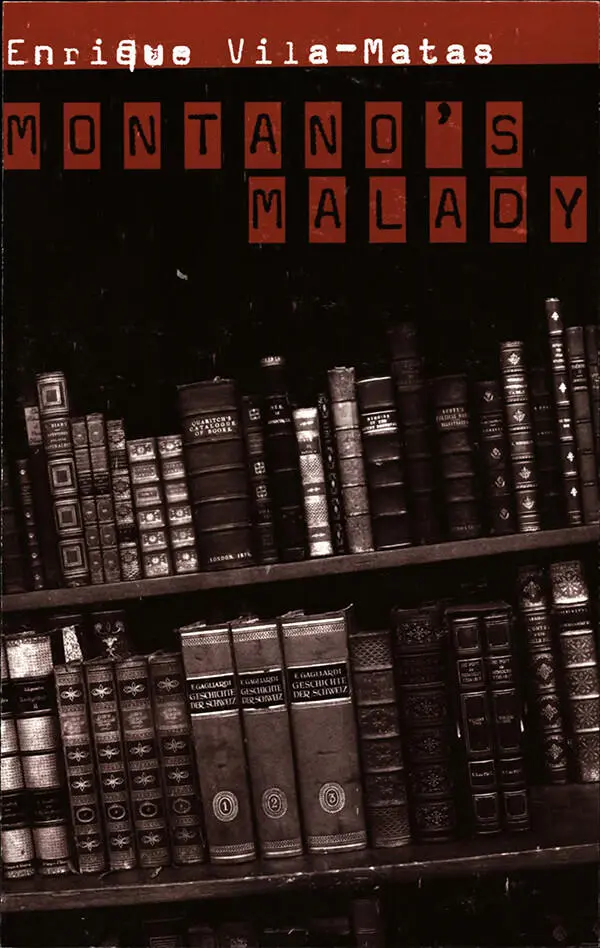
- Название:Montano's Malady
- Автор:
- Издательство:New Directions
- Жанр:
- Год:2007
- ISBN:нет данных
- Рейтинг книги:5 / 5. Голосов: 1
-
Избранное:Добавить в избранное
- Отзывы:
-
Ваша оценка:
Montano's Malady: краткое содержание, описание и аннотация
Предлагаем к чтению аннотацию, описание, краткое содержание или предисловие (зависит от того, что написал сам автор книги «Montano's Malady»). Если вы не нашли необходимую информацию о книге — напишите в комментариях, мы постараемся отыскать её.
is a writer named Jose who is so obsessed with literature that he finds it impossible to distinguish between real life and fictional reality. Part picaresque novel, part intimate diary, part memoir and philosophical musings, Enrique Vila-Matas has created a labyrinth in which writers as various as Cervantes, Sterne, Kafka, Musil, Bolano, Coetzee, and Sebald cross endlessly surprising paths. Trying to piece together his life of loss and pain, Jose leads the reader on an unsettling journey from European cities such as Nantes, Barcelona, Lisbon, Prague and Budapest to the Azores and the Chilean port of Valparaiso. Exquisitely witty and erudite, it confirms the opinion of Bernardo Axtaga that Vila-Matas is "the most important living Spanish writer."
Montano's Malady — читать онлайн бесплатно полную книгу (весь текст) целиком
Ниже представлен текст книги, разбитый по страницам. Система сохранения места последней прочитанной страницы, позволяет с удобством читать онлайн бесплатно книгу «Montano's Malady», без необходимости каждый раз заново искать на чём Вы остановились. Поставьте закладку, и сможете в любой момент перейти на страницу, на которой закончили чтение.
Интервал:
Закладка:
I want to delve deeply into unreality, to flee from so many hateful ghosts, so much falsification and masquerade, to flee from a reality that has lost its meaning. “One does not grow old in the space of an afternoon,” John Cheever remarked in his journals in reference to his story “The Swimmer,” whose protagonist crossed swimming pools in the course of a few hours that ended up turning into months, and finally years; he was an old man by the time he made it home. “Oh, well, kick it around,” I recall Cheever adding. And yet you have been able to see how it is perfectly possible to grow old in the space of a lecture on the private journal as narrative form. You have witnessed my unsightly transformation and know that I’m in an understandably bad mood. I shall leave this Literature Museum twenty years older, I have transformed into one of those terrible and very dangerous old men Macedonio Fernández talked about in one of his notes.
George Sand had already talked about this phenomenon of ageing live, in front of everybody. In one of her novels, she describes a French drawing room in which she observes the gestures and faces of the stale aristocracy and sees all the ancient aristocrats ageing right there . And Marcel Proust uses this idea for his Recherche . And now it could be said that the idea has used me, given that, as all of you have been perfectly able to appreciate — and this has formed the core spectacle of this lecture — I have been seen this evening to age right here , in front of everybody.
I feel bad for you, since you came to this museum to hear a lecture and have ended up witnessing the spectacle of a poor cuckold who has aged twenty years in an hour. The truth is that I never thought I would leave here so ancient and so dangerous, full of resentment, having just joined a band of imaginative elders, of wakeful monsters, although almost all have a cough, almost all are stooping, almost all are drug addicts, almost all are single, almost all are childless, almost all are in strange nursing homes, almost all are blind, almost all are forgers and fakes; and all, absolutely all, are deceived.
IV. Diary of a Deceived Man
SEPTEMBER 25
At the start of the twenty-first century, as if I were walking to the rhythm of literature’s most recent history, I was alone and without direction on some byroad, in the evening, heading inexorably for melancholy. A slow, enveloping, increasingly deep nostalgia for all that literature had once been merged with the mist at dusk. I considered myself a very deceived man. In life. And in art. In art, I saw hateful lies, falsifications, masquerades, frauds all around me. And I also felt very lonely. And when I looked at what was in front of my eyes, I always saw the same: literature at the start of the twenty-first century, in agony. I sensed that, like the castaway Crusoe at the start of his diary, I was reaching the point where I had “to enter into a melancholy relation of a scene of silent life.” I was wandering without direction along the byroad. And the mist was becoming increasingly thick and mysterious. I might bump into Musil, I told myself. In its decline, literature, like the day, was growing pale, dying. I wanted to discuss it with someone, but the byroad was empty. I kept going for a long time, and night fell. Suddenly I saw a shadow move next to an empty house. It was Emily Dickinson. She was wearing a white nightgown and walking a dog. I asked after Musil and she looked at me in surprise. That place resembled the end of the world, the end of the earth. “Fog,” she remarked. I carried on walking, all night I heard birds passing, I flew with them. At dawn, as I turned off the byroad, I saw Musil next to an abyss. He wore a white open-necked shirt, a very black coat down to his feet, and red broad-brimmed hat. He was staring thoughtfully at the ground. He raised his head and looked at me. Before us there was only a void. “It is the air of the time,” I said to him. He gazed toward the blurred horizon. “Let us not just hand ourselves to the age as it covets us,” he said.
When I went to Nantes in November of last year, I still hadn’t aged twenty years in a single evening in Budapest. And literature was in a bad way, but not so much as now — it isn’t that it has aged a lot, it’s that it now resembles the Austro-Hungarian Empire hurtling toward its destruction.
I went to Nantes and was still young. Ten months later, the hand of the person writing this diary is that of an old man who was deceived in Budapest.
Two weeks ago, on Tuesday the 11th, Manhattan was attacked. The news affected me, but not so much as when I aged twenty years in the course of the lecture I gave last June, one evening in Budapest. As is to be expected, I don’t have very happy memories of that Hungarian evening. The worst bit was perhaps at the end, when I had already gained twenty years and I realized that, at the rate time was passing, if I didn’t end the lecture soon, I would come out of there dead. The trouble was I didn’t know how to round off that lecture, which was gradually turning into something like the Museum of the Novel of the Eternal , that book Macedonio Fernández could never find an ending to.
I didn’t know how to finish, it only occurred to me to ask the public to leave me alone on the stage, to silently acknowledge my drama as an old, defeated man of letters in Budapest, and for them all to go. This is what I finally did, I begged the public to leave me all alone in that room.
They didn’t budge.
“But don’t you see I’ve aged twenty years? Please go, all of you, disappear, I can’t face anybody right now, the lecture has ended, we mustn’t let it turn into the Museum of the Eternal Lecture.”
“What will we do to disappear?” asked Blanchot. I didn’t know what I would do to disappear, but I knew that the public could go, could disappear, and that this could be a good ending.
They began to leave.
After their initial hesitation, they started heading for the exit, they all filed out, emptying the room; the last to go was the writer Imre Kertész, who came toward me as if he wanted to say something, but I cut him off with two sentences that were sufficiently extravagant to make him arch an eyebrow and to stop him in his tracks: “I want to be alone, Kertész, my friend. I want to know, when I’m done, whether I am not.”
Finally I was left alone, with a half-empty jug of water and the script dictated to me by that wretched Tongoy, who throughout the lecture I had always referred to as “monsieur,” as if eager to turn him into a kind of personal Monsieur Teste. I remained alone on the stage, telling myself that no doubt in the world of the theater — or in that of lectures like mine, with a theatrical slant — there is a closely guarded secret: that, when everything is over, the authors, the people responsible for so many words, carry on living there , remain in the theater and their words carry on living beyond the moment at which they were spoken.
Everyone left and for a few moments I remained living there , experiencing a strange and highly paradoxical sensation, since on the one hand I felt that I was living in the Literature Museum and on the other that, on remaining alone, I was not . It was during those moments of loneliness and life that wasn’t, but was, life, that I decided, in view of the nonsense of reality at that point, I would delve into unreality.
I had just made up my mind when the museum’s administrator appeared out of nowhere and immediately returned me to my condition as a deceived man, returned me to my brutalized, debatable, muddled, hateful, meaningless reality.
“Mr Girondo, your wife is waiting for you in the hall,” she informed me.
Читать дальшеИнтервал:
Закладка:
Похожие книги на «Montano's Malady»
Представляем Вашему вниманию похожие книги на «Montano's Malady» списком для выбора. Мы отобрали схожую по названию и смыслу литературу в надежде предоставить читателям больше вариантов отыскать новые, интересные, ещё непрочитанные произведения.





Обсуждение, отзывы о книге «Montano's Malady» и просто собственные мнения читателей. Оставьте ваши комментарии, напишите, что Вы думаете о произведении, его смысле или главных героях. Укажите что конкретно понравилось, а что нет, и почему Вы так считаете.