Enrique Vila-Matas - Montano's Malady
Здесь есть возможность читать онлайн «Enrique Vila-Matas - Montano's Malady» весь текст электронной книги совершенно бесплатно (целиком полную версию без сокращений). В некоторых случаях можно слушать аудио, скачать через торрент в формате fb2 и присутствует краткое содержание. Год выпуска: 2007, Издательство: New Directions, Жанр: Современная проза, на английском языке. Описание произведения, (предисловие) а так же отзывы посетителей доступны на портале библиотеки ЛибКат.
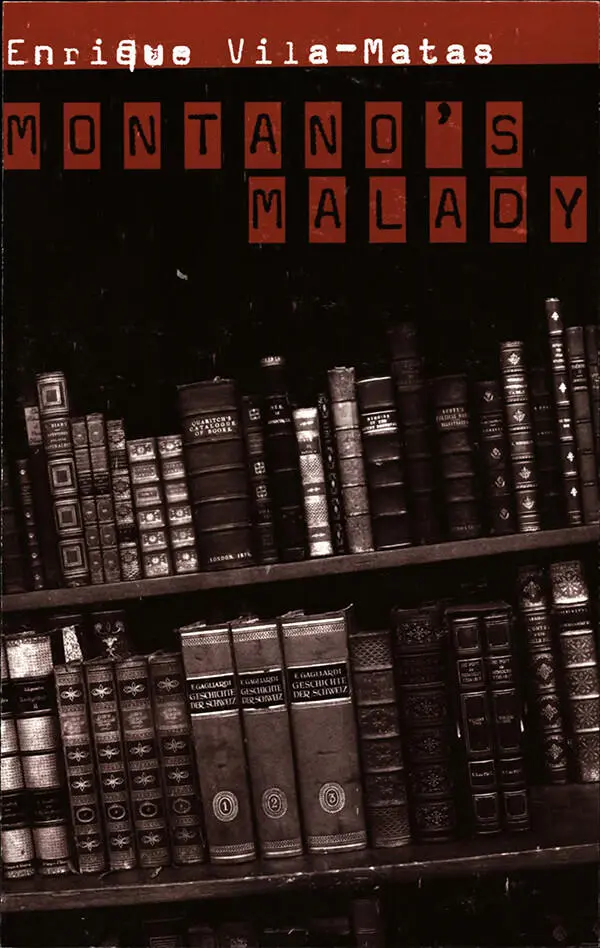
- Название:Montano's Malady
- Автор:
- Издательство:New Directions
- Жанр:
- Год:2007
- ISBN:нет данных
- Рейтинг книги:5 / 5. Голосов: 1
-
Избранное:Добавить в избранное
- Отзывы:
-
Ваша оценка:
Montano's Malady: краткое содержание, описание и аннотация
Предлагаем к чтению аннотацию, описание, краткое содержание или предисловие (зависит от того, что написал сам автор книги «Montano's Malady»). Если вы не нашли необходимую информацию о книге — напишите в комментариях, мы постараемся отыскать её.
is a writer named Jose who is so obsessed with literature that he finds it impossible to distinguish between real life and fictional reality. Part picaresque novel, part intimate diary, part memoir and philosophical musings, Enrique Vila-Matas has created a labyrinth in which writers as various as Cervantes, Sterne, Kafka, Musil, Bolano, Coetzee, and Sebald cross endlessly surprising paths. Trying to piece together his life of loss and pain, Jose leads the reader on an unsettling journey from European cities such as Nantes, Barcelona, Lisbon, Prague and Budapest to the Azores and the Chilean port of Valparaiso. Exquisitely witty and erudite, it confirms the opinion of Bernardo Axtaga that Vila-Matas is "the most important living Spanish writer."
Montano's Malady — читать онлайн бесплатно полную книгу (весь текст) целиком
Ниже представлен текст книги, разбитый по страницам. Система сохранения места последней прочитанной страницы, позволяет с удобством читать онлайн бесплатно книгу «Montano's Malady», без необходимости каждый раз заново искать на чём Вы остановились. Поставьте закладку, и сможете в любой момент перейти на страницу, на которой закончили чтение.
Интервал:
Закладка:
A TURNING TOWARD DESOLATION
John Cheever was a tireless writer of private journals over forty years, during which time he scarcely took a break when it came to trying to explain his complex conflict with life, because deep down, beyond appearances, the problem was life, as his son, Benjamin Cheever, writes in his foreword to the journals: “A simpleton might think that bisexuality was the essence of his problem, but of course it was not. Nor was alcoholism. He came to terms with his bisexuality. He quit drinking. But life was still a problem.”
There is an entry in his journals that I mentally carry as if it were permanently sewn in the left-hand pocket of all my trousers: “Hurricane watch, they say. Heavy rains after midnight. Gale winds. I wake at three. It is close. No sign of wind and rain. Then I think that I can do it, make sense of it, and recount my list of virtues: valor, saneness, decency, the ability to handle the natural hazards of life.”
Since reading this entry from his journal, I have carried it permanently on me, it is a list of values that has been decisive in my life. In the absence of other beliefs, I have had this list, which has served me never to lose my sense of direction. This past night, for example, it has helped me to deal with my problems and to save all of you the unpleasant cries of a wounded animal, the unpleasant signs of desperation.
The problems were always there, which enabled Cheever — this is the positive side of the matter — to write masterly pages in his journals, like this one that I carry loose in my pocket and shall now read you: “When the beginnings of self-destruction enter the heart it seems no bigger than a grain of sand. It is a headache, a slight case of indigestion, an infected finger; but you miss the 8:20 and arrive late at the meeting on credit extensions. The old friend that you meet for lunch suddenly exhausts your patience and in an effort to be pleasant you drink three cocktails, but by now the day has lost its form, its sense and meaning. To try and restore some purpose and beauty to it you drink too much at cocktails you talk too much you make a pass at somebody’s wife and you end with doing something foolish and obscene and wish in the morning that you were dead. But when you try to trace back the way you came into this abyss all you find is a grain of sand.”
Last night, distinguished public, I remained alone, alone and lost in Budapest, you yourselves have been witnessing my tragic process of separation from the others. This plunges me into a state of confusion that takes me even closer to the world of Cheever, who opened his extensive journals on a disconsolate note and he talked of loneliness and of how the beauty of the visible world seemed to crumble before him, even love crumbled. And Cheever spoke in this opening of some miscarriage, he had the impression that he had taken some wrong turning: the same impression that I have had today, here in Budapest, the sensation that, since seeing Detour , I have wandered from my road. I should never have gone into that movie, the beauty of the world has crumbled in me, and fatality has left me broken, alone, wandering along some byroad.
“The most I can make out of this hour is a kind of loneliness.” This is how Cheever’s journals begin, this is how I should begin my diary of a deceived man, because this is what my diary is turning into — that of a deceived man — after having told you the story of my turning toward desolation, the desolation I have come to know here in this city of Budapest, where I have undoubtedly taken a wrong turning, as if Cheever’s loneliness — the journals’ opening reminds me of the start of Robinson Crusoe’s diary: “And now being about to enter into a melancholy relation of a scene of silent life …”—continued to affect me.
I’m not going to sink further before you, I shall simply draw to a close this spectacle of someone who is not really hungry, who in the course of this lecture has gradually transformed into a deceived man, the composition of whose diary you have witnessed live, a diary that will continue even if the lecture finishes, that will go beyond this historic room and follow its course out of your sight, reflecting like Cheever on loneliness, on the weight of despair and dejection, on the painful attacks of unfounded anxiety, on love and hate, on the need for a writer to give words special importance, to move among them as comfortably as among human beings, if not more so; to dethrone words in order to show them to better seats, to squeeze them and question them and stroke them delicately and even paint with them impossible colors and, after so much intimacy with them, to know also how to be able to hide out of consideration for them.
RUSSIAN DIARY
It is not the revelation of some truth that my diary pursues, but information about my constant mutations. My diary has existed for years, but it only started to turn into a novel a few months ago, in November of last year, when I traveled to Nantes and imagined that I was visiting an invented son. I started to turn my diary into a novel being the writer that I am, but pretending to be a literary critic, later I began to construct a fake autobiography by injecting my diary with fragments from the lives or works of my favorite diarists and I discovered how right Gabriel Ferrater was when in 1956 he wrote in a letter to Jaime Gil de Biedma, “Have you noticed how curiously impersonal we letter-wounded are or, perhaps better, how lacking in intimacy our personality is?”
In short, I built myself a timid biography and later, here in Budapest, I transformed into a hungry lecturer whom I see now turning, after a new mutation because of his treacherous wife, into a lonely man, a man who wanders along some byroad, into a walker who tries out the identity of a deceived man.
The different characters I have been all suffered from literature-sickness, they needed to cling to literature in order to survive. The deceived vampire you see now before you is, of all those characters, the one who most needs literature to survive. This may be because in fiction he has just discovered a moral of life.
This deceived vampire’s diary is turning Russian since he connected it with another diary, that of Pierre Drieu La Rochelle, called Diary of a Deceived Man , no less. This man, by which I mean this vampire, remembers well a passage from the anti-Communist Drieu La Rochelle’s diary; two sentences were written nervously in the days when his compatriots were asking him to commit suicide so that they would not have to shoot him for his collaboration with the Nazis: “It is said that in Russia they no longer know what jealousy is. I know because I am Russian.”
The deceived man I have turned into is like a Russian, he no longer knows what jealousy is. So he’s not going to cry out here with pain and terror. But I feel rage and infinite resentment, I cannot hide it. I should like to destroy the world. I’m afraid that from now on I shall keep the diary of a deceived, resentful, vindictive man. Life has treated me badly. Nobody likes to be deceived. I am not deceiving you if I tell you that I am Russian and am not jealous, but I’m thinking of planting mental bombs in all the homes of all those swines who are destroying literature, all those businessmen who publish books, all those departmental managers, marketing directors on the wire, economics graduates. I’m after them, I’ve already located where their lackeys hang out on the island of Pico, and now I’m after them. What they do lacks spirit and grace. I’m becoming increasingly like the protagonist of Detour , that character we see at the end of the film lost and alone on a road at dusk, without direction, with an abstract freedom he can do little or nothing with, except to try to disappear or hide or dissolve in the last corner of the world.
Читать дальшеИнтервал:
Закладка:
Похожие книги на «Montano's Malady»
Представляем Вашему вниманию похожие книги на «Montano's Malady» списком для выбора. Мы отобрали схожую по названию и смыслу литературу в надежде предоставить читателям больше вариантов отыскать новые, интересные, ещё непрочитанные произведения.








Обсуждение, отзывы о книге «Montano's Malady» и просто собственные мнения читателей. Оставьте ваши комментарии, напишите, что Вы думаете о произведении, его смысле или главных героях. Укажите что конкретно понравилось, а что нет, и почему Вы так считаете.