Enrique Vila-Matas - Montano's Malady
Здесь есть возможность читать онлайн «Enrique Vila-Matas - Montano's Malady» весь текст электронной книги совершенно бесплатно (целиком полную версию без сокращений). В некоторых случаях можно слушать аудио, скачать через торрент в формате fb2 и присутствует краткое содержание. Год выпуска: 2007, Издательство: New Directions, Жанр: Современная проза, на английском языке. Описание произведения, (предисловие) а так же отзывы посетителей доступны на портале библиотеки ЛибКат.
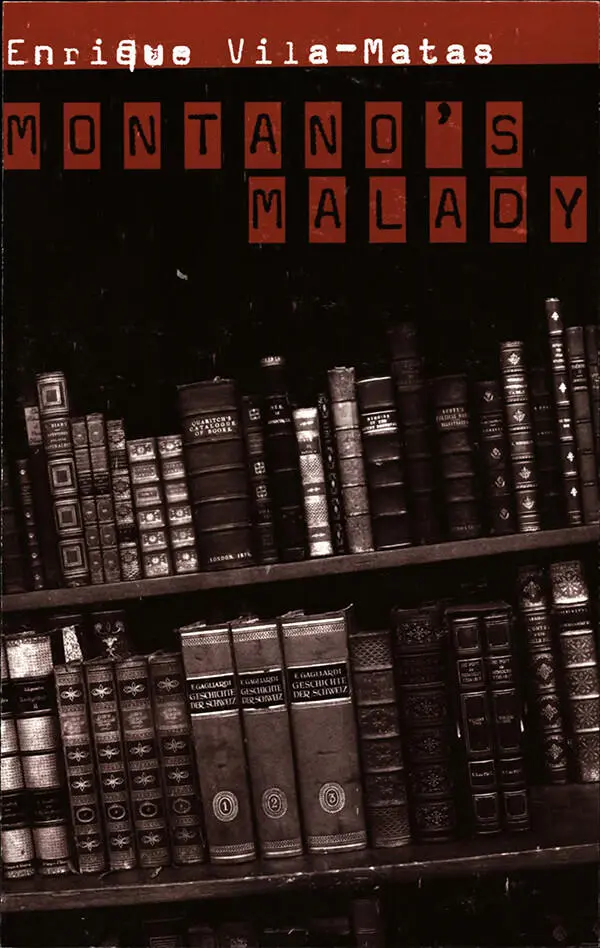
- Название:Montano's Malady
- Автор:
- Издательство:New Directions
- Жанр:
- Год:2007
- ISBN:нет данных
- Рейтинг книги:5 / 5. Голосов: 1
-
Избранное:Добавить в избранное
- Отзывы:
-
Ваша оценка:
Montano's Malady: краткое содержание, описание и аннотация
Предлагаем к чтению аннотацию, описание, краткое содержание или предисловие (зависит от того, что написал сам автор книги «Montano's Malady»). Если вы не нашли необходимую информацию о книге — напишите в комментариях, мы постараемся отыскать её.
is a writer named Jose who is so obsessed with literature that he finds it impossible to distinguish between real life and fictional reality. Part picaresque novel, part intimate diary, part memoir and philosophical musings, Enrique Vila-Matas has created a labyrinth in which writers as various as Cervantes, Sterne, Kafka, Musil, Bolano, Coetzee, and Sebald cross endlessly surprising paths. Trying to piece together his life of loss and pain, Jose leads the reader on an unsettling journey from European cities such as Nantes, Barcelona, Lisbon, Prague and Budapest to the Azores and the Chilean port of Valparaiso. Exquisitely witty and erudite, it confirms the opinion of Bernardo Axtaga that Vila-Matas is "the most important living Spanish writer."
Montano's Malady — читать онлайн бесплатно полную книгу (весь текст) целиком
Ниже представлен текст книги, разбитый по страницам. Система сохранения места последней прочитанной страницы, позволяет с удобством читать онлайн бесплатно книгу «Montano's Malady», без необходимости каждый раз заново искать на чём Вы остановились. Поставьте закладку, и сможете в любой момент перейти на страницу, на которой закончили чтение.
Интервал:
Закладка:
“Wretch, we’re lost because of you!” I told her, pretending that I was joking. It was the least I could say. I knew that, apart from confessing to her that I wrote poetry, I had to say something, and I told her this, but I did not go on, completely afraid that I would end up composing an ode to Venice before the sea of theaters.
How fragile I was back then, I wonder why.
THE BAT’S MONOLOGUE
Rosa has not come out of this biographical sketch very well, nor should Monsieur Tongoy hope to emerge from his unscathed. Here in Budapest he chose a miserable life, that of a bat. Chilling shadow of the vampire Lugosi, Monsieur Tongoy’s presence among us this evening ought to inspire us all with horror. Since I am unwilling to waste energy by criticizing him too much, in this theater-lecture I shall simply reproduce the miserable monologue that our vampire delivered today, when he proposed leaving the “cabin” and installing himself, at my expense — he achieved this — in the Kakania Grand Hotel.
“For days now I have eaten,” he said with a sleepless beggar’s pomposity, as if he wished to mimic a character from Beckett, “I have drunk, I have dressed and undressed, in this medium-sized cage facing Budapest’s northwest, with its marvelous view facing southeast of medium-sized cages. But soon I will have to get by in some other way, because the landscape is fatally doomed to demolition. Soon I will have to pack up my belongings and begin to eat, to drink, to sleep, to dress and undress, at the Kakania. With you, master. I will be the Sancho Panza you have always wanted me to be, but invite me to the Kakania, Rosario. Your squire is homeless. I’ve nothing left, only a cowpat and some red wine and these eyes that I open and shut, two central European eyes, I’ve nothing left except my tongue and eyes, my tongue that allows me to say that I will talk about myself when the repulsive vagrants have stopped, though in fact I won’t even talk about myself then, why, if what I really want is not to talk anymore, to rest at the Kakania, to be your squire, your monsieur.”
THE VAMPIRE’S TURNING
You must be thinking that it’s high time I told you that neither Rosa nor monsieur exist, since there is nobody in the front row and, what’s more, had Rosa and monsieur been seated there, they would be so indignant that they would have prevented me continuing some time ago.
Tell us, you must be thinking, that the two of them do not exist and, while you’re at it, confess that you’re not hungry after the banquet that was given today at the Kakania in your honor.
OK, ladies and gentlemen, distinguished Hungarian public, I am going to make an about-turn, a vampire’s turning. I shall tell truths, having lied to you slightly. I am not at all hungry, and you’re absolutely right that there’s nobody in the front row and the only one who looks like a vampire — I know that I resemble Christopher Lee — is me. But this does not mean that neither Rosa nor monsieur exist, that they aren’t in Budapest, that they aren’t now hungover having gone out last night, resting in their respective rooms at the Kakania.
Those of you who have already accepted that Monsieur Tongoy exists may be wondering if he and I look very much or a little alike. Well, the answer is: we bear an unmistakable family resemblance. That said, Monsieur Tongoy is not happy when he is placed in the bloody tradition of vampires. Unlike me, monsieur does not like to be connected with that depraved count who derived pleasure out of horror. I, however, feel the vampire’s pride. For example, for years I behaved in literature like a complete parasite. Later, I began to lose my attraction for the blood of other people’s work and, with their collaboration, I even cultivated a distinct style of my own: discreet, cultured, a little bit secret, perhaps just eccentric, but one that belongs to me and is a far cry from the uniform modern army of the identical. All the same, I have periods in which I relapse slightly into the vampirism of previous years. Today, to go no further, I have been behaving in this theater-lecture like a parasite, living off Monsieur Tongoy’s ideas, since it was he who provided the script, the outline of my speech this evening.
THIS THEORY’S LIFE
Monsieur Tongoy was born of chance. Like Monsieur Teste. Like everybody. The lecture he dictated to me is as far from the conventions of any lecture as the characters are eccentric in the story I have told you about: the mendicant vamp, the hungry quack — me myself — and the theoretical vagrant: erratic characters who arrived in Budapest a few days ago and went to see Detour and fell into the fatality that pursues those who watch this strange, extremely bizarre film.
I invented the vagrancy of these three characters on monsieur’s instructions. His lecture design required one fictional part — unusual for a lecture — that could be mixed, in the name of theater, with the essay part.
Monsieur Tongoy gave me two initial pointers for this lecture, two pointers he considered of paramount importance: 1) That I should not fail to emphasize the relationship between him and me; nor should I forget that Dracula — along with Faust, Don Quixote, Don Juan, and Robinson Crusoe — is one of the myths that founded contemporary man’s consciousness and, as in other myths, he did not marry or maintain stable and lasting relationships with women and, as in the others, he had a male servant or accomplice, which demonstrates his enormous self-centredness. 2) That my lecture should be a microcosm of what I am writing in Barcelona and should, therefore, combine essay, private memories, diary, travel book, and narrative fiction. And even copy the structure of my manuscript in Barcelona, going from fiction to reality, but without ever forgetting that literature is invention and, as Nabokov said, “fiction is fiction. To call a story a true story is an insult to both art and truth. Every great writer is a great deceiver.”
Monsieur Tongoy really is a distant relation of Bela Lugosi. He comes from a family of Hungarian Jews who went into exile in Chile. He has traveled to Budapest to trace his roots. Don’t tell me it isn’t moving…. It is also Monsieur Tongoy who gives life to this lecture’s theory. A few days ago, when I had just arrived in this city with Rosa, he was perplexed when he understood that I had nothing prepared to say here this evening, and he asked me, “So what are you going to do? Not say anything? Make words in the treasure of silence.”
I make words. I make theory as well and inform you that I share monsieur’s idea that the world can no longer be recreated as in novels before, from the writer’s unique perspective. Monsieur and I believe that the world has fallen apart and only if you dare to show it in its disintegration can you hope to offer a credible image of it.
I make word, therefore, and announce that, because of monsieur, my relationship with Rosa has not been stable for some time. It is also because of monsieur that, seeing me now, you may be thinking of Faust, Dracula, or Don Quixote. I’m not sure if this is so great, I’m not sure if I should thank him for it.
But in the meantime I make words and also a theater-lecture and keep going and, guided by the chance of monsieur’s mind, I see how the theory takes shape as it chooses, with rhythm and mystery, all by itself.
MONSIEUR TONGOY’S DIARY
Were monsieur to keep a diary, I would find it extremely interesting, since no doubt Rosa and I would figure in it quite a lot. Were he to keep a diary, I wouldn’t hesitate for a moment to steal it for a few hours, without him realizing, and to read the thoughts he would have consigned to these pages, fascinating for sure, since I am convinced that Monsieur Tongoy is a keen observer and a remarkable thinker. He is also, though you may not have imagined it, the ugliest man in the world. Yes, that’s right. And yet this isn’t a problem for him, it never has been, he thinks that his intelligence makes him beautiful. However, I do not wish to mislead you: he is horrible, he is the most monstrous, the ugliest man in the world.
Читать дальшеИнтервал:
Закладка:
Похожие книги на «Montano's Malady»
Представляем Вашему вниманию похожие книги на «Montano's Malady» списком для выбора. Мы отобрали схожую по названию и смыслу литературу в надежде предоставить читателям больше вариантов отыскать новые, интересные, ещё непрочитанные произведения.


Обсуждение, отзывы о книге «Montano's Malady» и просто собственные мнения читателей. Оставьте ваши комментарии, напишите, что Вы думаете о произведении, его смысле или главных героях. Укажите что конкретно понравилось, а что нет, и почему Вы так считаете.