Enrique Vila-Matas - Montano's Malady
Здесь есть возможность читать онлайн «Enrique Vila-Matas - Montano's Malady» весь текст электронной книги совершенно бесплатно (целиком полную версию без сокращений). В некоторых случаях можно слушать аудио, скачать через торрент в формате fb2 и присутствует краткое содержание. Год выпуска: 2007, Издательство: New Directions, Жанр: Современная проза, на английском языке. Описание произведения, (предисловие) а так же отзывы посетителей доступны на портале библиотеки ЛибКат.
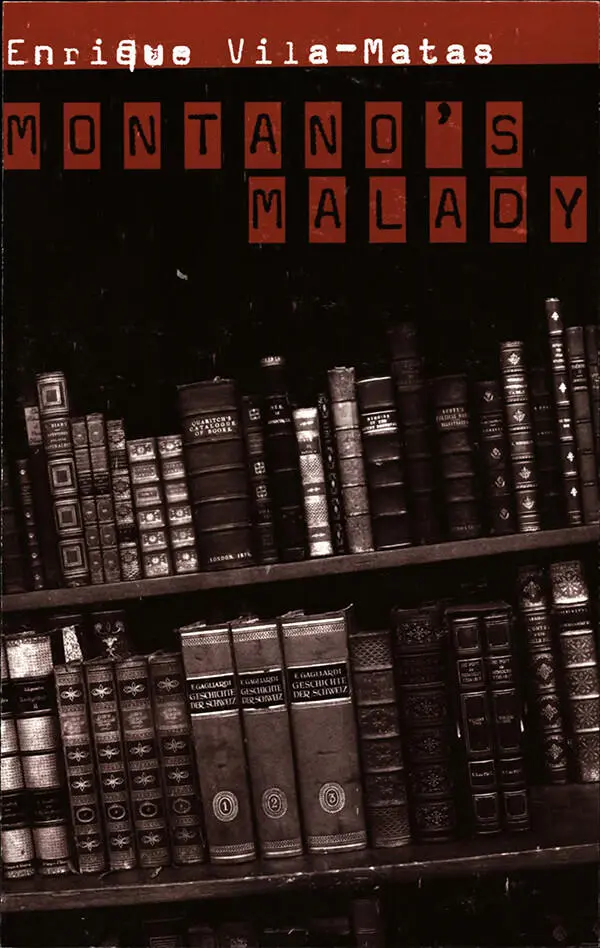
- Название:Montano's Malady
- Автор:
- Издательство:New Directions
- Жанр:
- Год:2007
- ISBN:нет данных
- Рейтинг книги:5 / 5. Голосов: 1
-
Избранное:Добавить в избранное
- Отзывы:
-
Ваша оценка:
Montano's Malady: краткое содержание, описание и аннотация
Предлагаем к чтению аннотацию, описание, краткое содержание или предисловие (зависит от того, что написал сам автор книги «Montano's Malady»). Если вы не нашли необходимую информацию о книге — напишите в комментариях, мы постараемся отыскать её.
is a writer named Jose who is so obsessed with literature that he finds it impossible to distinguish between real life and fictional reality. Part picaresque novel, part intimate diary, part memoir and philosophical musings, Enrique Vila-Matas has created a labyrinth in which writers as various as Cervantes, Sterne, Kafka, Musil, Bolano, Coetzee, and Sebald cross endlessly surprising paths. Trying to piece together his life of loss and pain, Jose leads the reader on an unsettling journey from European cities such as Nantes, Barcelona, Lisbon, Prague and Budapest to the Azores and the Chilean port of Valparaiso. Exquisitely witty and erudite, it confirms the opinion of Bernardo Axtaga that Vila-Matas is "the most important living Spanish writer."
Montano's Malady — читать онлайн бесплатно полную книгу (весь текст) целиком
Ниже представлен текст книги, разбитый по страницам. Система сохранения места последней прочитанной страницы, позволяет с удобством читать онлайн бесплатно книгу «Montano's Malady», без необходимости каждый раз заново искать на чём Вы остановились. Поставьте закладку, и сможете в любой момент перейти на страницу, на которой закончили чтение.
Интервал:
Закладка:
“Writing,” says Lobo Antunes, “is like taking drugs, you start purely for pleasure and you end up organizing your life around your vice like a drug addict. This is my life. Even when I suffer, I live it like a split personality: the man is suffering and the writer is considering how to use the suffering in his work.”
Such a great and scandalously literature-sick diarist as Renard could not be absent from these pages. He died without knowing that he would go down in the history of literature precisely for the diary he kept without ever wishing to publish it, he died without knowing he would be betrayed and his diary would be published posthumously, astounding, among others, a Catalan countryman called Josep Pla — who would write an exceptional private journal, El quadern gris —and most especially André Gide, who would turn this genre in which Renard had proved a virtuoso — that of the autopsychographical diary, to use an adjective invented by Pessoa — into a work of literary creation consciously addressed to a reader.
Renard was so scandalously literature-sick that, in the foreword to the Spanish edition of his diary, he is openly treated as such by Josep Massot: “Fascinating pages of a diary that, as well as being a cruel testimony, […] reflect the insatiable disquiet of a writer who is sick with literature.”
You have to be very sick, you have to be very seriously sick —to quote Jaime Gil de Biedma, another great Catalan diarist — very literature-sick to think what Renard thought when, at the end of his days, he fell physically ill and told himself that he could only get better if he wrote: “I am again off balance. Rock bottom. Immediate cure if I worked.” And a little further on, in the diary’s dying pages, he defines himself in this way: “Man without a heart, who has only had literary emotions.”
The last thing he records in his diary: “I want to get up tonight. Heaviness. One leg hanging out. Then a moist trickle flows down my leg. It has to reach my heel for me to make up my mind. It will dry on the sheets, as when I was Poil de Carotte.”
Poil de Carotte was a character of his, probably himself when he was a child. Renard died of literature, of his own, he died having turned into one of his characters, having turned into the rustic child he always was. This would explain above all why, in the final years of his life, he pretended to be writing in Paris when in fact he spent his life — like Josep Pla — in the countryside, in his hometown, in the world of Poil de Carotte, with his childlike skin, carrot top even, writing literature-sick sentences and, as Musil would ask later, questioning the usefulness of diaries: “Why these notebooks? Nobody tells the truth, not even their authors.”
Possibly because I have just arrived from Lisbon, I am reminded of something about “the truth” written by Pessoa, or rather by his heteronym Alvaro de Campos: “I am defeated today, as if I knew the truth.”
The truth is that Renard’s “nobody tells the truth” would quickly become fertile ground for fictional diaries, for André Gide’s “life of the mind” and, a little later, for Gombrowicz’s “construction of self” and even for the project of fragmented identity that I am, I who have spent days immersed in this dictionary, trying to be as truthful as possible and giving all sorts of reliable information about myself, not always successfully, since I often remark that all I’m really looking for now, defeated by the impossible truth, is to dissolve like a man without qualities in mid-diary.
The afternoon is ambiguously flat in Barcelona today. A bird goes by and I do not follow it. After my fleeting tour of Lisbon, I am once more in my study, every day more devoted — without will, but with an exaggerated regularity, with a monstrous perseverance — to my diary. I am writing, alone and almost still, with my shoulders draped in a shawl, in my office. Rosa put flowers in it this morning, the whole house is little by little turning into an imaginary hospital. Another bird goes by, which I don’t follow either. My mind was trapped, a few moments ago, in the memory of Paul Valéry, another noticeable and extreme sufferer of literature sickness, absorbed in the elaboration of a strange, something more than odd dictionary. “This man, my father,” his son wrote of him, “up before dawn, in his pyjamas, his shoulders draped in a shawl, a cigarette between his fingers, his eyes fixed on the vane of a chimney, watching the birth of the day, would devote himself, with a monstrous perseverance, to a solitary rite: creating his own language, redoing a dictionary for his personal use: 250 notebooks blackened with observations, schemes, maxims, calculations, drawings, 30,000 typed pages.”
I have just received a call from Juan Villoro, a friend who in August is going to settle in Barcelona with his family and who is now in the city making preparations for the move. Rosa spoke to him first and then handed me the phone. A long and as always warm conversation with Villoro, in the middle of which, with regard to whatever topic we were discussing at that moment, he quoted an aphorism by Lichtenberg, another great diarist: “Once you have an ailment, you have a personal opinion.” I didn’t tell him this, but I jotted the sentence down, since it seemed to me to bear some relation to the theme of the literature-sick.
After speaking on the phone, I felt full of personal opinions. And that same ambiguously flat afternoon then took me to Lady Macbeth’s literary illness and reminded me, as if the afternoon were a prompt, that Shakespeare tells us that in his majesty’s absence Lady Macbeth was seen to “rise from her bed, throw her nightgown upon her, unlock her closet, take forth paper, fold it, write upon it, read it, afterward seal it, and again return to bed; yet all this while in a most fast sleep.”
Lady Macbeth has an unusual way of sleeping. When the court doctor is informed, he describes the activity of his patient and writer, impatient writer, he describes literary activity in general, literature-sickness, in the following terms: “A great perturbation in nature, — to receive at once the benefit of sleep, and do the effects of watching.”
Clearly the doctor is also Shakespeare and he is also sick.
TESTE, MONSIEUR (Sète, 1871–Paris, 1945). Paul Valéry’s alter ego and paradigm of the coldest and most incisive intelligence, Teste took “the spirit’s most fearful discipline” to the limit. For all their differences — Tongoy does not think so much — this Monsieur Teste was Valéry’s Tongoy and was often almost identical to him, a good friend, then, at other times, a monster.
Valéry wrote the life of his mind in a kind of engagement book in which from 1894 until his death, beginning each day, he would record impressions and thoughts in what was not exactly a diary but notebooks without confessions or anecdotes, and related, therefore, to Musil’s diary, lacking as they did any reference to external or private affairs. Valéry’s intention was to capture and record thought as it awoke, to examine his dreams and their relationship with the movements of consciousness.
These notes — like a mental drawing that comes to life — gave birth to Teste, a being who lives only as a result of the activity of his mind. Teste is Valéry in action, the action of writing, of writing the kind of intellectual diary that reflects the life of a mind not made for novels, whose great scenes — he said — their outbursts, passions, tragic moments, far from exalting him, struck him as miserable glimmers, rudimentary states where every form of stupidity is allowed to run free, where a being is simplified to the point of idiocy and drowns instead of swimming in his circumstances.
Читать дальшеИнтервал:
Закладка:
Похожие книги на «Montano's Malady»
Представляем Вашему вниманию похожие книги на «Montano's Malady» списком для выбора. Мы отобрали схожую по названию и смыслу литературу в надежде предоставить читателям больше вариантов отыскать новые, интересные, ещё непрочитанные произведения.





Обсуждение, отзывы о книге «Montano's Malady» и просто собственные мнения читателей. Оставьте ваши комментарии, напишите, что Вы думаете о произведении, его смысле или главных героях. Укажите что конкретно понравилось, а что нет, и почему Вы так считаете.