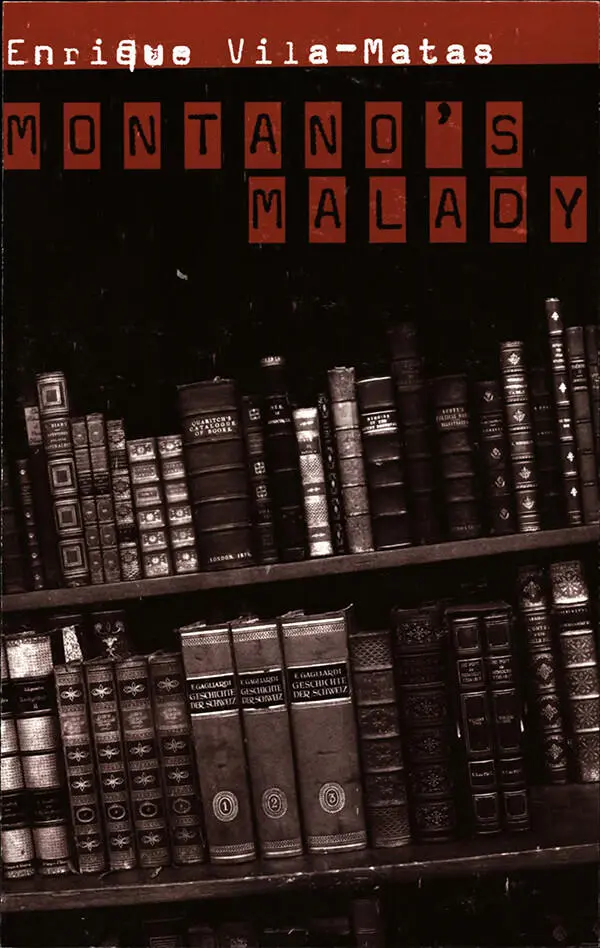
Enrique Vila-Matas - Montano's Malady
Здесь есть возможность читать онлайн «Enrique Vila-Matas - Montano's Malady» весь текст электронной книги совершенно бесплатно (целиком полную версию без сокращений). В некоторых случаях можно слушать аудио, скачать через торрент в формате fb2 и присутствует краткое содержание. Год выпуска: 2007, Издательство: New Directions, Жанр: Современная проза, на английском языке. Описание произведения, (предисловие) а так же отзывы посетителей доступны на портале библиотеки ЛибКат.
- Название:Montano's Malady
- Автор:
- Издательство:New Directions
- Жанр:
- Год:2007
- ISBN:нет данных
- Рейтинг книги:5 / 5. Голосов: 1
-
Избранное:Добавить в избранное
- Отзывы:
-
Ваша оценка:
Montano's Malady: краткое содержание, описание и аннотация
Предлагаем к чтению аннотацию, описание, краткое содержание или предисловие (зависит от того, что написал сам автор книги «Montano's Malady»). Если вы не нашли необходимую информацию о книге — напишите в комментариях, мы постараемся отыскать её.
is a writer named Jose who is so obsessed with literature that he finds it impossible to distinguish between real life and fictional reality. Part picaresque novel, part intimate diary, part memoir and philosophical musings, Enrique Vila-Matas has created a labyrinth in which writers as various as Cervantes, Sterne, Kafka, Musil, Bolano, Coetzee, and Sebald cross endlessly surprising paths. Trying to piece together his life of loss and pain, Jose leads the reader on an unsettling journey from European cities such as Nantes, Barcelona, Lisbon, Prague and Budapest to the Azores and the Chilean port of Valparaiso. Exquisitely witty and erudite, it confirms the opinion of Bernardo Axtaga that Vila-Matas is "the most important living Spanish writer."
Montano's Malady — читать онлайн бесплатно полную книгу (весь текст) целиком
Ниже представлен текст книги, разбитый по страницам. Система сохранения места последней прочитанной страницы, позволяет с удобством читать онлайн бесплатно книгу «Montano's Malady», без необходимости каждый раз заново искать на чём Вы остановились. Поставьте закладку, и сможете в любой момент перейти на страницу, на которой закончили чтение.
Интервал:
Закладка:
Rosa saw me engrossed in thought and suddenly asked me if anything was the matter. “No,” I said, “I was thinking about Caiado and how it’s a shame not to have seen him. Do you think he exists?” Rosa looked at me and downed her gin. “Maybe he’s dead,” she replied. I then recalled that death, another death, might also inhabit that famous paradise. And I proposed a toast to all the dead of Pico, to all those Pico souls who, according to the locals, take refuge in the farthest reaches of the wells and courtyards and whose voice is the song of crickets. Various sailors from the yachts anchored in Fayal and one or two of the old whalers joined the toast, all of them drunk and suddenly singing at the top of their voices a song of the Swiss Guard I had never heard before, the words of which fascinated me and which I jotted down on a Café Sport napkin:
Notre vie est un voyage
Dans l’hiver et dans la Nuit,
Nous chercherons notre passage
Dans le ciel où rien ne luit.
We then piled out on to the street, gin-soaked with the waning moon, rough sea, persistent moan of the wind. A bird went by. I followed it. Life is an inner journey, like Michaux’s travels. Life is a winter’s journey and goes from life to death. It is an entirely imaginary journey, as Louis-Ferdinand Céline said. This is where it derives its strength. Now I am in Barcelona, thinking that my problem is not suffering from Montano’s malady. This far into the winter’s journey, my problem is rather how to disappear—“What will we do to disappear?” as Blanchot said — how to manage to be a twin brother of MUSIL, Robert (Klagenfurt, 1880–Geneva, 1942), who dissolved in the fabric of his own unending work. Not long ago I remarked that it was not desirable for this diary to go on forever or to be mortal and have a single outcome. Now I see that what is really desirable may be to disappear inside it.
PAVESE, CESARE (Santo Stefano Belbo, 1908–Turin, 1950). Late into the night I was reading This Business of Living , Pavese’s private journal, I read to its well-known end (“Suicides are timid murderers […]. All this is sickening. Not words. An act. I won’t write any more.”). On closing the book, I told myself that literature cannot teach us practical methods, results to obtain, but only life’s coordinates. The rest is a lesson that should not be drawn from literature; it is life that should teach it. The private journal, literature in short, did not help Pavese to live very much, which was what most interested him. Could the diary have helped him in any way?
I closed the book and went to bed. I told myself that Pavese’s diary belonged to a period in world culture that tended to integrate existential experience with historical ethics. A period to which Pavese’s suicide seems to set a chronological boundary. I also told myself that, whereas Pavese’s diary was tragically anchored in life, that of Gide or Gombrowicz — closer to my sensibility — was anchored in literature, which is an autonomous world, an independent reality; it has no contact with reality because it is a reality in itself, a personal opinion of mine that no doubt Pavese would not agree with.
I closed the book and went to bed, thinking about all these things, admiring Pavese, but without being in tune with him, and I soon fell asleep. On a foggy road, I saw Robert Walser in conversation with Musil. “Out of here, that is my goal,” Walser was saying. “However much you cry, you won’t manage to be as real as I am,” replied Musil. “If I weren’t real, I couldn’t cry,” replied Walser. “I hope you don’t think those tears are real,” replied Musil.
They then left, or rather — making me feel incredibly jealous — they disappeared. I came to and wondered whether other ghosts from the dream would dare to speak. “Are you asleep?” Rosa asked from the sitting room, like a ghost. I pretended to be asleep and did not reply. Shortly afterwards Cesare Pavese deceased entered my room. He had walked a great distance, he told me, he had walked down Pico’s mysterious road and carried an empty, abandoned house — the world itself? — in his hand. “The dead do not laugh,” he told me. “Laughter is linked to life,” he told me. “Death will come and will have your eyes,” I told him. He was serious and quiet for a few moments. In effect he carried an empty house in his hand and walked along Pico’s road. “What’s the use of Pentothal” he finally said to me. I got up from bed and embraced him. Then Pavese asked me if I was Robert Walser. “I am,” I answered. “I’ve been waiting for you all my death and I’ll go on waiting,” he said. He possessed the voice I had imagined for Teixeira’s character, a nasal, somewhat sensual, but vaguely stupid voice. “Anything else?” I inquired. Pavese did not speak. Pavese was still there, but did not speak. “Not words,” I said. Then I fell asleep and dreamed nothing.
Saturday
THE DESPERATE FRIEND
Such is my regret for the lack of respect with which I undertook Pavese’s entry in this dictionary yesterday that I have spent the whole day today trying to add a few more constructive lines to it. I couldn’t, I cannot, correct what I wrote about the “nasal, somewhat sensual, but vaguely stupid voice” I imagined for Teixeira’s character and discovered was the voice of Pavese deceased. I cannot correct this, because it is true that I had this impression yesterday. And, if I had this impression, I am not now going to pretend and deny it; I do not forget that I swore at the start of this dictionary to kneel before the altar of Truthfulness. Nor can I deny that I saw him walking along Pico’s road, carrying an empty, abandoned house in his hand. I really did see him like this. What can I do if I saw him like this? By way of compensation, and above all because I was unfair yesterday, I believe I am in a position today to revise my opinion about Pavese’s diary and to recall here, without further ado, that, when he died, his friends had to force themselves to approach the bulging folder containing his diary (partly typed and partly handwritten); his friends had to overcome the sense of fearful reserve triggered by those pages, that secret itinerary of a life they had always supposed to be bitter and discontented, the pages of their friend whom they generally understood to be desperate.
Italo Calvino was one of the first friends to open Tutankhamen’s tomb, by which I mean Pavese’s diary, a dangerous diary because it might infect whoever read it with despair. His friends’ initial inspection of those pages was painstaking and restrained. They knew that they would not find there the reason for Pavese’s suicide, something sought by columnists in weekly and daily newspapers at that time; they knew that the reason for such an act can never be reduced to a formula or an episode, but must be sought over a whole life, the set of constants that Pavese, though not a fatalist, called his own destiny . But his friends felt that they were going to find there all the painful tension, the secret vibrations of his soul, which even they, his friends, had not always discerned: the traces of the ill he carried inside, under the guise of his stoicism.
Calvino relates how, on opening the diary at the first page, they realized that they were confronted with an impressive document, convulsed pages, desperate cries that overflowed from them loudly from time to time. “But, most of all, we also found something else, the opposite of despair and defeat: a patient, tenacious labor of self-construction , of inner clarity, of moral betterment, which is to be reached by means of work and reflection on the ultimate reasons behind art and one’s own and others’ lives.”
Yesterday I wrote that I admired Pavese’s diary, but without being in tune with it. Today I am ashamed to have written this. Because if there’s something the pages of my diary darkly pursue, it is the creation of myself and a moral improvement, which I seek by means of work and reflection on the precarious state of my life, of the lives of others and of the life of literature, which I need so much if I am to survive and which, at this century’s beginning, is exposed to the furious assaults of the enemies of the literary as never before.
Читать дальшеИнтервал:
Закладка:
Похожие книги на «Montano's Malady»
Представляем Вашему вниманию похожие книги на «Montano's Malady» списком для выбора. Мы отобрали схожую по названию и смыслу литературу в надежде предоставить читателям больше вариантов отыскать новые, интересные, ещё непрочитанные произведения.




Обсуждение, отзывы о книге «Montano's Malady» и просто собственные мнения читателей. Оставьте ваши комментарии, напишите, что Вы думаете о произведении, его смысле или главных героях. Укажите что конкретно понравилось, а что нет, и почему Вы так считаете.