Enrique Vila-Matas - Montano's Malady
Здесь есть возможность читать онлайн «Enrique Vila-Matas - Montano's Malady» весь текст электронной книги совершенно бесплатно (целиком полную версию без сокращений). В некоторых случаях можно слушать аудио, скачать через торрент в формате fb2 и присутствует краткое содержание. Год выпуска: 2007, Издательство: New Directions, Жанр: Современная проза, на английском языке. Описание произведения, (предисловие) а так же отзывы посетителей доступны на портале библиотеки ЛибКат.
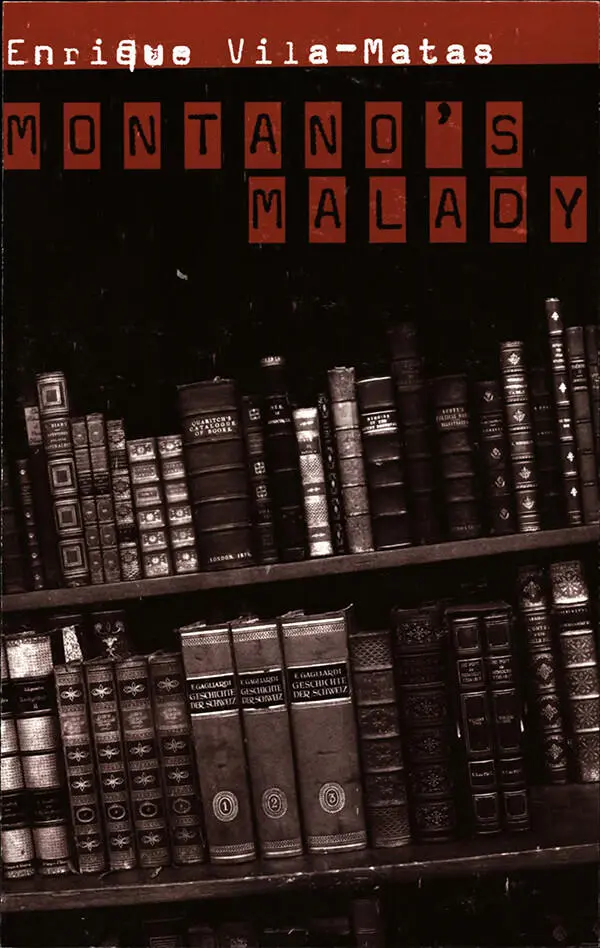
- Название:Montano's Malady
- Автор:
- Издательство:New Directions
- Жанр:
- Год:2007
- ISBN:нет данных
- Рейтинг книги:5 / 5. Голосов: 1
-
Избранное:Добавить в избранное
- Отзывы:
-
Ваша оценка:
Montano's Malady: краткое содержание, описание и аннотация
Предлагаем к чтению аннотацию, описание, краткое содержание или предисловие (зависит от того, что написал сам автор книги «Montano's Malady»). Если вы не нашли необходимую информацию о книге — напишите в комментариях, мы постараемся отыскать её.
is a writer named Jose who is so obsessed with literature that he finds it impossible to distinguish between real life and fictional reality. Part picaresque novel, part intimate diary, part memoir and philosophical musings, Enrique Vila-Matas has created a labyrinth in which writers as various as Cervantes, Sterne, Kafka, Musil, Bolano, Coetzee, and Sebald cross endlessly surprising paths. Trying to piece together his life of loss and pain, Jose leads the reader on an unsettling journey from European cities such as Nantes, Barcelona, Lisbon, Prague and Budapest to the Azores and the Chilean port of Valparaiso. Exquisitely witty and erudite, it confirms the opinion of Bernardo Axtaga that Vila-Matas is "the most important living Spanish writer."
Montano's Malady — читать онлайн бесплатно полную книгу (весь текст) целиком
Ниже представлен текст книги, разбитый по страницам. Система сохранения места последней прочитанной страницы, позволяет с удобством читать онлайн бесплатно книгу «Montano's Malady», без необходимости каждый раз заново искать на чём Вы остановились. Поставьте закладку, и сможете в любой момент перейти на страницу, на которой закончили чтение.
Интервал:
Закладка:
This man was undoubtedly very odd, and not just on account of his vampiric appearance. He was elegant, but very strange. And his elegance was also strange, not to say extravagant. For example, he was wearing a belt strapped around his waist, on top of his white shirt, as if he were tying himself up.
It seemed to me, despite his chilling gaze, that he was joking and I simply had to go along with it.
“They’re pretending to be adults,” I said. “But they’re just as much children as are you, who owns the ball.”
His next look made me think I was mistaken and this man had nothing to do with the Brodskys, I had been talking to a stranger in the literal sense of the word.
“Mistakes like yours,” he told me, suddenly sounding like Gombrowicz and adopting a very unpleasant tone, “deserve a flick. And now, mister intruder, clear off if you do not want to discover that my belt is a whip.”
Your head reminds me of a large lily, I thought of telling him. But the sentence was too soft for my liking. Your pale forehead is a confused map. This also seemed too soft, and sweet besides, and even sickeningly poetic. You’re the one who’s a flick, I thought of telling him. But I found that simplistic. You son of a bitch. This seemed more to the point, but too vulgar and direct. Besides, I had to show respect for my elders. All the same, I felt a sudden dislike for this man, he struck me as rude and detestable, and finally I went for this bold question:
“Did Your Majesty get his Draculean or DraculARSEan ears from his lady mother, the Great Arse?”
I thought that he would at least give me a smack or a heavy lash, but he didn’t. He looked at me, smiled, and roared with monumental, theatrical laughter, as spectacular as that terrace. Everyone suddenly turned toward us, and I almost blushed. His laughter seemed to have no end, but it ended. He then became very serious and reached out his hand to me in a friendly manner.
“Tongoy,” he said, “Felipe Tongoy.”
He was a friend of the Brodskys, I was not mistaken. But the fact he was reading Gombrowicz was in no way related to the previous night’s argument in Tunquén. Felipe Tongoy had been a fan of Gombrowicz his whole life, and that was all. Or nothing. Because Tongoy had such an odd appearance, he was seven times Dracula compared to me. And it was difficult to be sure about him, though this much was undoubtedly clear: he was friends with the Brodskys and read Gombrowicz.
“Tongoy,” he said again. “Felipe Tongoy. I am the Brodskys’ oldest friend. I like dry martinis, Chile, Gombrowicz, and vampires. Garçon ,” he shouted to the waiter, “ink, please!”
He had ink on his gums, perhaps he had just eaten squid in their ink. He aroused in me neither disgust nor fear, I saw him as a friend, but most of all — this calmed me — as a friend of the Brodskys; though he did arouse in me a certain amount of fear, or even a great deal, not because of the Brodskys, but because of the strange ink on his gums. My blood was not circulating too well, I could feel it. I had never seen anyone so literature-sick as this monster.
“Girondo,” I replied, trembling. “Rosario Girondo at your service.”
“Do you like Chile?” he asked me with a devilish look.
I thought hard before answering.
“Chile is OK,” I said finally.
He smiled at me, I suppose so that I could see the ink again. And shortly afterward, with his left hand, which was the one he had free — because with his right he was again calling the waiter — he touched his monstrous right ear.
I recalled Gombrowicz: “If you wish to indicate that you liked my work, simply touch your right ear when you see me.”
“Girondo,” I said, also touching my ear. “Rosario Girondo.”
This tremulous and extravagant exchange of ears by way of credentials — with Gombrowicz in the background — was the start of a great, unexpected friendship.
“My dear Mrs. Girondo,” Tongoy said suddenly, with a huge, horrific happy smile, “welcome to the Brighton.”
Thursday
BUT IT’S RAINING!
The rain is falling on Barcelona, though with less wind and less cruelty than yesterday, when I went to the Avenida Palace to meet Rita Gombrowicz. It may seem a very curious coincidence or a very fortuitous chance, but the fact is that, as I was absorbed in the entry for Gombrowicz in this dictionary, Rita, his widow, arrived yesterday in Barcelona, and I went to see her at her hotel, the Avenida Palace. It may seem a very fortuitous chance, but in truth I had known for a month that Rita Gombrowicz was going to come to Barcelona and that she and I had to present a book by her husband in the bookshop La Central. To be honest, knowing this made me linger over the word Gombrowicz, because I did not want to find myself commenting on another author of private journals — Kafka, for example, the next entry in this dictionary — with Rita in Barcelona.
Yesterday I went to fetch her from the Avenida Palace. It was a very unpleasant afternoon, rain and a strong wind, a rare winter’s day in the middle of spring. I had seen only old photographs of Rita, images from the 1960s, from the time she went to live with Witold Gombrowicz, but I immediately recognized her. Inclined as I am to mythologize writers (Gombrowicz has always been a myth for me, which is not to say that he has influenced my writing, I made this very clear in Tunquén), I was nervous at the beginning of the meeting with Rita, but soon there arose between us a mutual current of sympathy and intimacy, as if we had known each other our whole lives.
It was raining steadily outside, it was raining in an aggressive way that was not at all melancholic, but the conversation in the hotel foyer turned nostalgic and persistent, seemingly enveloped in a strange melancholy invented by a rain that was not the rain outside, and gradually the meeting with Rita inclined toward intimacies: “He was someone,” she said of her husband, “who worked a lot on himself, creating his own style. He belonged to a group of writers whose work is the reincarnation of their own personality.”
We proceeded to talk about the close relationship between life and work, and we discussed writers who devote themselves to creating their own style. I didn’t wish to say anything about myself, but if there is one point I have in common with Gombrowicz, it is the origin of my literary style, based — as in his case — on a radical departure from the boring and conservative family discourse.
Gombrowicz’s style would have been nothing without the participation of his mother, who was naive, gluttonous, comfort loving, and whose culture was more fashionable than anything else. She was all this by nature, but she believed that she was lucid, intellectual, frugal, and heroically ascetic. “It was she,” wrote her son, “who pushed me to pure folly, to the absurd, which would later become one of the most important features of my art.” Together with his brother Jerzy, Gombrowicz very quickly hit upon the ideal way to wind her up: it involved systematically affirming the opposite of what she might say. Their mother had only to declare that the sun was shining for the two brothers to reply in unison, “But what are you saying? It’s raining!”
It is no surprise that, years later, Gombrowicz declared that he did not worship poetry and was not overly progressive or modern, or the typical intellectual, or even a nationalist, Catholic, Communist, upright man, nor did he revere science, art, or Marx: “Who was I then? Frequently I was simply the negation of everything the other person said.”
In my case, I learned, every day more skilfully, to interrupt my father’s boring discourse on, for example, our country’s dreams, its bungles and culture. I became the negation of everything he would propose, suggest, lay out, or declare. But, since my father’s discourse hardly ever flagged and was one-sided — only he could speak at home — I barely had time for my interjections, which took advantage of short pauses in my father’s discourse to slip in small tributes to folly, always trying to unbalance him. “You’re no son of mine,” my father would say. And also: “I don’t know why you always have to be different in front of me.”
Читать дальшеИнтервал:
Закладка:
Похожие книги на «Montano's Malady»
Представляем Вашему вниманию похожие книги на «Montano's Malady» списком для выбора. Мы отобрали схожую по названию и смыслу литературу в надежде предоставить читателям больше вариантов отыскать новые, интересные, ещё непрочитанные произведения.




Обсуждение, отзывы о книге «Montano's Malady» и просто собственные мнения читателей. Оставьте ваши комментарии, напишите, что Вы думаете о произведении, его смысле или главных героях. Укажите что конкретно понравилось, а что нет, и почему Вы так считаете.