Enrique Vila-Matas - Montano's Malady
Здесь есть возможность читать онлайн «Enrique Vila-Matas - Montano's Malady» весь текст электронной книги совершенно бесплатно (целиком полную версию без сокращений). В некоторых случаях можно слушать аудио, скачать через торрент в формате fb2 и присутствует краткое содержание. Год выпуска: 2007, Издательство: New Directions, Жанр: Современная проза, на английском языке. Описание произведения, (предисловие) а так же отзывы посетителей доступны на портале библиотеки ЛибКат.
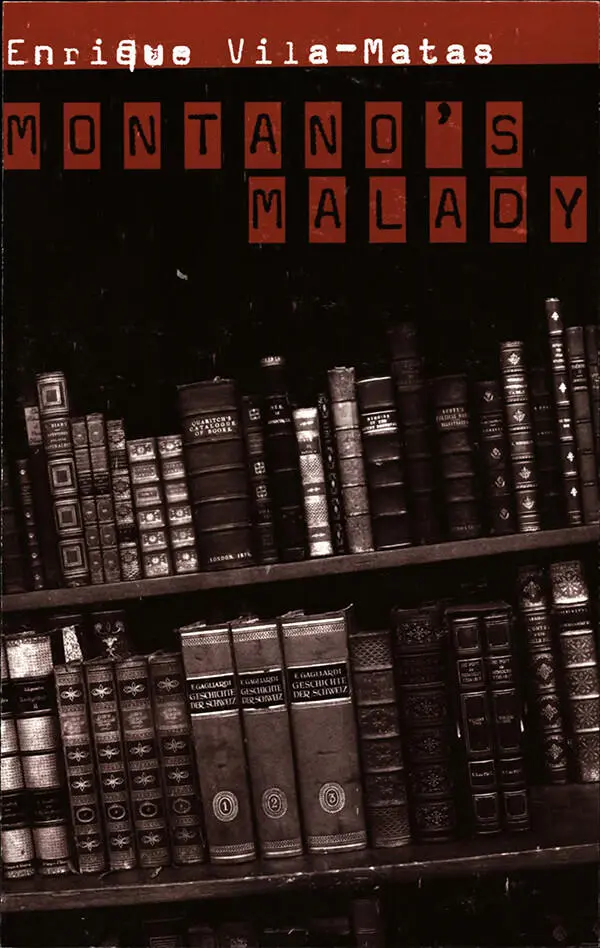
- Название:Montano's Malady
- Автор:
- Издательство:New Directions
- Жанр:
- Год:2007
- ISBN:нет данных
- Рейтинг книги:5 / 5. Голосов: 1
-
Избранное:Добавить в избранное
- Отзывы:
-
Ваша оценка:
Montano's Malady: краткое содержание, описание и аннотация
Предлагаем к чтению аннотацию, описание, краткое содержание или предисловие (зависит от того, что написал сам автор книги «Montano's Malady»). Если вы не нашли необходимую информацию о книге — напишите в комментариях, мы постараемся отыскать её.
is a writer named Jose who is so obsessed with literature that he finds it impossible to distinguish between real life and fictional reality. Part picaresque novel, part intimate diary, part memoir and philosophical musings, Enrique Vila-Matas has created a labyrinth in which writers as various as Cervantes, Sterne, Kafka, Musil, Bolano, Coetzee, and Sebald cross endlessly surprising paths. Trying to piece together his life of loss and pain, Jose leads the reader on an unsettling journey from European cities such as Nantes, Barcelona, Lisbon, Prague and Budapest to the Azores and the Chilean port of Valparaiso. Exquisitely witty and erudite, it confirms the opinion of Bernardo Axtaga that Vila-Matas is "the most important living Spanish writer."
Montano's Malady — читать онлайн бесплатно полную книгу (весь текст) целиком
Ниже представлен текст книги, разбитый по страницам. Система сохранения места последней прочитанной страницы, позволяет с удобством читать онлайн бесплатно книгу «Montano's Malady», без необходимости каждый раз заново искать на чём Вы остановились. Поставьте закладку, и сможете в любой момент перейти на страницу, на которой закончили чтение.
Интервал:
Закладка:
Pentothal for the lukewarm, dead horizon. Here I am, quiet and alone, in my white clothes. The afternoon is flat. And there is a cold kiss on the window. I write this August afternoon in a dialect of ice, I write sentences I do not understand, sentences that merit no commentaries. At times I perceive the second life of things, the secret and elusive life behind what is on view, behind famous reality. There is nothing worse than fame, and reality definitely has this fame. Whenever I think about this, I recall Seneca, who said that fame is horrible because it relies on the judgment of others. How horrible reality seems to me when it is on everybody’s lips, when it is famous and grateful for the judgment of others, and poor reality laughs without realizing that it is no more than mere appearance, and I disregard its fame, minute by minute, I erase it on the map of the future. Because I perceive what will happen and I also perceive the second life of objects and say things that even I do not understand and that merit no commentary […]. I perceive the secret and elusive life behind what is on view, behind reality. At times I see this, what I call the second mask, but I have no one to share this perception with, unless it be Hamlet — I dream in him — or else my poor son, who one day, on some byroad in the night, will bump into Hamlet, who will ask him about me, and by then I shall be only white clothes and a blank look of a forgotten back room, the distant echo of a woman who on a day like today, one August afternoon like today, wrote sentences she did not even think, sentences to find rest from the effort of an essay that will not merit a single commentary by anyone.
COMMENTARY ON MY MOTHER’S EXTRACT
At the age of fifty, José Cardoso Pires — he himself tells the story in an unforgettable book — decided to smoke in front of the mirror and ask, And now, José?
To smoke in front of the mirror, as everyone knows, is an intelligent exercise, it is also to know how to confront our most ordinary, considered face. I also am now smoking in front of the mirror, it is midnight and I am standing — having been left alone in the city, Rosa has traveled to Madrid during this long weekend on which half of Spain has taken to the road — I am standing and smoking in front of the mirror. And now, Rosario?
I shouldn’t have been left so alone at home, on such a long weekend, I am dangerous without Rosa watching over me, I am capable of draining every single bottle in the house during this weekend, I am capable even of ceasing to write this dictionary, I shouldn’t have been left so free in such a big house, with so many bottles and the whole weekend ahead. And now, José?
I stand looking at myself in the mirror and I smoke and I think about Rosario Girondo, my mother. And I tell myself that there is evidence of madness in the extract from “Theory of Budapest” that I have included in this dictionary, but there is madness throughout her diary: conventional housewife on the one hand; disturbed woman writer on the other.
The opening to the extract from “Theory of Budapest” has an acceptable poetic rhythm — with the tendency to say nothing, but in a way that sounds nice. However, my mother soon quotes Seneca and loses the rhythm of the narrative — if there ever was a narrative — and even makes grammatical mistakes, as, for example, “I dream in him” with reference to Hamlet. One deduces that she meant she dreamed of Hamlet, not in Hamlet. And yet I must be grateful for this possible error of my mother’s, since it gave me the idea for the short story, “11 rue Simon-Crubellier,” which I attributed to my son in Montano’s Malady , that story which supposedly condenses into seven squalid pages the history of literature seen as a succession of writers unexpectedly inhabited by the memories of other, earlier writers: the history of literature seen with reversed chronology. This story by Montano contains a series of writers who dream in , inside, in the interior of other writers preceding them in time. I believe that thanks to my mother saying “I dream in him” about Hamlet, thanks to that minute error, I had the whole idea of that spectacular story that enabled Montano to escape from his tragic writer’s block, from the imposed silence that so tormented him back in the bookshop in Nantes.
I must accept reality. My mother behaved impeccably as a housewife, but as a writer of a secret diary she more than took revenge on her conventional life and filled the diary with the language of dementia. That she was mad when she wrote is perfectly clear in the extract from “Theory of Budapest,” where she herself says that she is going to give way to delirium, where she talks, for example, of Hamlet and says quite naturally that one day he will ask about her, and by then she will be “only white clothes.” I need not add what she says about my bumping into Hamlet on some byroad. Though this turned out to be somewhat prophetic, since in Montano’s Malady I talk to my son, who thinks he is Hamlet, and I took the idea from her.
Dangerous weekend, which could give way to drink and a tragic trail of traceless days. And now, Rosario.
For the moment, I abstain. I smoke in front of the mirror and tell myself that basically my mother always had Montano’s malady, was literature-sick. I inherited the disease from her, this much is obvious. And now, José.
To avoid drinking and writing that I am giving up the dictionary, I decide — it’s midnight, a perfect time — to summon the ghosts, to turn into a kind of mailbox able, from now on, to receive their messages, their opinions from the other world. I tell myself that I shall listen to their stories willingly and decipher them should they reach me a little distorted by some rare wave. Here I am, waiting for you, ghosts. Waiting for your visits. In the meantime, I smoke, and smoke, and look at myself in the mirror, next to the open window. Time goes by and no one communicates. And now, Rosario.
The time for spirits goes by, it’s long past midnight, nobody came, it’s a fact. I suppose it was fairly predictable. I shouldn’t have been left so alone on this night of the first Friday in May. I keep smoking in front of the mirror, I imagine that I am conversing with Hamlet, I feel strange, and see that I smoke strangely in front of the strange mirror. And now, José.
Tomorrow is another day.
And now, Rosario.
Who said that?
“Now,” says a voice, “keep smoking.”
Monday
I got up at eight, as usual, just as Rosa with a forceful and very energetic smack turned off the alarm clock. We had breakfast together. A quick instant coffee, cakes from the supermarket, and oatmeal. I laughed at one of her clients, one of those authors she has to put up with daily. As always, she wasn’t in the least amused. “Carry on like this and you can find yourself another literary agent,” she told me angrily.
Around nine, Rosa left for the office and I had another coffee and lit a cigarette and, by way of intellectual warm-up to see if I was in the mood to write — every morning I tend to read a passage from a book I have read previously that I know is not going to disappoint me and generally I end up feeling stimulated by the reading and encouraged to go to my study and to pick up where I left off writing the day before — I immersed myself in some pages by Julian Barnes on childhood memories. In them, Barnes talks of the envy he experienced on a particular occasion reading an extract from Edmond de Goncourt’s diary, where the author said that he had a very clear memory of a morning from his childhood days in which, needing help to prepare his fishing tackle, he went into his cousin’s bedroom and saw her, with her legs open and her bottom on a cushion, as she was about to be penetrated by her husband. There was a flurry of bedclothes and the scene was witnessed as quickly as it vanished. “But the image stuck,” confesses Goncourt, “that pink bottom on a cushion with embroidered festoons was the sweet, exciting image that appeared before me every night …” Barnes states that he is amazed by Goncourt’s excellent memory of something that happened fifty years earlier and, most of all, he feels professional envy at how well preserved that memory is, because Goncourt saw and registered in his mind the embroidered festoons on the cushion. Barnes says that this demonstrates Goncourt’s capacity as a writer; he reads Goncourt’s description and wonders if he would have noticed those embroidered festoons, had he been the one standing there, staring wide-eyed at the couple.
Читать дальшеИнтервал:
Закладка:
Похожие книги на «Montano's Malady»
Представляем Вашему вниманию похожие книги на «Montano's Malady» списком для выбора. Мы отобрали схожую по названию и смыслу литературу в надежде предоставить читателям больше вариантов отыскать новые, интересные, ещё непрочитанные произведения.






Обсуждение, отзывы о книге «Montano's Malady» и просто собственные мнения читателей. Оставьте ваши комментарии, напишите, что Вы думаете о произведении, его смысле или главных героях. Укажите что конкретно понравилось, а что нет, и почему Вы так считаете.