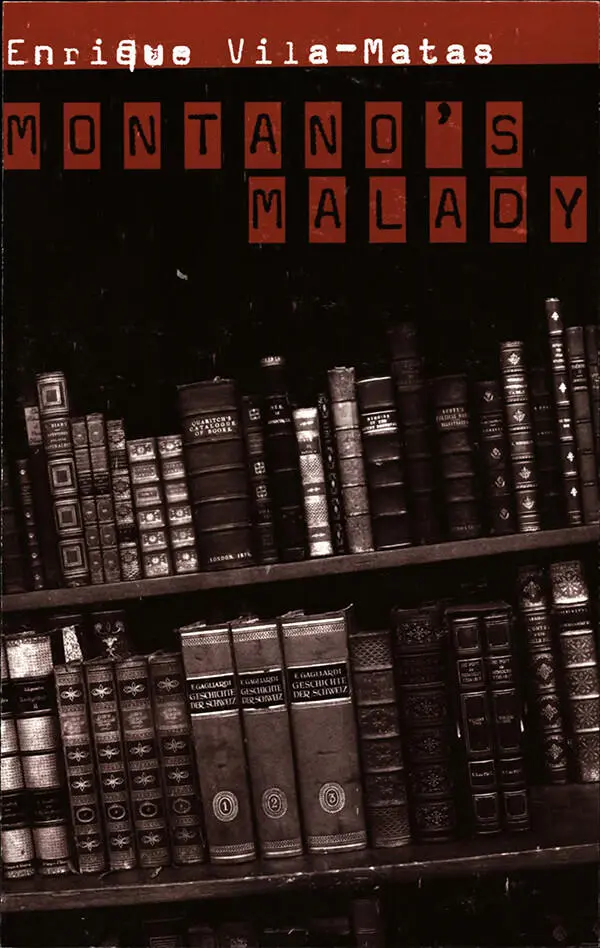
Enrique Vila-Matas - Montano's Malady
Здесь есть возможность читать онлайн «Enrique Vila-Matas - Montano's Malady» весь текст электронной книги совершенно бесплатно (целиком полную версию без сокращений). В некоторых случаях можно слушать аудио, скачать через торрент в формате fb2 и присутствует краткое содержание. Год выпуска: 2007, Издательство: New Directions, Жанр: Современная проза, на английском языке. Описание произведения, (предисловие) а так же отзывы посетителей доступны на портале библиотеки ЛибКат.
- Название:Montano's Malady
- Автор:
- Издательство:New Directions
- Жанр:
- Год:2007
- ISBN:нет данных
- Рейтинг книги:5 / 5. Голосов: 1
-
Избранное:Добавить в избранное
- Отзывы:
-
Ваша оценка:
Montano's Malady: краткое содержание, описание и аннотация
Предлагаем к чтению аннотацию, описание, краткое содержание или предисловие (зависит от того, что написал сам автор книги «Montano's Malady»). Если вы не нашли необходимую информацию о книге — напишите в комментариях, мы постараемся отыскать её.
is a writer named Jose who is so obsessed with literature that he finds it impossible to distinguish between real life and fictional reality. Part picaresque novel, part intimate diary, part memoir and philosophical musings, Enrique Vila-Matas has created a labyrinth in which writers as various as Cervantes, Sterne, Kafka, Musil, Bolano, Coetzee, and Sebald cross endlessly surprising paths. Trying to piece together his life of loss and pain, Jose leads the reader on an unsettling journey from European cities such as Nantes, Barcelona, Lisbon, Prague and Budapest to the Azores and the Chilean port of Valparaiso. Exquisitely witty and erudite, it confirms the opinion of Bernardo Axtaga that Vila-Matas is "the most important living Spanish writer."
Montano's Malady — читать онлайн бесплатно полную книгу (весь текст) целиком
Ниже представлен текст книги, разбитый по страницам. Система сохранения места последней прочитанной страницы, позволяет с удобством читать онлайн бесплатно книгу «Montano's Malady», без необходимости каждый раз заново искать на чём Вы остановились. Поставьте закладку, и сможете в любой момент перейти на страницу, на которой закончили чтение.
Интервал:
Закладка:
“It’s about someone who’s literature-sick.”
“You mean, someone just like you?”
“No. Worse than me, much worse.”
I was afraid that the years would go by and I would never write that book.
“What exactly does this Montano do?” they would ask me from time to time.
“He looks out over the marshes.”
Parasitic note
I would love to have been visited by Alan Pauls’ personal memories, by the memories of the day he wrote “Second Hand,” a chapter in his book The Borges Factor . There is in what I have just said a clear desire to be in the skin of an admired essayist, a desire that is really not so strange as Kafka’s desire to be a redskin. The fact that I admire “Second Hand” should not surprise anyone, it is a particularly astute reflection on the great Borges’ literary parasitism, on a theme — that of book vampirism — which in the streets of Nantes had made me very uneasy and concerned, and which I suddenly resolved by beginning to act as a literary parasite on myself. This happy discovery has come to me now, after I knew of the existence of The Borges Factor , a book I came across last week in Barcelona, in the home of Rodrigo Fresán.
In “Second Hand,” Alan Pauls looks at the beneficial effect on the young Borges of an unfavorable review written in 1933 by one Ramón Doll about Discussion , the book of essays that Borges had published a year earlier. Ramón Doll was a nationalist critic who, in his book Intellectual Police , launched an attack on Borges, accusing him of being a literary parasite: “These essays, bibliographical in their intention or content, belong to that genre of parasitic literature that involves repeating badly things others have said well; or in pretending Don Quixote and Martín Fierro were never published, and printing entire pages lifted from these works; or in making out that one is interested in elucidating some point and with a candid air incorporating the opinions of others, to be seen not to be one-sided, but to have respect for all ideas (and in that way the essay gets written).”
Shall I repeat badly something Alan Pauls has said well? I hope not, I assume a candid air and write that Pauls says that poor Doll is scandalized, yes, but his outrage should not overshadow the fact that the charges he levels at Borges sound particularly pertinent. Pauls remarks that Borges, contrary to the policeman Doll’s expectations, very probably did not disapprove of the critic’s words, but quite the opposite: “With the shrewdness and sense of economy of great misfits, who recycle the enemy’s blows to strengthen their own, Borges does not reject Doll’s condemnation, rather he converts it— reverts it — into his own artistic program. Borges’ work is teeming with such secondary, slightly obscure characters, who like shadows follow the trail of a more luminous work or character. Translators, exegetes, annotators of sacred texts, interpreters, librarians, even lackeys of beautiful people and brawlers: Borges defines the true ethics of subordination in this gallery of anonymous creatures […]. And Pierre Menard culminates a long series of literary submissions by rewriting some chapters from Don Quixote —what is Pierre Menard if not the ultimate parasitic writer, the visionary who takes the subordinate vocation to its highest point and to its extinction?”
These secondary characters, ethics of subordination, unite Borges with Robert Walser, the author of Jakob von Gunten , a novel that is also a diary, with a memorable beginning: “One learns very little here, there is a shortage of teachers, and none of us boys of the Benjamenta Institute will come to anything, that is to say, we shall all be something very small and subordinate later in life.”
Walser himself was always a subaltern and could easily have been one of his own characters or one of Borges’ obscure characters. In fact Walser worked as a copyist in Zurich, he would from time to time retire to the “Chamber of Writing for Unoccupied Persons”—the name appears to be an invention by Borges for a story of copyists or by Walser himself, but it isn’t, it isn’t an invention — and there, “seated on an old stool, in the evening, in the pale light of an oil lamp, he would make use of his graceful handwriting to copy addresses and do little jobs of the kind entrusted by businesses, associations, or private individuals.”
Walser worked in many things, always as a subaltern, he claimed to feel well “in the lower regions.” He was, for example, bookshop assistant, lawyer’s clerk, bank employee, worker in a factory that made sewing machines, and finally majordomo of a castle in Silesia, all of this with the permanent wish to learn how to serve.
Led also by a certain wish to serve, I should like to tell the reader that, despite the obvious differences, my literary modus operandi can sometimes — though I did not realize it until recently, until I read “Second Hand”—recall that of Borges. I was a literary parasite in the first poem I wrote, some love verses intended to enamor a girl at school. I constructed the poem by copying Cernuda and occasionally, very occasionally, inserting a line of my own: “I love you in the goodness of your foggy fatherland,” for example.
I failed to enamor the girl at school, but she did tell me that I wrote very well. Instead of remembering that eighty percent of the poem was Cernuda’s, I concluded that it was my own verses — elaborated thanks to the company of a great poet — that the girl had liked. This gave me immense confidence from that day on, it had a decisive influence on my subsequent literary development. Gradually the percentage of copying in my poems decreased and slowly, but with a certain amount of confidence, my own personal style evolved, always constructed — to a greater or lesser extent — with the collaboration of those writers whose blood I sucked for my own benefit. Without haste, I began to acquire a little of my own style, nothing dazzling, but sufficient, something that was unmistakably mine , thanks to vampirism and the involuntary collaboration of the rest, those writers I laid hands on to find my personal literature. Without haste, arriving always after , in second place, accompanying a writer, all the Cernudas I discovered along the way, who appeared first, original. Without haste, like Walsers secondary or Joseph Roth’s discreet characters, who pass through life in endless flight, placing themselves on the margins of the reality that troubles them so much and also on the margins of existence — in the face of the mechanism of sameness so dominant in the world today, to defend an extreme residue of irreducible individuality, something that is unmistakably theirs . I discovered mine in the others, arriving after them, first accompanying them and later liberating myself.
I think I can now say, for example, that thanks to Cernuda’s protective staff I began to walk on my own and to find out what kind of writer I was, and also not to know who I was, or, better put, to know who I was, but just a bit, in the same way as my literary style is just an extreme residue, but that will always be better than nothing. The same can be applied to my existence: I have just a bit of my own life — as can be observed in this timid dictionary — but it is unmistakably mine, which, to be honest, to me already seems a lot. Given the state of the world, it is no small thing to have a bit of autobiography.
I know myself little; perhaps it’s better like this, to have a life that is “deliberately slender” (as Gil de Biedma would say), but at least to have a life, which not many do. Perhaps it’s better like this, for, as Goethe said to Eckermann, “I do not know myself, and God forbid that I should.”
Читать дальшеИнтервал:
Закладка:
Похожие книги на «Montano's Malady»
Представляем Вашему вниманию похожие книги на «Montano's Malady» списком для выбора. Мы отобрали схожую по названию и смыслу литературу в надежде предоставить читателям больше вариантов отыскать новые, интересные, ещё непрочитанные произведения.






Обсуждение, отзывы о книге «Montano's Malady» и просто собственные мнения читателей. Оставьте ваши комментарии, напишите, что Вы думаете о произведении, его смысле или главных героях. Укажите что конкретно понравилось, а что нет, и почему Вы так считаете.