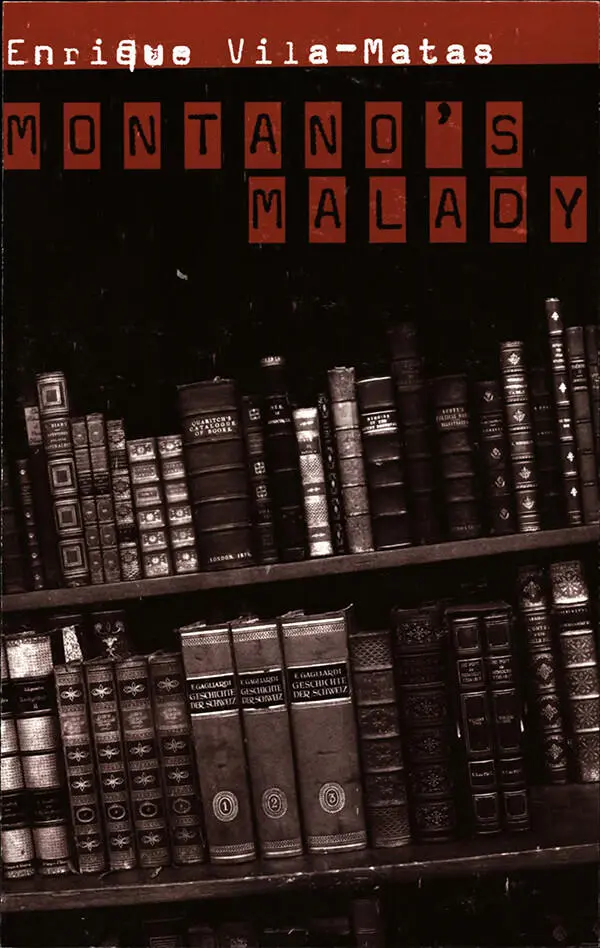
Enrique Vila-Matas - Montano's Malady
Здесь есть возможность читать онлайн «Enrique Vila-Matas - Montano's Malady» весь текст электронной книги совершенно бесплатно (целиком полную версию без сокращений). В некоторых случаях можно слушать аудио, скачать через торрент в формате fb2 и присутствует краткое содержание. Год выпуска: 2007, Издательство: New Directions, Жанр: Современная проза, на английском языке. Описание произведения, (предисловие) а так же отзывы посетителей доступны на портале библиотеки ЛибКат.
- Название:Montano's Malady
- Автор:
- Издательство:New Directions
- Жанр:
- Год:2007
- ISBN:нет данных
- Рейтинг книги:5 / 5. Голосов: 1
-
Избранное:Добавить в избранное
- Отзывы:
-
Ваша оценка:
Montano's Malady: краткое содержание, описание и аннотация
Предлагаем к чтению аннотацию, описание, краткое содержание или предисловие (зависит от того, что написал сам автор книги «Montano's Malady»). Если вы не нашли необходимую информацию о книге — напишите в комментариях, мы постараемся отыскать её.
is a writer named Jose who is so obsessed with literature that he finds it impossible to distinguish between real life and fictional reality. Part picaresque novel, part intimate diary, part memoir and philosophical musings, Enrique Vila-Matas has created a labyrinth in which writers as various as Cervantes, Sterne, Kafka, Musil, Bolano, Coetzee, and Sebald cross endlessly surprising paths. Trying to piece together his life of loss and pain, Jose leads the reader on an unsettling journey from European cities such as Nantes, Barcelona, Lisbon, Prague and Budapest to the Azores and the Chilean port of Valparaiso. Exquisitely witty and erudite, it confirms the opinion of Bernardo Axtaga that Vila-Matas is "the most important living Spanish writer."
Montano's Malady — читать онлайн бесплатно полную книгу (весь текст) целиком
Ниже представлен текст книги, разбитый по страницам. Система сохранения места последней прочитанной страницы, позволяет с удобством читать онлайн бесплатно книгу «Montano's Malady», без необходимости каждый раз заново искать на чём Вы остановились. Поставьте закладку, и сможете в любой момент перейти на страницу, на которой закончили чтение.
Интервал:
Закладка:
Ah! — I lamented — how I should have liked to write about a man without qualities, clearly even in this type of expression or lament I wish to have Musil ever close. I also show a certain tendency to act as a parasite on what is not mine. Seeing, in Coiffard’s, that I had once again succumbed to literary vampirism — to which I must add physical vampirism, a certain resemblance to Christopher Lee when he played Count Dracula — I decided to enter the bookshop and put these thoughts to one side.
I made a supreme effort to concentrate and rudely dismissed the man without attributes, the available man —as Gide called him — the modern man who doesn’t do anything, the nihilist of our times.
But I was so horribly literature-sick that, having entered Coiffard’s, I was powerless to prevent Musil’s returning to my mind, which happened after I read a sentence from his book about the man without properties, about the available man: “A man without qualities can also have a father endowed with qualities.”
Unlikely as it seems, this sentence, not especially important, would be crucial, decisive, hugely important in my life.
How right Gide was when he said that illnesses are keys that can unlock certain doors for us! I say this because this discreet sentence from Musil’s book, which on a whim I linked with my illnesses, was the key that unlocked the doors of the solution to my most pressing problems. The thing is that suddenly, instead of behaving like a thief of other people’s words, I began to act as a literary parasite on myself when I decided right there in Coiffard’s to turn my complaints into the central theme of a narrative marking my return to writing.
Right there in Coiffard’s, while flicking absentmindedly through a French edition of Borges’ The Aleph , I invented a son who would be called Montano — I had just seen a French translation of a book by Arias Montano, Felipe II of Spain’s secret adviser — a son who would live right there in Nantes and suffer an extreme case of writer’s block, from which a father endowed with certain qualities — which poor Montano would lack — would try to free him. The son would run a bookshop in Nantes, possibly even Coiffard’s. And would receive the visit of his father, who would travel from Barcelona to Nantes to try to help him overcome his tragic inability to write, an inability he had suffered since publishing a book about writers who’d given up writing.
The father would be a prestigious literary critic and hopelessly literature-sick, but would not be thinking about himself, only about his son, he would go to Nantes to try to free up Montano’s creative block.
It struck me as a useful idea to transfer some of my problems on to an invented son.
How curious, I commented to myself. I have begun to act as a literary parasite on myself, in my problems following the publication of Nothing Ever Again , I have found the inspiration to return to the world of fictional creation. What’s more, I went on, perhaps this will help me to get well. And I remembered what Walter Benjamin said about the possible relationship that exists between the art of storytelling and the healing of illnesses.
Somebody might wonder: Why turn Montano’s father into a literary critic? I declared that I would be sincere in everything and I shall be so even in this: I am a frustrated literary critic. In fact, one of the major incentives I discovered when writing Montano’s Malady was the opportunity fiction afforded me to be able to pretend to be a critic of the stature of Samuel Johnson, Edmund Wilson, Cyril Connolly, Stanisław Wicińsky, or Alfred Kerr.
I return to Coiffard’s bookshop and the moment when I slammed shut The Aleph and decided to leave. While squeezing past the other customers, I saw that a young man was blocking the exit, which was still some way off. Not only that, I had the fleeting conviction that this man was the spitting image of a young Musil. However, when I reached the door, I discovered that he was not a young man at all, but ancient, with bulging eyes and virtually green skin, slicked-back white hair, and a tie with the word “pop” on it, a poor devil without qualities (I drew inspiration from this mistake, by the way, for the episode in Tunquén in Montano’s Malady , where the youngsters turn out to be old people). I almost gave this disgusting, green-skinned creature a shove. However, when I stepped outside, back into the rain, I had the impression that I had rarely felt better in my life. This was hardly surprising. During a brief foray into a bookshop lasting only five minutes, in one fell swoop I had freed myself from my most pressing problems. It was even likely that I had gone some way toward freeing myself from my literary illness, since I was not unaware that I could get well if I wrote an exhaustive commentary on the illness in that narrative about my son which I proposed to start writing as soon as possible.
It is well known that there is no better way to overcome an obsession than by writing about it. I know this from personal experience, the point is to talk about the theme obsessing you until you exhaust it; this is something I have done in some of my books and generally I have achieved my objective, in the end almost completely eliminating the obsession that had me trapped.
I remember myself the following morning seated at a desk in the hall of the Julien Gracq Institute, looking very serious and, apparently, in sight of everybody, noting down everything the professor Aline Roubaud said. She was delivering in French a brilliant and very lively lecture about the Spanish Golden Age. And, while it cannot be said that I wasn’t listening to her, the truth is that the notes I was taking had little to do with her lecture; they dealt, instead, with the detailed construction of what would turn into Montano’s Malady .
I still have these notes and find in them isolated phrases, early pointers, simple and tender words, which today represent an engaging document to me, in that they are the written testimony of what was the timid gestation of Montano’s Malady .
Two of those phrases or early pointers:
Married to Aline Roubaud . A slightly perverse decision, clearly this refers to my intention of marrying Montano to a young French woman named after the elderly lady who at that moment was delivering her brilliant lecture.
Behaves like Hamlet . Refers to the fact that the father would try to help the son overcome his literary block, but the latter would react strangely and behave as if he were Hamlet and sought revenge.
I remember that, while I was taking those notes, I felt happy, but a little tortured by the idea that I would not get around to writing the narrative I had in mind and would end up resembling the main character in Paludes , André Gide’s novel, which tells the story of a man who wants to write a book but is always putting it off for another day. This book deals with a man who lives in a marsh and doesn’t do anything.
This writer who does not write and is the main character in Paludes is sometimes asked what he does, how he occupies his time.
“Why, I write Paludes ,” he replies always irritably, “the story of a bachelor who lives in a tower surrounded by marshlands.”
“Why a bachelor?”
“Well, it makes it all so much easier.”
“Is that it?”
“That’s it. I’ll tell you what he does.”
“What does he do?”
“He looks out over the marshes.”
The years go by and nothing changes, the writer who plans to write Paludes does not get around to it.
I was frightened that something similar would happen to me and I would end up stuck in the “antechamber” of this project I had recently conceived in Nantes. That from time to time people would ask me what my new text was about and I would reply:
Читать дальшеИнтервал:
Закладка:
Похожие книги на «Montano's Malady»
Представляем Вашему вниманию похожие книги на «Montano's Malady» списком для выбора. Мы отобрали схожую по названию и смыслу литературу в надежде предоставить читателям больше вариантов отыскать новые, интересные, ещё непрочитанные произведения.



Обсуждение, отзывы о книге «Montano's Malady» и просто собственные мнения читателей. Оставьте ваши комментарии, напишите, что Вы думаете о произведении, его смысле или главных героях. Укажите что конкретно понравилось, а что нет, и почему Вы так считаете.