Enrique Vila-Matas - Montano's Malady
Здесь есть возможность читать онлайн «Enrique Vila-Matas - Montano's Malady» весь текст электронной книги совершенно бесплатно (целиком полную версию без сокращений). В некоторых случаях можно слушать аудио, скачать через торрент в формате fb2 и присутствует краткое содержание. Год выпуска: 2007, Издательство: New Directions, Жанр: Современная проза, на английском языке. Описание произведения, (предисловие) а так же отзывы посетителей доступны на портале библиотеки ЛибКат.
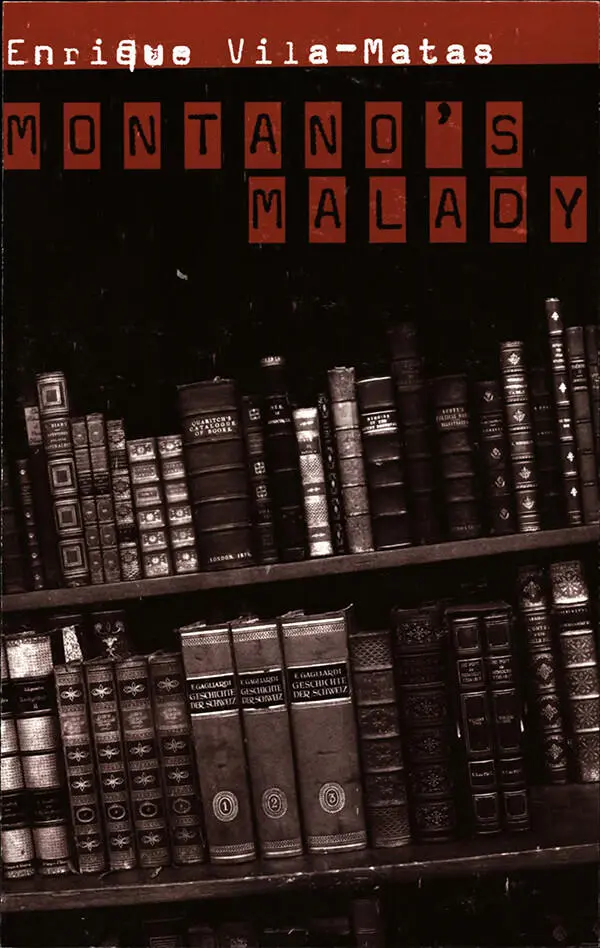
- Название:Montano's Malady
- Автор:
- Издательство:New Directions
- Жанр:
- Год:2007
- ISBN:нет данных
- Рейтинг книги:5 / 5. Голосов: 1
-
Избранное:Добавить в избранное
- Отзывы:
-
Ваша оценка:
Montano's Malady: краткое содержание, описание и аннотация
Предлагаем к чтению аннотацию, описание, краткое содержание или предисловие (зависит от того, что написал сам автор книги «Montano's Malady»). Если вы не нашли необходимую информацию о книге — напишите в комментариях, мы постараемся отыскать её.
is a writer named Jose who is so obsessed with literature that he finds it impossible to distinguish between real life and fictional reality. Part picaresque novel, part intimate diary, part memoir and philosophical musings, Enrique Vila-Matas has created a labyrinth in which writers as various as Cervantes, Sterne, Kafka, Musil, Bolano, Coetzee, and Sebald cross endlessly surprising paths. Trying to piece together his life of loss and pain, Jose leads the reader on an unsettling journey from European cities such as Nantes, Barcelona, Lisbon, Prague and Budapest to the Azores and the Chilean port of Valparaiso. Exquisitely witty and erudite, it confirms the opinion of Bernardo Axtaga that Vila-Matas is "the most important living Spanish writer."
Montano's Malady — читать онлайн бесплатно полную книгу (весь текст) целиком
Ниже представлен текст книги, разбитый по страницам. Система сохранения места последней прочитанной страницы, позволяет с удобством читать онлайн бесплатно книгу «Montano's Malady», без необходимости каждый раз заново искать на чём Вы остановились. Поставьте закладку, и сможете в любой момент перейти на страницу, на которой закончили чтение.
Интервал:
Закладка:
II. Dictionary of a Timid Love for Life
On June 27, I shall go to Budapest to deliver a lecture as part of an international symposium on the diary as narrative form; I shall go to Budapest, I shall return to its Museum of Literature — where I was a few years ago — I shall think a lot about my poor mother, who wrote an essay, “Theory of Budapest,” which she concealed in her secret private journal: an extravagant essay that neglects to mention any theory or even Budapest, a city she neither knew nor was interested in. On June 27, I shall go to Budapest and once again stay at the Kakania Grand Hôtel and think about my mother and be glad to be back in this city where I felt so well on my previous trip, since I had the impression that walking down its streets allowed me, even though he was not from Budapest, to be closer to Robert Musil, someone I have always liked to feel close to.
Rosa will come with me to Budapest, and Tongoy may travel with us; I am trying to convince him to visit the country of the legendary Bela Lugosi, a distant relation of his. During the last month I have more or less lost sight of Montano’s malady, my obsessive tendency toward the literary has abated. I would say that I have ceased to behave like Borges, who acted as if people were only interested in literature. I have not lost sight, however, of Montano’s Malady , the nouvelle I finished writing in Fayal after fornicating wildly, the nouvelle in which fiction and my real life are intertwined. Montano’s Malady contains a fair amount that is autobiographical, but also a lot that is invented. For example, it is not true — I hardly need say it — that Rosa is a film director. Rosa, as many of my readers already know, is a literary agent and, most of all, my eternal girlfriend. We have been living together for twenty years, we have not had even a civil wedding, we have not had children, nor have we had them with third parties. Hence, Montano does not exist.
Tongoy, however, does exist and really is an actor living in Paris, who is quite well known in France and Italy, though not so much in Spain. It is completely true that his physical appearance evokes Nosferatu, as it is also true that I met him on a recent trip to Chile, his country of origin. The aviator Margot Valerí, however, is someone who does not exist, she is invented by me and any likeness to a real person is purely coincidental. I did not make it up when I said that Tongoy, Rosa, and I had traveled to the Azores together last month. Needless to say, however, we did not go to film a documentary, only on holiday, since I was curious to see Café Sport, the mythical bar that appears in “The Woman of Porto Pim,” a story by Antonio Tabucchi.
I imagine there is no need for me to say that I am not a literary critic, but a writer with a long and distinguished career. This is true, as it is that I finished my nouvelle in Fayal and, coming back from the islands, had the idea of giving this diary a twist and turning it, for a time, into a short dictionary that would tell nothing but truths about my fragmented life and reveal my more human side and, in short, make me more accessible to my readers: a dictionary with entries listed under the names of the authors of private journals who have held the greatest interest for me over many years spent reading books of this intimate literary genre; some names of authors who, by reinforcing my autobiography with their lives, would curiously help me to build up a broader and more faithful portrait of my real personality, constructed in part from the private journals of others, which is why they’re there: to help turn someone, who would otherwise probably be a completely rootless human being, into a complex character with a certain timid love for life.
So I am going to give this diary a certain change of pace. I have just revised Montano’s Malady, I have read it from top to bottom to see if my nouvelle was missing anything; it’s not missing anything, I regard it as finished, I even consider its pages now as somewhat past, antiquated. I recall Kafka, who on June 27, 1919, changed diary and wrote, “New diary. For the simple reason that I was reading the old one.”
“My fragmented life,” I said. And I am reminded of Ricardo Piglia, who says that, while a writer writes in order to know what literature is, a critic works inside the texts he reads in order to reconstruct his autobiography. Although I am not a literary critic, I am going to act sometimes in this dictionary as if I were one. I propose to work away discreetly inside the diaries of others and enlist their collaboration in the reconstruction of my precarious autobiography, which naturally, fragmented or not, will be presented as split, like my personality, which is multifaceted, ambiguous, hybrid, and is basically a combination of experiences (mine and others’) and reading matter.
My life! It will do it good to be reduced to a short dictionary, which I shall write thinking about the reader and the right he has to know me better. Saturated with so much mixing invention and autobiography and thus creating a fictional text, I should like now for the reader to know my life and personality much better, I should like not to hide behind my creative text. I am with W. G. Sebald when he says he has the sensation that it is necessary for whoever writes a fictional text to show his hand, to say something about himself, to allow an image of himself.
On this April afternoon in Barcelona, I make it my solemn intention not to hide behind so much fictional text, and to tell the reader something about myself, to offer him some reliable information about my life. I kneel before the altar of real life and lift a bowl in the air and intone:
“ Introibo ad altare Dei. ”
In short, I commend myself to the God of Truthfulness.
AMIEL, HENRY FRÉDÉRIC (Geneva, 1821–1881). Owes his literary fame almost exclusively to the book Amiel’s Journal , published posthumously in 1883, in which this Swiss writer displays a rare talent as a highly astute psychological observer. He examines himself very well, although as a reader, on finishing his diary, I was left with the suspicion that to know oneself well is a bore and leads nowhere. I remembered a character of Scott Fitzgerald in This Side of Paradise , who says, or rather cries, “I know myself, but that is all.” That aside, a remark of Amiel in his diary has always made me laugh: “These pages act as confidant, by which I mean as friend and wife.”
To tell the truth — and let’s not forget that I have commended myself to the god of truthfulness — I would never have been able to say, for example, “These pages act as confidant, by which I mean as Tongoy and Rosa.”
This diary has never served as my confidant, and I don’t think I have ever wanted it to. But the truth is that it has served for other things. Last year, to go no further, it served as a refuge for me when I suffered a tragic case of writer’s block after publishing Nothing Ever Again , my book about writers who give up writing. I spent several months devoid of ideas for a new book, as if I were being punished for having written about those who stop writing. But the diary helped me to survive, I began to record all kinds of trivialities, which are so common in this genre, and I went so far as to describe in minute detail, for example, the cracks in the ceiling of my study. I would write about anything just to avoid feeling completely blocked. And it worked, the diary helped me.
Somebody might think that this block which made me take refuge in the diary is very similar to what happened to Amiel, but this is not the case, far from it. Amiel spent his whole life blocked as an artist and taking refuge in his diary, whereas I was tragically unable to write only for a very short period. I soon overcame my problem, I overcame it in November of last year, in the city of Nantes, when, driven by a mysterious impulse, I began to turn my diary into a literary work that might easily require a reader. In fact I went to Nantes with the idea that this city — where I had been invited to some Rencontres littéraires espagnols , the city of Jacques Vaché, one of the heroes in my Nothing Ever Again and a character I have always believed to bring me good luck — could be an ideal place to start having ideas for new books again. So I traveled to Nantes with some hope — not a lot — that this city could be a key factor in my artistic recovery, I went to the city of Vaché with a certain timid hope, but without ever losing sight of a sentence Amiel wrote in his diary, which kept up my spirits, but also my guard, in the face of possible new events: “Every hope is an egg that may produce a serpent instead of a dove.”
Читать дальшеИнтервал:
Закладка:
Похожие книги на «Montano's Malady»
Представляем Вашему вниманию похожие книги на «Montano's Malady» списком для выбора. Мы отобрали схожую по названию и смыслу литературу в надежде предоставить читателям больше вариантов отыскать новые, интересные, ещё непрочитанные произведения.





Обсуждение, отзывы о книге «Montano's Malady» и просто собственные мнения читателей. Оставьте ваши комментарии, напишите, что Вы думаете о произведении, его смысле или главных героях. Укажите что конкретно понравилось, а что нет, и почему Вы так считаете.