Enrique Vila-Matas - Montano's Malady
Здесь есть возможность читать онлайн «Enrique Vila-Matas - Montano's Malady» весь текст электронной книги совершенно бесплатно (целиком полную версию без сокращений). В некоторых случаях можно слушать аудио, скачать через торрент в формате fb2 и присутствует краткое содержание. Год выпуска: 2007, Издательство: New Directions, Жанр: Современная проза, на английском языке. Описание произведения, (предисловие) а так же отзывы посетителей доступны на портале библиотеки ЛибКат.
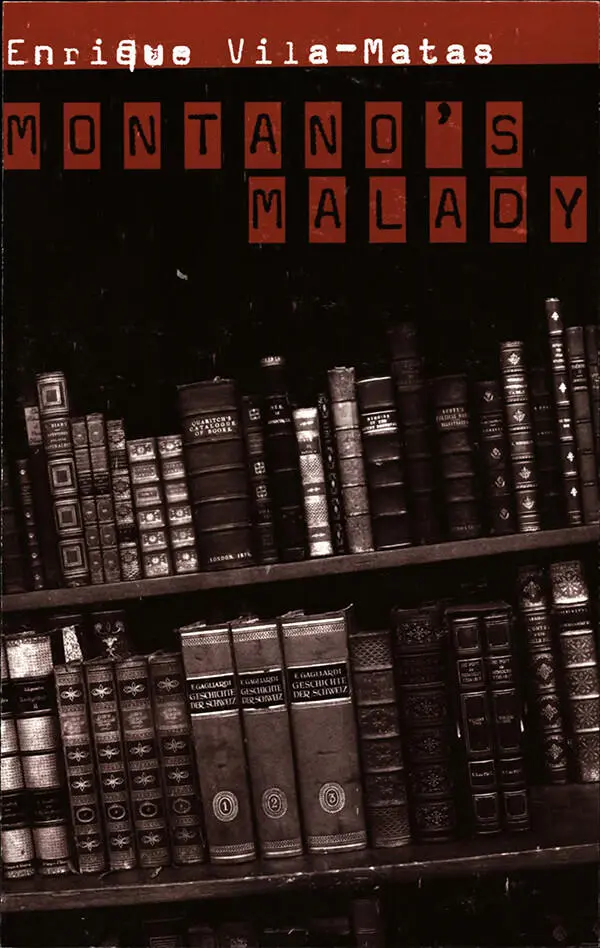
- Название:Montano's Malady
- Автор:
- Издательство:New Directions
- Жанр:
- Год:2007
- ISBN:нет данных
- Рейтинг книги:5 / 5. Голосов: 1
-
Избранное:Добавить в избранное
- Отзывы:
-
Ваша оценка:
Montano's Malady: краткое содержание, описание и аннотация
Предлагаем к чтению аннотацию, описание, краткое содержание или предисловие (зависит от того, что написал сам автор книги «Montano's Malady»). Если вы не нашли необходимую информацию о книге — напишите в комментариях, мы постараемся отыскать её.
is a writer named Jose who is so obsessed with literature that he finds it impossible to distinguish between real life and fictional reality. Part picaresque novel, part intimate diary, part memoir and philosophical musings, Enrique Vila-Matas has created a labyrinth in which writers as various as Cervantes, Sterne, Kafka, Musil, Bolano, Coetzee, and Sebald cross endlessly surprising paths. Trying to piece together his life of loss and pain, Jose leads the reader on an unsettling journey from European cities such as Nantes, Barcelona, Lisbon, Prague and Budapest to the Azores and the Chilean port of Valparaiso. Exquisitely witty and erudite, it confirms the opinion of Bernardo Axtaga that Vila-Matas is "the most important living Spanish writer."
Montano's Malady — читать онлайн бесплатно полную книгу (весь текст) целиком
Ниже представлен текст книги, разбитый по страницам. Система сохранения места последней прочитанной страницы, позволяет с удобством читать онлайн бесплатно книгу «Montano's Malady», без необходимости каждый раз заново искать на чём Вы остановились. Поставьте закладку, и сможете в любой момент перейти на страницу, на которой закончили чтение.
Интервал:
Закладка:
Laughter of (literature’s) death in the middle of paradise. I mentioned this to Tongoy as we left the house at the foot of the volcano with just enough time for the taxi to take us to catch the return ferry. But Tongoy did not reply. There was a threatening black cloud again over the channel as the ferry began to make its way toward Fayal, like someone traveling through the heart or the very soul of darkness. We took some seasickness tablets, which didn’t help at all, they merely churned up our stomachs even more, and we spent the entire journey throwing up the whiskey, beer, and, above all, Sinhalese tea. By the time we reached Fayal, we had turned into two new men. We must have looked awful, because Rosa, who had come to the small pier to fetch us, was visibly shocked. “What did you see over in Pico?” she asked. “The new man,” I replied. “It’s not every day you see the soulless man of the future, it’s not every day you see the glacial, laughable face that humanity will have on the strange tomorrow that awaits us, this man is currently hiding over in Pico and he laughs a lot.”
Rosa looked at me as if to say, “You’ve been drinking.” Tongoy, in turn, stood staring at me with real concern because of what I had just said. In the end he asked me who this new man was, because the taxi driver was very old and Teixeira was a professor of laughter therapy, lost in a large house at the world’s end. To make him understand that the new man we had seen, the amoral man of the future, was Teixeira, I mimicked his metallic, canned, and amoral laughter. Tongoy immediately realized who I was talking about and burst out laughing in such an odd way that he looked like a real wreck. It occurred to me at that moment that Rosa’s film should start like this, with Tongoy pretending to be an old whaler from the Azores, with his pointed ears and vampiric teeth, reciting some strange sentences I would write for him, reciting these strange sentences and then letting out an odd laugh, like a wreck. This laugh would be followed by the opening credits.
“Teixeira, the new man?” said Tongoy, scratching his shaved head. “Don’t make me laugh. The guy was an idiot!”
Today, seven days after that trip to Pico, Tongoy again laughs like a wreck, but this time he does it in front of the cameras. I wrote the lines with which he opens the documentary about the lost world of whalers in the Azores.
A real close-up of Tongoy, with his big, pointed ears, his shaved head, and vampiric gaze directed with a harpooner’s ferocity toward the camera; looking in silence for a few seconds until he says, “Everybody used to talk about Freud when I was young. But I never read him. Shakespeare didn’t read him either. And I don’t think Melville did. Let alone Moby-Dick.”
He laughs like a wreck, the opening credits roll.
Today I spent a good while gazing at the fuzzy silhouette of Pico’s volcano and pondering a question Canetti put to himself one day: “Will God return when his creation is destroyed?”
Anxiety everywhere. I felt trapped both by the volcano and by Canetti’s aphorism. To avoid growing more anxious with all this, I resorted to thinking about something else; I thought how quick Tongoy has been these last few days to reproach me for having grabbed the first advice he gave me in Chile to help me combat my literary illness. According to Tongoy, it would have been better to wait for more advice, because I had taken his idea of combating the death of literature too literally. According to Tongoy, it is characteristic of disoriented minds to be concerned about something as commonplace and at the same time as elastic as the death of literature.
Recalling Tongoy’s reproaches — for example, he is always reproaching me for my ever-growing obsession for transforming everything I see, systematically converting it into concepts or literary quotations, which in his opinion makes conversation often dull or unbearable — recalling the persecution Tongoy has been subjecting me to recently with his criticism, has, however, helped me to forget both of Pico’s volcano and Canetti’s aphorism, which had kept my soul in suspense. But a possibly regrettable thing has happened. I have forgotten Pico, and the aphorism, but I have not managed to take my mind off Canetti. I have not been able to forget the figure of Kien, a character in Auto-da-Fé , his only novel: a character who one day, at the time he usually gets up, dreamed of a large library standing next to the crater of a volcano that in eight minutes would start to erupt.
Needless to say, with Canetti’s return, the volcano came back — not Pico’s, but it was as if it had been — that volcano which I thought I had lost sight of. And with it, as if this were not enough — and my mind were not giving serious signs of how literature-sick I am — the memory of Montano’s story and, with this memory, that of all the mountains there are in the world, all the mountains, volcanoes included, which Josep Pla — as he explained in his exemplary diary — liked so much, mountains similarly adored by André Gide; in Montano’s story, Gide infiltrates the memory of a young Samuel Beckett, who is dining with some friends in Dublin and is suddenly surprised by this mental visit of Gide, who says, point-blank, that adoration for any mountain is characteristic of Protestantism.
“So what?” asks Beckett. “First the bones,” answers Gide, disappearing as quickly as he came into the mind of Beckett at the table, who years later, according to Montano, would write with clear reference to Gide and his unexpected visit to Dublin: “What were skull to go? As good as go.”
Having freed myself of Pla’s mountains, Gide’s bones, Protestantism, Canetti and Beckett, Kien and everybody else, including the one who might return when his creation is destroyed; having freed myself of everybody, I was nevertheless afraid of falling into the clutches of any other writer or aphorism or passage from Montano’s story, and at this point I was overcome with anxiety, I felt so stifled in reality by my literary memory that I even thought Tongoy may have been right when he warned me that I had taken my idea of combating the unliterary too far.
I felt so angst-ridden that I would have given anything — here on the island of Fayal, where I am a manuscript — to return to my childhood, to the simple days when I was fascinated by space and those starry night skies. I would have given anything to return to the days of childhood when I journeyed through the space of the infinite universe and never felt the need to interpret it, let alone to transform it into a concept or literary quotation. I would have given anything, yes. Melancholy here in Fayal, as I think about those simple days in space.
At the break of day, the air was so clear that, without the help of my binoculars, I could see the foam created by the waves that were breaking against the bow of a boat sailing in the distance. For the first time in ages, an image simply existed. As if I were suddenly cured. A moment’s joy at dawn. I felt so alive suddenly that I could have swum to the boat and got on board. The early morning sun shone, the surface of the water was a mirror.
This lunchtime Rosa, in a break from filming, came into the room to fetch something she had forgotten and found me sprawled on the sofa, sleeping beside the great map of Montano’s malady, which was lying completely unfolded next to me.
“What is that?” she asked.
I immediately came out of the pornographic dream I was having and, still half asleep, understood that she was asking me about my wet trousers, not about the map.
How many years was it since my last emission like this? I had just come in my sleep and soiled my underpants, and that is why the last thing that occurred to me was that she might be interested in the map.
Читать дальшеИнтервал:
Закладка:
Похожие книги на «Montano's Malady»
Представляем Вашему вниманию похожие книги на «Montano's Malady» списком для выбора. Мы отобрали схожую по названию и смыслу литературу в надежде предоставить читателям больше вариантов отыскать новые, интересные, ещё непрочитанные произведения.



Обсуждение, отзывы о книге «Montano's Malady» и просто собственные мнения читателей. Оставьте ваши комментарии, напишите, что Вы думаете о произведении, его смысле или главных героях. Укажите что конкретно понравилось, а что нет, и почему Вы так считаете.