Enrique Vila-Matas - Montano's Malady
Здесь есть возможность читать онлайн «Enrique Vila-Matas - Montano's Malady» весь текст электронной книги совершенно бесплатно (целиком полную версию без сокращений). В некоторых случаях можно слушать аудио, скачать через торрент в формате fb2 и присутствует краткое содержание. Год выпуска: 2007, Издательство: New Directions, Жанр: Современная проза, на английском языке. Описание произведения, (предисловие) а так же отзывы посетителей доступны на портале библиотеки ЛибКат.
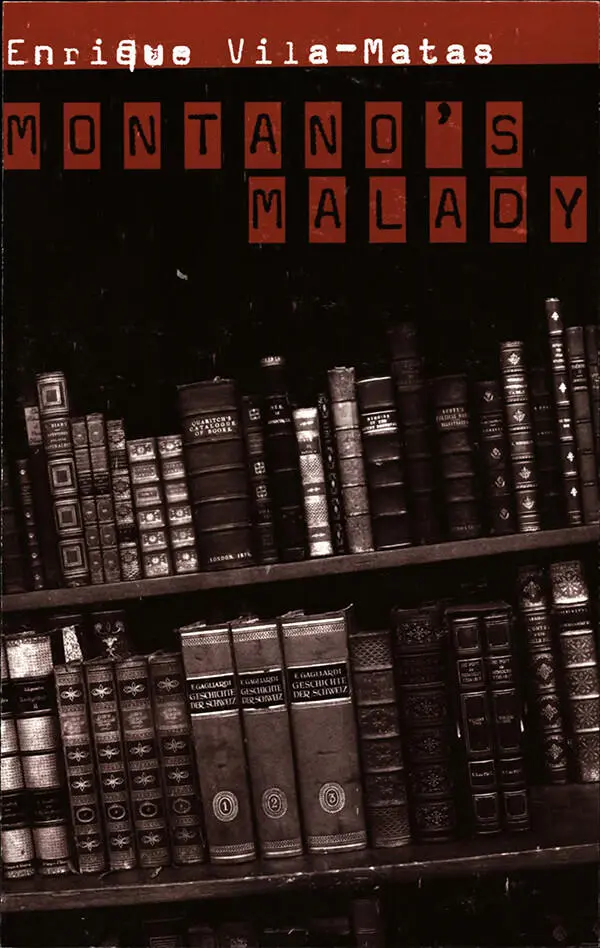
- Название:Montano's Malady
- Автор:
- Издательство:New Directions
- Жанр:
- Год:2007
- ISBN:нет данных
- Рейтинг книги:5 / 5. Голосов: 1
-
Избранное:Добавить в избранное
- Отзывы:
-
Ваша оценка:
Montano's Malady: краткое содержание, описание и аннотация
Предлагаем к чтению аннотацию, описание, краткое содержание или предисловие (зависит от того, что написал сам автор книги «Montano's Malady»). Если вы не нашли необходимую информацию о книге — напишите в комментариях, мы постараемся отыскать её.
is a writer named Jose who is so obsessed with literature that he finds it impossible to distinguish between real life and fictional reality. Part picaresque novel, part intimate diary, part memoir and philosophical musings, Enrique Vila-Matas has created a labyrinth in which writers as various as Cervantes, Sterne, Kafka, Musil, Bolano, Coetzee, and Sebald cross endlessly surprising paths. Trying to piece together his life of loss and pain, Jose leads the reader on an unsettling journey from European cities such as Nantes, Barcelona, Lisbon, Prague and Budapest to the Azores and the Chilean port of Valparaiso. Exquisitely witty and erudite, it confirms the opinion of Bernardo Axtaga that Vila-Matas is "the most important living Spanish writer."
Montano's Malady — читать онлайн бесплатно полную книгу (весь текст) целиком
Ниже представлен текст книги, разбитый по страницам. Система сохранения места последней прочитанной страницы, позволяет с удобством читать онлайн бесплатно книгу «Montano's Malady», без необходимости каждый раз заново искать на чём Вы остановились. Поставьте закладку, и сможете в любой момент перейти на страницу, на которой закончили чтение.
Интервал:
Закладка:
DALÍ, SALVADOR (Figueres, 1904–1989). An infinitely better writer than painter. When I was very young, I used to have a great time in Cadaqués reading Diary of a Genius a few steps away from his house. I knew some of its passages by heart and would recite them in gatherings with friends, I remembered passages like this one: “How can I doubt that everything that happens to me is enormously exceptional?” I liked this excerpt very much, because in it he was laughing at the diaries of writers with mediocre experiences. “Today I received the visit of three perfectly stupid Swedes.” I write this sentence down from memory, because I didn’t manage to find it in my copy of Diary of a Genius . Might I have invented it? If so, I beg the Swedes’ pardon.
From this diary I also recall a reference to an illness of the stomach and bowels which he considered heaven-sent: “Bravo! This illness is a gift from God! I wasn’t ready yet. I wasn’t worthy yet to undertake the bowels and thorax of my Corpus Hypercubicus .”
This vision of illness as something particularly positive and heaven-sent reminds me a lot of what happened in Nantes when I arrived in this city out of sorts, sick in soul, though with my hopes pinned on the Vaché factor, and very soon my evil was turned to good. But I shall deal with this in GIDE, ANDRÉ (Paris, 1869–1951), the next entry in this dictionary.
To tell the truth, I prefer the diary that Dalí wrote as a young man and which was published recently in Catalonia. These adolescent pages are superior to Diary of a Genius , they are more spontaneous, and the permanent display of talent is less forced.
An hour ago, I called the poet Pere Gimferrer to ask him which of Dalí’s two diaries he likes more: “Why do you want to know?” Gimferrer, who always wants to know everything, asked me. “I don’t know if I want to know,” I told him, “really I called you so that you would appear in the diary I’m writing, which has turned into a novel and dictionary and looks less and less like a diary, especially since I started talking about things from the past, maybe that’s why I rang you, perhaps to have something to relate that occurred today, that happened this Thursday in real life, I need a bit of the present.”
Short silence at the other end of the line.
“If you want,” Gimferrer suddenly spoke, “I’ll tell you what for me most defines and distinguishes a writer’s diary.” “Excellent idea,” I replied. “What defines and distinguishes it,” he told me, “is the perspective it adopts, the tone or timbre of voice, and therefore the moral existence of the individual writing.”
“I understand you, I understand you very well,” I told him. Renewed silence. “Do you want to add something else?” I asked. “Don’t forget,” he told me, “that a diary’s real substance is not external events, but the author’s moral evolution.”
“Thanks, Pere,” I replied. “Thank you, now I can include some daily life in the diary, thanks a lot.”
“No problem. La vie est belle ,” the poet said. And hung up.
GIDE, ANDRÉ (Paris, 1869–1951). In an unintentional way, this writer’s diary tells the story of someone who spent his life seeking to write a masterpiece and did not achieve it. Or perhaps he did achieve it, and paradoxically that great book would be the diary in which he reflected the daily search for that masterpiece.
With the possible exception of Paludes —a short work of genius, which could have been written by Queneau — the rest of what Gide wrote is fairly illegible nowadays, the modern reader sees it as something strange, archaic, distant. The diary, on the other hand, though it falls short of the masterpieces of Proust and his contemporaries, is today a literary milestone, one of the great writers’ diaries that exists, it is a pleasure to read, most of all because it is connected with a highly intelligent tone or timbre of voice and because it presents, with all its light and shade and going beyond this—“the excellent and the worst. Too easy, ah! not to see more than the one or the other”—the fascinating complexity that can arise in the soul of a man seeking to find an end to the search, to the spirit’s agitation.
Unlike so many mediocre diarists who tediously hand out their notebooks as if they were the parish newsletter, Gide is always a set of essential newsletters, he never confuses literature with literary life. It is also possible to read the pages of his diary like a novel — Gide transformed the genre, he was a pioneer in the use of the fictitious diary — which recounts, over a period of no less than sixty-three years, the intimate and spiritual path of a man who throughout his life inquired into the premise that upholds the principle of morality, although he also inquired into that which upholds the principle of immorality.
I have always noted his sympathy for illnesses, I think he saw in them the starting point for feverish creative activity. “I believe that illnesses,” he writes in his diary, February 6, 1944, “are keys that can unlock certain doors for us. There is a state of good health that does not allow us to understand it all […]. I have yet to meet someone who boasts that he has never been ill who is not also a bit stupid; the same as someone who takes pride in having never traveled.”
I arrived in the city of Nantes, literature-sick and tragically unable to write, one rainy day in the month of November last year. I arrived out of sorts on account of my literary block and, to make matters worse, I sought even more reasons to feel bad and worried. I told myself, for example, that I had been a thief of other people’s words too often, that frequently I acted as a parasite on the writers I most admired. Hence it might be said that there were three essential dramas I was carrying when I arrived in Nantes: I was sick with Montano’s malady — still without knowing that this was the name of my complaint — tragically unable to write, and a literary parasite.
I was met at Nantes Airport by Yves Douet and Patrice Viart, the organizers of the Rencontres , and they took me to the Hôtel La Perouse, where I drank seven vodkas in the bar in animated conversation with them — the main topic being Makelele, a soccer player who used to play for Nantes. At around five o’clock, I indicated my intention to sleep until the following day, and they politely withdrew. “See you tomorrow,” they said, fairly impressed, I think, by the number of vodkas I had consumed.
It was my intention to take my leave of the world until the following day, but an hour later I had already changed my mind and felt a huge desire to go for a walk around Nantes. So, taking hold of the red umbrella that Rosa had put in my suitcase at the last minute, I headed towards the Quai de la Fosse; I walked calmly along the streets of the city of Jacques Vaché and Jules Verne, I walked whistling the Barbara song about the rain in Nantes and came to a halt in front of the old bookshop Coiffard’s.
I was so literature-sick that, looking in the bookshop window, I saw myself reflected in the glass and thought that I was a poor child out of Dickens in front of the window of a bakery. Shortly afterward, this child turned into the man without qualities from Musil’s novel, that idealistic mathematician who would contemplate the streets of his city and, watch in hand, time the cars, carriages, trams, and silhouettes of pedestrians blurred by the distance. This man would measure the speeds, angles, magnetic forces of the fugitive masses….
There at the door of Coiffard’s, just like the man without qualities , I ended up laughing as he laughed in Musil’s novel and recognizing that the devotion to that kind of eccentric espionage was of a supreme folly, “the titanic effort of a modern individual who doesn’t do anything.”
Читать дальшеИнтервал:
Закладка:
Похожие книги на «Montano's Malady»
Представляем Вашему вниманию похожие книги на «Montano's Malady» списком для выбора. Мы отобрали схожую по названию и смыслу литературу в надежде предоставить читателям больше вариантов отыскать новые, интересные, ещё непрочитанные произведения.




Обсуждение, отзывы о книге «Montano's Malady» и просто собственные мнения читателей. Оставьте ваши комментарии, напишите, что Вы думаете о произведении, его смысле или главных героях. Укажите что конкретно понравилось, а что нет, и почему Вы так считаете.