Enrique Vila-Matas - Montano's Malady
Здесь есть возможность читать онлайн «Enrique Vila-Matas - Montano's Malady» весь текст электронной книги совершенно бесплатно (целиком полную версию без сокращений). В некоторых случаях можно слушать аудио, скачать через торрент в формате fb2 и присутствует краткое содержание. Год выпуска: 2007, Издательство: New Directions, Жанр: Современная проза, на английском языке. Описание произведения, (предисловие) а так же отзывы посетителей доступны на портале библиотеки ЛибКат.
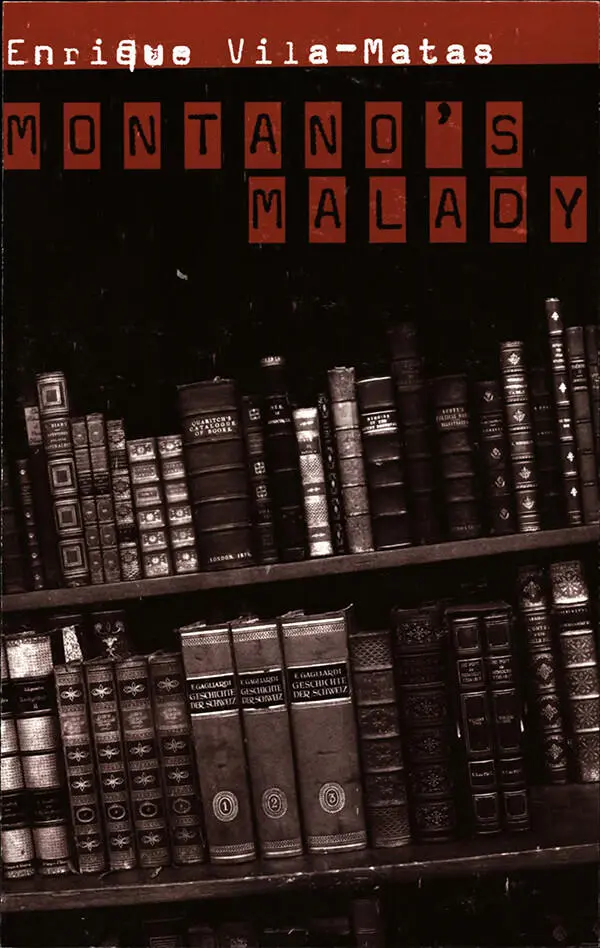
- Название:Montano's Malady
- Автор:
- Издательство:New Directions
- Жанр:
- Год:2007
- ISBN:нет данных
- Рейтинг книги:5 / 5. Голосов: 1
-
Избранное:Добавить в избранное
- Отзывы:
-
Ваша оценка:
Montano's Malady: краткое содержание, описание и аннотация
Предлагаем к чтению аннотацию, описание, краткое содержание или предисловие (зависит от того, что написал сам автор книги «Montano's Malady»). Если вы не нашли необходимую информацию о книге — напишите в комментариях, мы постараемся отыскать её.
is a writer named Jose who is so obsessed with literature that he finds it impossible to distinguish between real life and fictional reality. Part picaresque novel, part intimate diary, part memoir and philosophical musings, Enrique Vila-Matas has created a labyrinth in which writers as various as Cervantes, Sterne, Kafka, Musil, Bolano, Coetzee, and Sebald cross endlessly surprising paths. Trying to piece together his life of loss and pain, Jose leads the reader on an unsettling journey from European cities such as Nantes, Barcelona, Lisbon, Prague and Budapest to the Azores and the Chilean port of Valparaiso. Exquisitely witty and erudite, it confirms the opinion of Bernardo Axtaga that Vila-Matas is "the most important living Spanish writer."
Montano's Malady — читать онлайн бесплатно полную книгу (весь текст) целиком
Ниже представлен текст книги, разбитый по страницам. Система сохранения места последней прочитанной страницы, позволяет с удобством читать онлайн бесплатно книгу «Montano's Malady», без необходимости каждый раз заново искать на чём Вы остановились. Поставьте закладку, и сможете в любой момент перейти на страницу, на которой закончили чтение.
Интервал:
Закладка:
Some of her poems from the 1970s recall those of Alejandra Pizarnik — sheer coincidence, I believe — who was fourteen years her senior and whom she spotted one afternoon in the Taita, a bar in Barcelona, one afternoon in October 1969, an event that my mother described in her diary: “Today I saw that tiny Argentinian poet, who appears tormented, she was with some posh children from the Calvo Sotelo district….”
Some of her poems could have been by Pizarnik herself, as, for example, some verses my mother wrote in the afternoon of July 27, 1977: “To live free. / In the lamps of night, / in the center of the void, in the open darkness, / in the shadows the blackness and me. / To live free. / Leaning on the grave, / lost me, / in the sole light of the son.”
What does she mean by “sole light of the son”? Judging by what it says in the diary, I was the only person in this world who motivated her to live, she felt obliged not to kill herself and to help me as much as she could. She felt real compassion for me and some regret for having given birth to me. This compassion of hers is another of the recurring themes in her secret notebooks. Compassion drove her to make plans and to decide that, when I was older, were I to show a tendency toward writing, she had to channel it towards a literary activity that was not negative, that was not affected by her negative spirit. This led her to plan for me a kind of writing aimed exclusively, as far as I was concerned, at the elaboration of a personal myth.
Throughout her diary there is a surprising amount of verbal violence, surprising in someone like her, who never raised her voice and was, like many depressed people, a peaceable, very calm person. But in the diary she was terrible, destructive when talking about people. She loathed almost everybody, except Margot Valerí, a supposed friend of hers, an imaginary woman who happens to be an old Chilean aviator, perhaps her alter ego, a woman who did not exist and to whom she dedicates this short, strange poem: “Time 07:15, / direction 243°, / 7,000 feet. / Fog. / You and I are Emily. / Dickinson. / White housecoat and sad dog. / High climate and a goal at the summit. / The spirit’s salvation.”
Her verbal violence is surprising, but it should not be so surprising. After all, in private journals one is not merely talking to oneself, one is also conversing with others: all the conversations that we can never conduct in real life, because they would descend into outbursts of violence, get deposited in the diary.
When I think about it, I can see that my mother reserved her madness exclusively for her diary. She led a double life: model housewife and at the same time seriously disturbed woman whenever she wrote. Whereas Georges Bataille said that he wrote so as not to go mad, it could be said of my mother that, being a sensible person in real life, she went mad whenever she wrote.
Her writing is linked to the Secret, it is possible that she only understood literature linked to this idea of the Secret. This would explain why, when I began to publish under the name Rosario Girondo, my mother gave it no importance. Perhaps to her my writing, being neither private nor secret, was not exactly writing, perhaps she considered my writing only as a distant relation of what she understood to be real literature (always linked in her mind to the Secret): “Spanish poets today, / sad, sad, / distant relations / of what one day was real.”
The first Friday of each month, she would imagine a suicide and turn it into a poem, like this one dated Friday, October 2, 1953: “Today would be perfect / a mad dash toward the balcony, / a terrible jump into the void, / to splinter the wood in this coal-house / on Provença Street, / the jump into the void, / flinging myself from the sixth floor, / with the indifference of a bucket / of dirty, dirty water / emptied by a housewife.”
We lived on Sant Joan Avenue — later in Rovira Square — but my mother speaks in the poem of a house on Provença Street, possibly a deliberate mistake obeying her secret desire for a change of address, to which I would add a change of husband. While the poem is extravagant, even more so is the way in which she brought it to a close, something she explains in the diary three days later, when she says that the Siamese cat — as imaginary as Margot Valerí—interrupted the poem with her paw, at which point she decided it was finished and, what’s more, considered that the cat had written it.
When my first novel appeared, a pedantic exercise in style entitled Errant Necropolis , my mother simply remarked that she would have given it the title Theory of Budapest . And when I asked her why it had to have this title, given that my novel contained no theory whatsoever and made no mention of the city of Budapest, my mother smiled and replied that this was why it had to have that tide, precisely because it contained no theories and Budapest was not in it.
Years later, when I read her diary, in the second of her square notebooks I came across a lengthy essay written in 1956 and entitled “Theory of Budapest,” in which she lucidly disserted on the practice of writing private journals, but made no mention of Budapest, a city that, because of the bloody Hungarian national uprising, was frequently referred to in newspapers in the summer of 1956, when she wrote her “Theory,” which might explain why the Hungarian capital appeared in the tide of her essay.
My mother. Ever fragile and living in married hell, at times lost among barbiturates, dreaming of trains that would run her down, silent and long-suffering enemy of my father, whom, however, she needed if she was to write the diary, as becomes clear in “Theory of Budapest,” where she rails mercilessly against him and against the noisy staircase in the building on Barcelona’s Sant Joan Avenue, and against the daily horror, in short, against this, that, and everything. And says that she is not happy, but nor does she particularly want to be, since then she would have nothing to write about in her precious diary.
The “Theory” contains some of the best writing in her square notebooks, but the last line in her diary, the last of all, deserves to be framed, as I have done in my own home. Written three days before her death, when my mother knew that she had only a few days of life left, this last line obsessively — as if she were looking at the old school exercise book where she had learned neat penmanship — repeats a verse by Oliverio Girondo, the avant-garde poet whom she considered a distant relation, I do not know if in relation to real literature as well.
This verse by the avant-garde poet — which she had found within a poem by Félix de Azúa — this verse — repeated ad infinitum at the end of her diary, repeated in beautiful handwriting about thirty times, by way of bringing her square notebooks to an unsettling close — this verse — written obsessively at the end of her diary, as if my mother wished through so much repetition to sum up what had been the repetitive daily hell of her life: a circular, reiterative and unbearable hell — this verse by the avant-garde poet, a verse my mother wished to repeat so many times at the close of the great disaster that had been her life — and it was as if finally by repeating it she were lamenting having reached the dying moments of her life’s delirium without the prized, and at times indirectly announced, suicide — in short this once-avant-garde verse said as follows:
What’s the use of Pentothal.
“THEORY OF BUDAPEST” (EXTRACT)
Solitude this August afternoon, anxiety controlled by poison, Pentothal for the lukewarm, dead horizon. It’s been more than an hour since I started writing this Theory, I feel the time has come for a short rest and I give way to delirium.
Читать дальшеИнтервал:
Закладка:
Похожие книги на «Montano's Malady»
Представляем Вашему вниманию похожие книги на «Montano's Malady» списком для выбора. Мы отобрали схожую по названию и смыслу литературу в надежде предоставить читателям больше вариантов отыскать новые, интересные, ещё непрочитанные произведения.




Обсуждение, отзывы о книге «Montano's Malady» и просто собственные мнения читателей. Оставьте ваши комментарии, напишите, что Вы думаете о произведении, его смысле или главных героях. Укажите что конкретно понравилось, а что нет, и почему Вы так считаете.