Alan Moore - Jerusalem
Здесь есть возможность читать онлайн «Alan Moore - Jerusalem» весь текст электронной книги совершенно бесплатно (целиком полную версию без сокращений). В некоторых случаях можно слушать аудио, скачать через торрент в формате fb2 и присутствует краткое содержание. Год выпуска: 2016, Издательство: Liveright Publishing Corporation, Жанр: Современная проза, на английском языке. Описание произведения, (предисловие) а так же отзывы посетителей доступны на портале библиотеки ЛибКат.
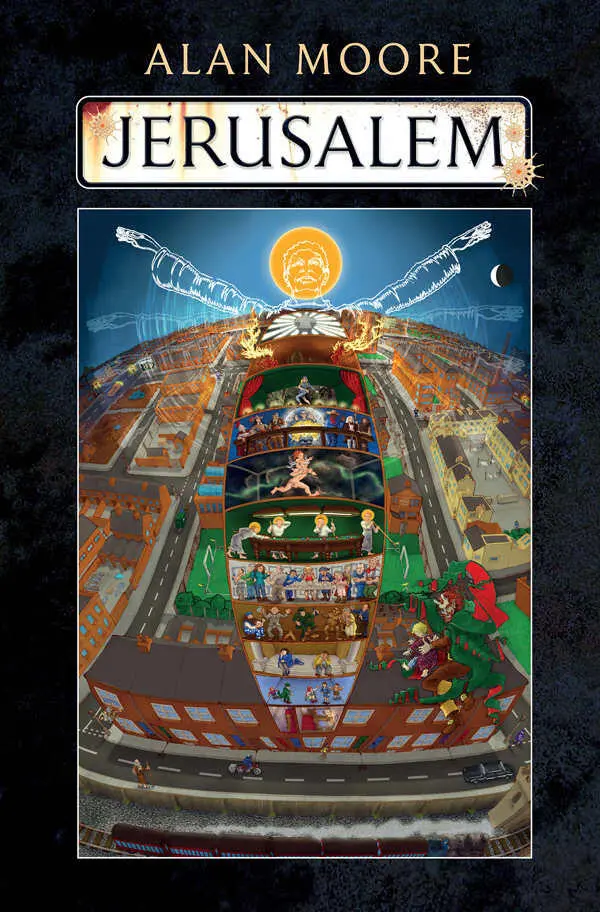
- Название:Jerusalem
- Автор:
- Издательство:Liveright Publishing Corporation
- Жанр:
- Год:2016
- ISBN:нет данных
- Рейтинг книги:4 / 5. Голосов: 1
-
Избранное:Добавить в избранное
- Отзывы:
-
Ваша оценка:
Jerusalem: краткое содержание, описание и аннотация
Предлагаем к чтению аннотацию, описание, краткое содержание или предисловие (зависит от того, что написал сам автор книги «Jerusalem»). Если вы не нашли необходимую информацию о книге — напишите в комментариях, мы постараемся отыскать её.
Disappeared lanes yield their own voices, built from lost words and forgotten dialect, to speak their broken legends and recount their startling genealogies, family histories of shame and madness and the marvellous. There is a conversation in the thunderstruck dome of St. Paul’s cathedral, childbirth on the cobblestones of Lambeth Walk, an estranged couple sitting all night on the cold steps of a Gothic church-front, and an infant choking on a cough drop for eleven chapters. An art exhibition is in preparation, and above the world a naked old man and a beautiful dead baby race along the Attics of the Breath towards the heat death of the universe.
An opulent mythology for those without a pot to piss in, through the labyrinthine streets and pages of Jerusalem tread ghosts that sing of wealth and poverty; of Africa, and hymns, and our threadbare millennium. They discuss English as a visionary language from John Bunyan to James Joyce, hold forth on the illusion of mortality post-Einstein, and insist upon the meanest slum as Blake’s eternal holy city. Fierce in its imagining and stupefying in its scope, this is the tale of everything, told from a vanished gutter.
Jerusalem — читать онлайн бесплатно полную книгу (весь текст) целиком
Ниже представлен текст книги, разбитый по страницам. Система сохранения места последней прочитанной страницы, позволяет с удобством читать онлайн бесплатно книгу «Jerusalem», без необходимости каждый раз заново искать на чём Вы остановились. Поставьте закладку, и сможете в любой момент перейти на страницу, на которой закончили чтение.
Интервал:
Закладка:
The nearest Alma can come to conceiving this sole motionless spectator of an ultimate reality is the stone angel that’s atop the Guildhall, somewhere to her rear as she strides up across the marketplace towards its northwest corner. The archangel Michael, hopelessly mixed up with Michael, patron saint of corporations, standing with his shield and snooker cue above the town, hearing its every thought yet never opening those birdshit-spattered lips to voice a warning or betray a confidence. Aware of several deaths and several hundred copulations every hour, knowing which of a hundred billion sperm will hit the mark, will end up as a nurse, a rapist, a social reformer or an accident statistic; end up going through divorce, a bankruptcy, a windscreen. Fully cognisant of every Starburst wrapper, every dog turd, every atom, every quark; knows if Gerard ’t Hooft’s equations of an underlying state beneath the charm and strangeness will turn out to be correct or not; knows if Benedict Perrit will be coming to her opening tomorrow. Every fact and fancy, everything reflected perfectly, exquisitely, upon the dull stone brow. This entire universe, including Alma and her current musings, caught in a synaptic shimmer of the gelid and impartial granite mind.
Halfway across the emptying market, it occurs to her that she is walking through the blossoming iron phantom of the monument, the empty spot where once it stood upon its stepped stone base. Perhaps she even transects an eight-year-old self sat risking piles on the cold pedestal, examining her knees where they extend beyond the pleated hem of her thin navy skirt. The vague, ungathered wool of memory that fills the square is spun into specific strands of yarn upon the monument’s ghost-spindle. Shiny, rain-licked cobbles emerge briefly through the pink replacement paving and the empty wooden outlines of each stall are coloured in, filled with dead traders and their long-since perished merchandise. A trestle of unbranded sweets, cartoon confectionery even then unseen outside the pages of The Beano , all presided over by a man with heavy black Italian eyebrows and a starched white coat. The stand of comics and used paperbacks that she still sometimes dreams about, Sid’s, its proprietor in cap and gloves and muffler, breath and pipe-smoke hanging in the winter air and all around a gaudy flowerbed of Adventure Comics and Forbidden Worlds held down by flat, round iron paperweights, Mad magazine or True Adventure with its Nazi temptresses and whipped G.I.s, hanging from bulldog-clips along a spring-like wire connected to the bookstall’s upper reaches, just below the green-and-white stripes of its canopy. In the pre-Christmas dark the huddled pitches look like painted paper lanterns from above, the white glare of the storm lamps sieved through coloured canvas. Glowing cigarette ends hover in the black. Magnificent and evanescent, the Emporium Arcade flares on her right, alight with toys and knitting patterns, before once again subsiding to a blank and stone-clad modern wall, the grand wrought-iron Victoriana of its entrance melting to a brutal concrete underpass where teenagers kicked an Albanian man to death a year or two ago.
As she is heading from the open corner of the marketplace towards the indeterminate point where the Drapery meets Sheep Street, Alma glances downhill to her left and notices the Halifax Building Society’s confident frontage on the corner of Drum Lane. Caught in the floss of other times, Alma can still see Alfred Preedy’s paper shop that occupied the premises forty or fifty years before, the place she’d had the dream about when she was five, the hooded foreman and his midnight crew of carpenters that she’d attempted to describe with Work in Progress . Was the job completed to its schedule, or is it still going on, she wonders, somewhere in the dreams of children? A fragmentary idea comes to her, something about the planed wooden boards of the nocturnal workers representing lengths of time or sets of linked events, with every human life a nail, her and her brother Warry, Tony Blair, Keogh and O’Connor, everyone she knows and everyone she doesn’t know, hammered into being by their parents’ coital rhythms, bang, bang, bang, immovably embedded in the hard grain of eternity, so that –
Her train of thought is interrupted by a genial young fellow in a baseball cap and trainers that are better-looking than her own. All that he wants to do is shake her hand and tell her that her work’s amazing while apologising for approaching her, which makes her feel all warm and motherly. Just as she’s saying goodbye to him, one of the remaining traders on the market square behind her calls out, “Me too! Well done, Alma!” giving her a brief round of applause. She beams and waves. Sometimes this is all like a dream, too pleasant, a reality suspiciously benevolent to Alma Warren. There are times when she suspects it’s all some ludicrously vain and self-regarding compensatory fantasy she’s dreaming in some other, less auspicious life. Perhaps she’s really sitting, heavily sedated, in a pool of her own piss at an asylum somewhere, or maybe she’s in a coma in the 1970s after she drank so much that she stopped breathing at her twentieth birthday party. It occurs to her that her unusually enjoyable existence might be some hallucination happening in the stretched-out instant of her death, a vision of the life she might have had. Who knows? Perhaps she never really cleared that alley full of rusted junk, back when she was eleven.
She passes between the Abbey National’s Drapery Branch and the majestic colonnaded front of the old Corn Exchange, its chiselled steps ascending into what had once been the town’s other major cinema, called variously the Gaumont and the Odeon. Here she’d been forced to watch The Sound of Music three times with her mum Doreen, which she considered to be technically a form of child abuse. She’d been stood up twice, waiting on the cold steps for some acne-stippled tossrag who’d quite evidently only asked her out when dared to by his mates. She’d also come here several years before her teenage trials, when she had been a member of the Gaumont Boys and Girls club. Every Saturday they’d be let in for sixpence and would then be led by an enthusiastic adult, Uncle Something, in the singing of peculiar old songs like “Clementine”, “The British Grenadiers” or “Men of Harlech in the Hollow” before they were allowed to watch a short cartoon, a Children’s Film Foundation main show that would frequently involve an island, schoolboys and a foreign saboteur, then finally one episode from an ongoing eight-week serial, King of the Rocket Men or an old black-and-white Batman and Robin where the couple drove around in a completely ordinary 1940s car and Robin pushed his cardboard mask up on his forehead while conversing with his costumed pal in public. The main entertainment had been crawling under people’s legs along the rows of seats, or deftly flicking an ice-lolly stick to maybe blind a seven-year-old stranger several rows in front.
These days, of course, the building is another theme pub, a Hard Rock Café, and the town’s major cinema is a bog-standard multiplex at Sixfields, out past Jimmy’s End and a car-ride away. There’s almost a conceptualist brilliance to it all: turn all the cinemas to pubs, get everybody ruinously pissed and then make sure that there’s no outlet for the spasms of imagination, fury or libido, nothing to drain off the clumsy fantasies that bob up to the surface of a seventh pint of Wifebeater. The simple-minded plotlines, absent motivation and pointless momentum of the cancelled celluloid will back up and spill out into the Saturday night streets. Before long you’ll have fascinating pieces of pure verité on every corner, budget Tarantino stabbings with assailants who hold their knives sideways and debate pop-culture trivia while giving you a Chelsea smile. The Oscars will be going to a flock of scattering shadows on CCTV.
Читать дальшеИнтервал:
Закладка:
Похожие книги на «Jerusalem»
Представляем Вашему вниманию похожие книги на «Jerusalem» списком для выбора. Мы отобрали схожую по названию и смыслу литературу в надежде предоставить читателям больше вариантов отыскать новые, интересные, ещё непрочитанные произведения.






Обсуждение, отзывы о книге «Jerusalem» и просто собственные мнения читателей. Оставьте ваши комментарии, напишите, что Вы думаете о произведении, его смысле или главных героях. Укажите что конкретно понравилось, а что нет, и почему Вы так считаете.