Alan Moore - Jerusalem
Здесь есть возможность читать онлайн «Alan Moore - Jerusalem» весь текст электронной книги совершенно бесплатно (целиком полную версию без сокращений). В некоторых случаях можно слушать аудио, скачать через торрент в формате fb2 и присутствует краткое содержание. Год выпуска: 2016, Издательство: Liveright Publishing Corporation, Жанр: Современная проза, на английском языке. Описание произведения, (предисловие) а так же отзывы посетителей доступны на портале библиотеки ЛибКат.
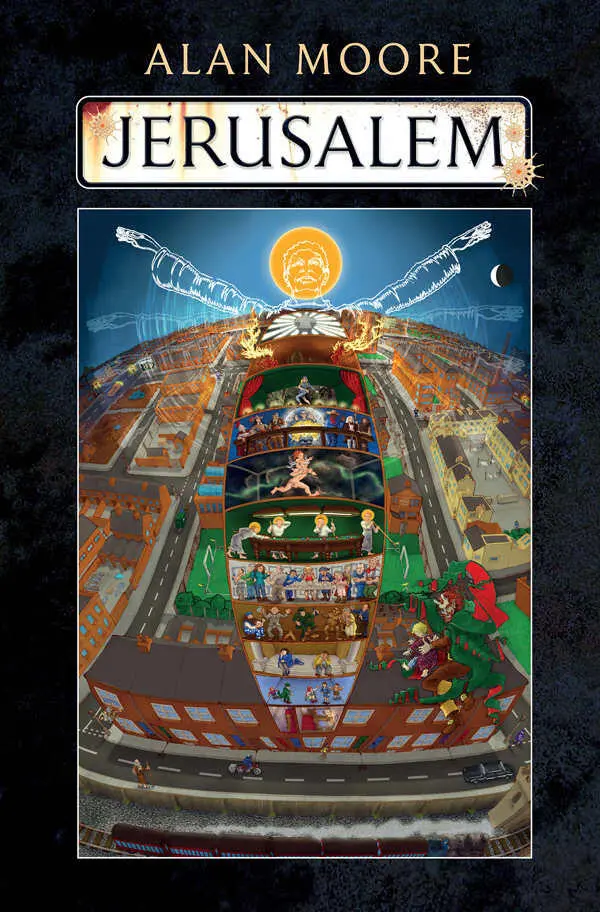
- Название:Jerusalem
- Автор:
- Издательство:Liveright Publishing Corporation
- Жанр:
- Год:2016
- ISBN:нет данных
- Рейтинг книги:4 / 5. Голосов: 1
-
Избранное:Добавить в избранное
- Отзывы:
-
Ваша оценка:
Jerusalem: краткое содержание, описание и аннотация
Предлагаем к чтению аннотацию, описание, краткое содержание или предисловие (зависит от того, что написал сам автор книги «Jerusalem»). Если вы не нашли необходимую информацию о книге — напишите в комментариях, мы постараемся отыскать её.
Disappeared lanes yield their own voices, built from lost words and forgotten dialect, to speak their broken legends and recount their startling genealogies, family histories of shame and madness and the marvellous. There is a conversation in the thunderstruck dome of St. Paul’s cathedral, childbirth on the cobblestones of Lambeth Walk, an estranged couple sitting all night on the cold steps of a Gothic church-front, and an infant choking on a cough drop for eleven chapters. An art exhibition is in preparation, and above the world a naked old man and a beautiful dead baby race along the Attics of the Breath towards the heat death of the universe.
An opulent mythology for those without a pot to piss in, through the labyrinthine streets and pages of Jerusalem tread ghosts that sing of wealth and poverty; of Africa, and hymns, and our threadbare millennium. They discuss English as a visionary language from John Bunyan to James Joyce, hold forth on the illusion of mortality post-Einstein, and insist upon the meanest slum as Blake’s eternal holy city. Fierce in its imagining and stupefying in its scope, this is the tale of everything, told from a vanished gutter.
Jerusalem — читать онлайн бесплатно полную книгу (весь текст) целиком
Ниже представлен текст книги, разбитый по страницам. Система сохранения места последней прочитанной страницы, позволяет с удобством читать онлайн бесплатно книгу «Jerusalem», без необходимости каждый раз заново искать на чём Вы остановились. Поставьте закладку, и сможете в любой момент перейти на страницу, на которой закончили чтение.
Интервал:
Закладка:
Exiting the bank she nips next door into the premises of Martin’s, the newsagents, so that she can stock up on essentials: Rizla papers, fags, Swan matches, magazines. She pulls the latest issues of New Scientist and Private Eye down from their upper shelves, wondering if their placement might be part of an entirely sensible campaign to make sure that only the tall receive appropriate intellectual stimulation. One day soon, when she and her kind have grown smart enough to formulate a foolproof plan, then Stephen Fry will give the signal and they’ll all rise up and massacre the short-arse numbskulls in their beds. Something like that, at any rate. Let a girl have her daydreams.
Alma takes the two mags to the till where genial, bullet-headed Tony Martin and long-suffering wife Shirley have already got her forty Silk Cut Silver, five packs of green Rizla papers and two boxes of Swan matches waiting for her. Tony shakes his shaved dome ruefully while ringing up the Rizlas.
“Alma, honestly! All o’ these Rizla papers! Surely you must ‘ave got that scale model of the Eiffel Tower completed ages ago? What’s the matter with yer?”
Shirley looks up from re-stocking shelves and tells her husband to shut up and not to be so rude, but Alma’s grinning.
“Yeah, I did, but I got bored with it and started on a model of the Vatican. Now, are you going to ring those up, or shall I get my matchstick Pope to excommunicate you?”
It’s a running joke between them. Years ago someone who worked behind the counter had asked Alma why she bought so many Rizla papers, to which Alma had replied with a deadpan expression and without a beat that she was building a scale model of the Eiffel Tower out of the flimsy, gum-edged leaves. While this had only been a gag she’d found it an appealing one, an idea she could get a bit of mileage out of. Well, more than a bit as it turned out. She sees ideas much as a farmer sees his pigs, and doesn’t even want to waste the squeal if she can help it.
With her purchases inside a flimsy plastic carrier-bag, the national flower, she waves a clattering metallic goodbye to the Martins and steps back out of the shop into the wide pink precinct. She continues her descent of Abington Street, calling in at Marks & Spencer’s to pick up some bits and pieces for her evening meal: a couple of long demon-tongue Ramiros peppers, cranberry and orange stuffing, and some feta cheese. She navigates a designated path between the open-plan departments, overlooked by Myleene Klass and a still-lovely Twiggy. Alma never feels entirely comfortable in the conspicuously poncey store, but, having recently boycotted Sainsbury’s, lacks for a convenient alternative.
The Sainsbury’s episode still makes her smile, though it’s the ghastly smile of something that one really should have killed but only wounded. She had been emerging from the Grosvenor Centre branch of Sainsbury’s, where she knew most of the ladies at the tills by name, laden down by two bulging store-brand bags-for-life filled with her purchases. A uniformed security guard, shrewdly noticing the lizard-green-with-watermelon-pink-interior hoodie that she happened to be wearing, had deduced she was therefore a member of the underclass (which, emotionally at least, she was) and stepped to block her path, demanding to see Alma’s till receipt. Towering above the relatively pint-sized individual she had craned her neck, lowering her massive head to his eye-level as if talking to a woefully underachieving eight-year-old. Explaining that she wasn’t in the habit of collecting till receipts, Alma had asked if this was some new policy of random stop-and-search, or if he’d had some other reason for selecting her amongst the dozen or so more conventional-looking shoppers who were then emerging from the supermarket. Looking more and more uncertain by the moment, the guard had then pointlessly requested that she show him what was in her Sainsbury’s shopping bags, perhaps suspecting somehow that they’d prove to contain shopping that had come from Sainsbury’s.
She had repeated her inquiry, leaving an exaggerated gap between each word so that he had the time to fully comprehend one syllable before being required to struggle with the next. “Why … did … you … stop … me … specifically?” By this point other customers were nervously approaching and protesting Alma’s innocence, looking more worried for the clearly-new employee, understandably, than they were for the famously belligerent giantess. Attempting to salvage a sense of his authority in this deteriorating situation, the guard had said that Alma must keep her receipts. Alma had duly noted this new Sainsbury’s policy but had explained that since she wouldn’t be returning to the store, it wasn’t really going to affect her. Smiling anxiously as she’d begun to walk away, he’d called out a reminder to hang on to her receipt next time, which had made Alma pause, sigh heavily, and then explain in her best child-friendly voice what all the long words about not returning to the store in her last sentence were intended to convey. When she’d got home she’d rung customer services and told them it was Alma Warren calling, at which the young woman on the other end had chirpily informed her that she’d seen Alma on telly just the previous night. Alma had told her that was nice and then gone on to detail what had happened earlier, explaining that she could only interpret the guard’s scrutiny as being class-based and how this had prompted her decision to give Sainsbury’s a miss in future. She’d assured the perfectly-nice woman that she wasn’t asking Sainsbury’s for an apology, though anyone who knew her would have heard the implication that it was too late for such a useless trifle to placate her; that she was by now embarked upon a grudge that she would carry to the grave.
It hadn’t been the first time she’d attracted the attention of security in Sainsbury’s, although on the previous occasion she’d been in the company of her dear chum, the actor Robert Goodman, so she hadn’t really blamed them. Bob, blessed with what a desperate estate agent would call “distinctive features”, had during his various career played the Hamburglar, and the corpse-humping rapist solider in Luc Besson’s Joan of Arc , while in a number of advertisements for car alarms, alongside his appearances upon The Bill, Eastenders , and in Batman and A Fish Called Wanda , he had made the role of Second Scar-faced Thug his own. Given Bob’s murderous demeanour, she wasn’t surprised that they’d been followed round the store. If Alma didn’t know Bob personally, and if he wasn’t currently researching stuff on her behalf pertaining to tomorrow’s exhibition, then she’d have him taken out by snipers; would have more than likely done so long ago. This latest incident, however, had no such extenuating circumstances: she’d been stopped and questioned because she looked poor. In fucking Sainsbury’s, which Alma hadn’t realised was now such an elite concern. By contrast, here in poncey Marks & Spencer’s, the one guard who’d ever spoken to her had just smiled and said he was a fan. Class prejudice, apparently, is not seen as a major issue, possibly because its victims are traditionally inarticulate. Alma herself, of course, never shuts up, particularly when it comes to people of her background being demonised. She can drone on about the subject endlessly, most usually in the two or three media interviews she does each week, or some more permanent form. No, she won’t be needing an apology.
Back in Abington Street, burdened by two carrier bags now, she carries on towards the coffee shop down at the bottom, Caffè Nero. Why name a café after someone like Nero, Alma wonders? You might just as well call it Caffè Caligula or Caffè Heliogabalus. Or Caffè Mussolini for that matter. The caffeine of Europe.
Читать дальшеИнтервал:
Закладка:
Похожие книги на «Jerusalem»
Представляем Вашему вниманию похожие книги на «Jerusalem» списком для выбора. Мы отобрали схожую по названию и смыслу литературу в надежде предоставить читателям больше вариантов отыскать новые, интересные, ещё непрочитанные произведения.







Обсуждение, отзывы о книге «Jerusalem» и просто собственные мнения читателей. Оставьте ваши комментарии, напишите, что Вы думаете о произведении, его смысле или главных героях. Укажите что конкретно понравилось, а что нет, и почему Вы так считаете.