Alan Moore - Jerusalem
Здесь есть возможность читать онлайн «Alan Moore - Jerusalem» весь текст электронной книги совершенно бесплатно (целиком полную версию без сокращений). В некоторых случаях можно слушать аудио, скачать через торрент в формате fb2 и присутствует краткое содержание. Год выпуска: 2016, Издательство: Liveright Publishing Corporation, Жанр: Современная проза, на английском языке. Описание произведения, (предисловие) а так же отзывы посетителей доступны на портале библиотеки ЛибКат.
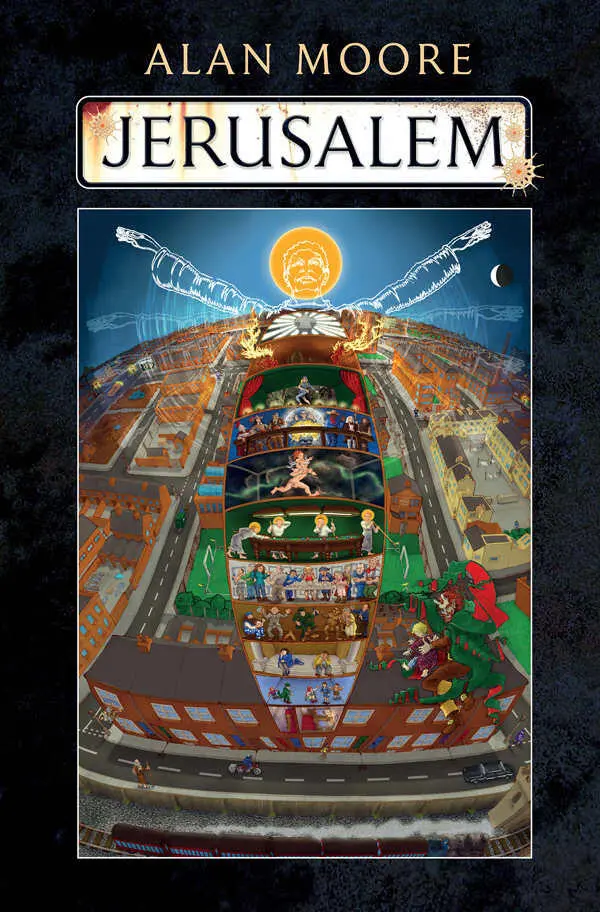
- Название:Jerusalem
- Автор:
- Издательство:Liveright Publishing Corporation
- Жанр:
- Год:2016
- ISBN:нет данных
- Рейтинг книги:4 / 5. Голосов: 1
-
Избранное:Добавить в избранное
- Отзывы:
-
Ваша оценка:
Jerusalem: краткое содержание, описание и аннотация
Предлагаем к чтению аннотацию, описание, краткое содержание или предисловие (зависит от того, что написал сам автор книги «Jerusalem»). Если вы не нашли необходимую информацию о книге — напишите в комментариях, мы постараемся отыскать её.
Disappeared lanes yield their own voices, built from lost words and forgotten dialect, to speak their broken legends and recount their startling genealogies, family histories of shame and madness and the marvellous. There is a conversation in the thunderstruck dome of St. Paul’s cathedral, childbirth on the cobblestones of Lambeth Walk, an estranged couple sitting all night on the cold steps of a Gothic church-front, and an infant choking on a cough drop for eleven chapters. An art exhibition is in preparation, and above the world a naked old man and a beautiful dead baby race along the Attics of the Breath towards the heat death of the universe.
An opulent mythology for those without a pot to piss in, through the labyrinthine streets and pages of Jerusalem tread ghosts that sing of wealth and poverty; of Africa, and hymns, and our threadbare millennium. They discuss English as a visionary language from John Bunyan to James Joyce, hold forth on the illusion of mortality post-Einstein, and insist upon the meanest slum as Blake’s eternal holy city. Fierce in its imagining and stupefying in its scope, this is the tale of everything, told from a vanished gutter.
Jerusalem — читать онлайн бесплатно полную книгу (весь текст) целиком
Ниже представлен текст книги, разбитый по страницам. Система сохранения места последней прочитанной страницы, позволяет с удобством читать онлайн бесплатно книгу «Jerusalem», без необходимости каждый раз заново искать на чём Вы остановились. Поставьте закладку, и сможете в любой момент перейти на страницу, на которой закончили чтение.
Интервал:
Закладка:
Waving farewell while still snickering down her nose at intervals, she wanders a few paces further down the street and then remembers that she had originally been heading for the bank, correcting her trajectory accordingly. She’s thinking about Benedict, about how one of the most blazing and important moments in her life had been provoked by Ben’s inspiring idiocy. They were both something like ten or eleven and had worked out an ingenious way to climb up to the rooftops of the copper warehouse which stood on the corner that connected Freeschool Street with Green Street. This ascent, which obviously needed to be made at night, had first required a trip to Narrow-Toe Lane, just around the block, where they could wriggle on their bellies underneath the locked gate of a builder’s yard. Here they had clambered up a borrowed ladder onto a rear wall of the adjacent Perrit property and scampered giggling along the ridge of Benedict’s dad’s woodpile in the starlight. This eventually allowed them access to the warehouse outbuildings, from whence it was an easy scramble up to the slate roofs and chimneypots above.
For months it had been their precarious kingdom, only shared with cats and birds. Dangerous games of chase evolved to suit the slanted planes of the new landscape, but these had their limits: dead-end precipices that the two kids couldn’t find the nerve to overcome. The worst of these was at the far end of a guttering, a rain channel between the slope of one roof and the upright wall that was the boundary of the next. Their chases would end prematurely at this point, night after night, because of the sheer drop into a narrow alley filled with metal scrap and probable impalement that plunged down into the dark immediately beyond. The threatening passage had been only four or five feet wide and had the angled tiles of a one-storey storage shed on its far side. If it had been a jump between two chalk marks in a sunny playground they’d have made it without hesitation, but to try the same thing on a rooftop in pitch darkness with an abyss full of tetanus junk beneath you was a very different matter.
Then, one moonlit evening, Benedict had upped his game. Alma was chasing him across the blue-grey hills some thirty feet above the street, pursuing him with an unsettling degree of relish through a Caligari world of chimneys, tilts, and shadows. Benedict, only a few paces ahead of her, was giggling with terror that was wholly justified and understandable: most people would get through their lives without being pursued across the skyline by a predatory Alma Warren anywhere save in unusually vivid nightmares, while for Benedict this had been his unenviable reality. Upon the night in question she had herded him into the dead-end fold between the rooftops, knowing that she had him trapped and slavering triumphantly as she moved in upon her shrill and tittering quarry for the kill. It was at this point that Ben’s fear of being caught by Alma had at last outweighed his squeamishness regarding getting speared by shards of glass or rusty railings in the alleyway below. Benedict jumped, shrieking with fear and somehow laughing at the same time, hurtling across the lethal gap to land upon the shed roof, five or six feet lower down on its far side.
Alma, still running at full tilt behind him, had just seconds to decide that she preferred the possibility of gory death at age eleven to the utter certainty of someone beating her at something. Having made her mind up, when she reached the edge she just kept going.
In the fraction of a second during which she hung in empty space above the snarl of rusted implements and broken windows down below, Alma had been illuminated. As the instant stretched itself, she realised that she’d accidentally jumped free of all her fears and limitations, fears of injury and death and ruin. Trusting only to the moment she’d propelled herself past doubt and gravity and in that moment had known with abiding certainty that there was nothing she was scared of, nothing that she couldn’t do.
Even as an eleven-year-old girl she had, of course, been both considerably bigger and much heavier than Benedict. She sailed across the treacherous alleyway to land on the shed roof beside him and immediately went through it, shattering its slates and ending up embedded in its gradient to her scabby knees. Oh, how they’d laughed, exhilarated and hysterical, once they’d checked to make sure that nobody had lost an eye. The incident had given Alma an important insight into overcoming psychological impediments, which she’d experimented further with. Having a morbid dread of drowning, as a twelve-year-old she’d swum out to the steel partition that divided one end of Midsummer Meadow’s lido from the other and had dived down to one of the railed vents that were some feet underwater. She had pushed her arm between the bars then turned it round so that she wasn’t certain she could pull it out again. For perhaps thirty long and awesome seconds she had floated at the still heart of her wholly self-inflicted terror, trying to absorb and understand it, and then she had calmly turned her arm the right way round to pull it from between the bars and strike back for the glittering surface. Alma smiles now at the memory as she enters the bank. The critics and sometimes admirers who describe her as eccentric really haven’t got the first idea.
She knows all the bank staff by name, the Co-op having been her bank of choice for the last twenty years. She’d started with them solely on the basis of their ethical investment policies, but as the decades had ticked past on her milometer she’d come to notice that whenever there was a financial meltdown caused by banking improprieties, the Co-op’s frankly boring logo never featured in the cascade of shamed high-street brands that poured across the teatime news-screens. In the dizzying casino spin of a roulette economy, inside a threadbare circus tent stuffed with adrenaline-deranged rogue traders, oligarchs, and corporate bosses living beyond anybody’s means, the Co-op stood fast. Despite its refusal to invest resources with arms manufacturers, the bank stuck to its guns. Also, when Alma’s mum Doreen had died in 1995 they’d sent a big bouquet of flowers with personal messages from everybody at the branch. As far as Alma is concerned, they could be caught providing orphan baby seals for Rio Tinto Zinc to use as sex-slaves after that, and she’d most probably turn her blind eye.
After she’s said hello to everyone, Alma inspects herself on the closed circuit television while she waits in line. The camera is over by the Abington Street entrance several yards behind her, and so only gives a rear-view long-shot of the leather-jacketed old woman with the hanging-gardens hairstyle, a good head and shoulders taller than the other people in the queue. This is the nearest that she ever gets to an objective image of herself and finds she doesn’t like it very much. It makes her feel obscurely isolated, and besides, she doesn’t see herself like that. She sees herself as bigger and a great deal nearer. And not from behind.
She checks her balance and draws out a random wad of cash to stuff in the side-pocket of her jeans. Just yesterday she’d had a chat with the incorrigible serial-sympathiser and unlikely innocent Melinda Gebbie, her best mate from Semilong. The other woman artist had remarked on how she always liked to have some reassuring totem in her pocket, useful Kleenex tissues, dead bees or particularly pretty leaves that she’d picked up. Alma had thought about it for a while and then said “Yeah, well, see, for me that would be money.” While she’s probably lost several high-denomination notes across the years she still resists the idea of a purse or handbag, reasoning that this would only be a good way to lose everything at once. She thinks it highly probable that she’d eventually leave the handbag in a café, whereas it’s unlikely that she’d leave her trousers. Not out of the question, but unlikely.
Читать дальшеИнтервал:
Закладка:
Похожие книги на «Jerusalem»
Представляем Вашему вниманию похожие книги на «Jerusalem» списком для выбора. Мы отобрали схожую по названию и смыслу литературу в надежде предоставить читателям больше вариантов отыскать новые, интересные, ещё непрочитанные произведения.






Обсуждение, отзывы о книге «Jerusalem» и просто собственные мнения читателей. Оставьте ваши комментарии, напишите, что Вы думаете о произведении, его смысле или главных героях. Укажите что конкретно понравилось, а что нет, и почему Вы так считаете.