Alan Moore - Jerusalem
Здесь есть возможность читать онлайн «Alan Moore - Jerusalem» весь текст электронной книги совершенно бесплатно (целиком полную версию без сокращений). В некоторых случаях можно слушать аудио, скачать через торрент в формате fb2 и присутствует краткое содержание. Год выпуска: 2016, Издательство: Liveright Publishing Corporation, Жанр: Современная проза, на английском языке. Описание произведения, (предисловие) а так же отзывы посетителей доступны на портале библиотеки ЛибКат.
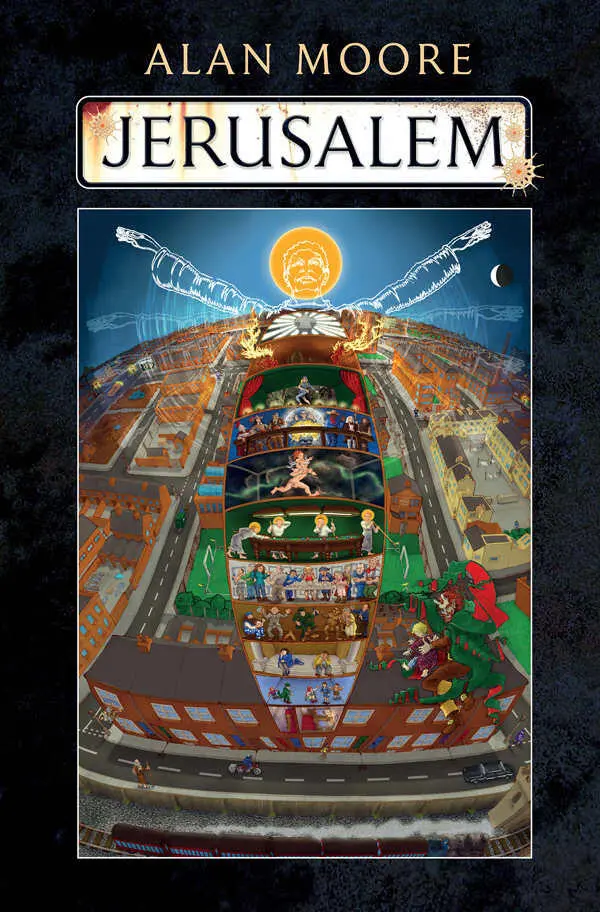
- Название:Jerusalem
- Автор:
- Издательство:Liveright Publishing Corporation
- Жанр:
- Год:2016
- ISBN:нет данных
- Рейтинг книги:4 / 5. Голосов: 1
-
Избранное:Добавить в избранное
- Отзывы:
-
Ваша оценка:
Jerusalem: краткое содержание, описание и аннотация
Предлагаем к чтению аннотацию, описание, краткое содержание или предисловие (зависит от того, что написал сам автор книги «Jerusalem»). Если вы не нашли необходимую информацию о книге — напишите в комментариях, мы постараемся отыскать её.
Disappeared lanes yield their own voices, built from lost words and forgotten dialect, to speak their broken legends and recount their startling genealogies, family histories of shame and madness and the marvellous. There is a conversation in the thunderstruck dome of St. Paul’s cathedral, childbirth on the cobblestones of Lambeth Walk, an estranged couple sitting all night on the cold steps of a Gothic church-front, and an infant choking on a cough drop for eleven chapters. An art exhibition is in preparation, and above the world a naked old man and a beautiful dead baby race along the Attics of the Breath towards the heat death of the universe.
An opulent mythology for those without a pot to piss in, through the labyrinthine streets and pages of Jerusalem tread ghosts that sing of wealth and poverty; of Africa, and hymns, and our threadbare millennium. They discuss English as a visionary language from John Bunyan to James Joyce, hold forth on the illusion of mortality post-Einstein, and insist upon the meanest slum as Blake’s eternal holy city. Fierce in its imagining and stupefying in its scope, this is the tale of everything, told from a vanished gutter.
Jerusalem — читать онлайн бесплатно полную книгу (весь текст) целиком
Ниже представлен текст книги, разбитый по страницам. Система сохранения места последней прочитанной страницы, позволяет с удобством читать онлайн бесплатно книгу «Jerusalem», без необходимости каждый раз заново искать на чём Вы остановились. Поставьте закладку, и сможете в любой момент перейти на страницу, на которой закончили чтение.
Интервал:
Закладка:
Pigeons rise fluttering around her, blissfully oblivious to the mean-spirited poster pasted on a rubbish bin which states that feeding them is a variety of littering and therefore punishable by a fine. It isn’t that she thinks this will make any difference to the birds themselves, who after all can’t read and don’t depend on handouts from animal-lovers to sustain them in the first place, but she feels indignant at the sentiments expressed. What in the name of fuck is wrong with pigeons? If the council were attempting to discourage wasps, attack dogs or the Jesus Army she could see some sense in the campaign, but pigeons? With that green and violet shimmering on the ruff; that wobbling and fluffed-up coo? If the municipal authorities think getting rid of pigeons is their number one priority for the apparently-condemned town centre, then why don’t they just plant landmines on all of the window sills and get it over with instead of sticking up their pissy little threatening notices?
She carries on down Abington Street. There are very few other pedestrians but she is wading through a crowd of ghosts and memories, her killer robot hands deep in her jacket pockets like a 1950s badboy, Jimmy Dean after the menopause. She skirts around the dopey Francis Crick memorial erected in the centre of the thoroughfare, a piece of kitsch with silvery double-helix twists supporting what appear to be a pair of nudist superheroes, sexless manikins whose bald and featureless Barbie pudendas clearly won’t be passing on inherited genetic traits to anyone. Besides, the only thing connecting Abington Street with the local scientific pioneer is the conspicuous DNA evidence to be found following an average Friday night. Of course, the monument might be a comment on local inbreeding, with the figures diving upwards in a desperate spiral to escape a tiny, stagnant gene-pool, more of a gene-puddle if the truth be told. Alma recalls the rumour of an entire cyclops-village somewhere out near Towcester, full of cyclops postmen, cyclops publicans and cyclops toddlers, then remembers it was her that started it.
By curving round the structure to her left she is now walking down beside the library, the only building in the street that hasn’t changed since Alma was a little girl. She’d joined up at the age of five and visited the library several times a fortnight for the next ten years, mostly for ghost-stories and yellow-jacketed Victor Gollancz science-fiction. She’d had haunting, memorable dreams about the institution as a child, walking through winding corridors of wooden shelving with impossible and fascinating tomes propped up to every side, books that you couldn’t read because the words would crawl around upon the page if they were opened. Her dream-library had padded flooring covered in red vinyl like a bar stool or a car-seat into which were set round holes that were most probably vaginal, so that the book-browsing clientele could climb from floor to floor.
The actual waking library had been almost as marvellous in its interior — the tiny section like an open wardrobe that hummed with the aura of the books on séances and mesmerism that were kept there — and from the outside it was still beautiful, the busts of benefactors set into the honey-coloured stone. Alma likes showing visiting Americans the library, just so she can point to the carven likeness at the upper right of its façade and ask them who they think it is. They generally assume that it’s George Washington, an English gesture of respect for their first president, seeming bewildered when informed that it is in fact Andrew, George’s older relative, back from before the Washingtons left Barton Sulgrave for America when the New Model Army were converging on Northamptonshire during the sixteen-hundreds. The family, reputedly, had even pinched the village crest of bars and mullets to provide a basis for the starry, stripy flag of their adopted home. To be quite frank, the only Washingtons she unreservedly respects are Dinah, Booker T. and Geno, whom she feels at least gave something back.
She’s just about to cross the precinct to the Co-op Bank on its far side when she becomes aware of an unusually solid-looking ghost from bygone times approaching from the opposite direction, walking up past the dilapidated mouth of the former Co-op Arcade. Dragging her hair back from the soot-ringed blast-sites of her eyes to take a closer look, she realises that the only thing which marks the figure as a ghost is the anachronistic clothing it affects: the pinstripe shirt, the neckerchief and waistcoat. With her spirits lifting out of their default disgruntlement, she recognises the bucolic spectre as perhaps her oldest mate, Benedict Perrit. Ah, Northampton. Just when you’ve decided that the planners have clubbed her into insensibility, she throws you a bouquet.
The moment Benedict sees Alma, he goes into one of his routines. First the appalled look, then the turning round and going back the way he’s come as if pretending that he hasn’t seen her, then another sharp reverse to bring him back in her direction, only this time quivering with silent giggles. Good old Ben, mad as a Chinese situation comedy, the only one amongst Alma’s associates and former classmates to consistently out-strange her without even trying, and one of the few artists or poets from her teenage years who didn’t jack it all in for a comfortable life when they hit twenty-five. Anything but. Benedict’s face is creased with lines of verse and looks like it resulted from an ill-judged one-night stand between the masks of comedy and tragedy. He has been killed by poetry, and at the same time poetry is all that saves him and redeems him. Good old Ben.
He sticks one paw out for a handshake, but she’s much too pleased to see him and she isn’t having it. Dodging around the proffered hand she plants her bloody lips upon his cheek and scoops him up into a python hug. Sooner or later he’ll breathe out, which will allow her to constrict him further and then when he loses consciousness she’ll dislocate her jaw and swallow him. Before she can accomplish this he flinches back out of her grip, frantically wiping at the Girl-Ebola she has left smeared on his chops.
“Get off! Ah ha ha ha ha ha!”
His laugh is that of Tommy Cooper, left marooned upon a desert island until it has morphed into the seagull-scaring cackle of Ben Gunn. Delighted, Alma tells him he’s a suave Lothario and asks him if he’s writing these days. When he tells her he’s still scribbling, she remarks on reading “Clearance Area” a day or two ago and lets him know what a good poem she thinks it is. He looks at her uncertainly, unsure if she is being genuine.
“I weren’t bad, was I? Ah ha ha.”
The use of the past tense and subtle shift of subject from the poem to its author registers as a small blip on Alma’s radar of concern. It doesn’t sound good, like a clichéd western gunslinger retired to the saloon, fondly remembering his cordite-scented triumphs through a haze of redeye. What a load of shit. She sternly reassures him that he’d been considerably better than “not bad”, then, realising that she too has used the past tense, she attempts to rectify her blunder by just coming out and telling him without condition that he’s a good writer, whereupon he taps her up for a few quid.
This startles her, even as she is fumbling automatically in her jeans’ pocket for a piece of crumpled paper that won’t turn out to be an old till receipt from Morrison’s. Alma has gladly dished out cash to the town’s homeless ever since they blossomed in shop doorways during the late ’Eighties, and especially since it became official policy that this was just “encouraging the beggars”. Having come from a community of beggars, this only spurs on her bloody-minded generosity, much the same way that she’s been idly planning to strew crumbled blueberry muffins up and down the precinct ever since she spotted that annoying pigeon notice at the street’s top end. A friend, like Benedict, is always welcome to some spare cash if she has it, but as she presses a note into his palm she’s more concerned about the shift in self-esteem that seems to have befallen him since the last time they met. Taken along with the “I weren’t bad, was I?” comment, Alma’s feeling a bit worried for him. Making matters worse, he’s looking guilty now about taking the money, which she brashly brushes over by assuring him she’s “fucking loaded”, anxious to get on to safer ground. The moment passes. Alma asks him to tomorrow’s exhibition, not expecting him to come, and when they’re saying goodbye some few minutes later Benedict is telling her that he’s a Cyberman and Alma’s laughing like a drain. Everything’s good again.
Читать дальшеИнтервал:
Закладка:
Похожие книги на «Jerusalem»
Представляем Вашему вниманию похожие книги на «Jerusalem» списком для выбора. Мы отобрали схожую по названию и смыслу литературу в надежде предоставить читателям больше вариантов отыскать новые, интересные, ещё непрочитанные произведения.






Обсуждение, отзывы о книге «Jerusalem» и просто собственные мнения читателей. Оставьте ваши комментарии, напишите, что Вы думаете о произведении, его смысле или главных героях. Укажите что конкретно понравилось, а что нет, и почему Вы так считаете.