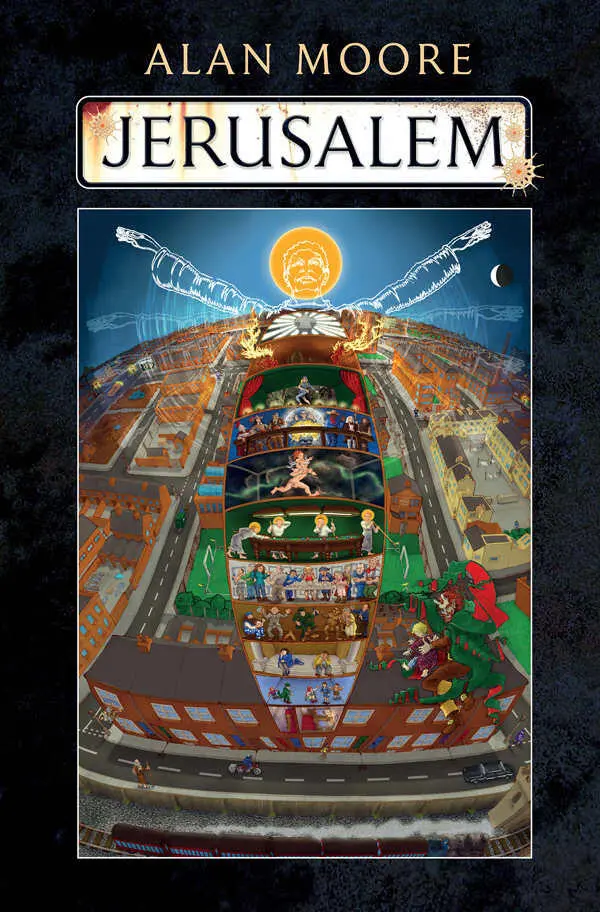
Alan Moore - Jerusalem
Здесь есть возможность читать онлайн «Alan Moore - Jerusalem» весь текст электронной книги совершенно бесплатно (целиком полную версию без сокращений). В некоторых случаях можно слушать аудио, скачать через торрент в формате fb2 и присутствует краткое содержание. Год выпуска: 2016, Издательство: Liveright Publishing Corporation, Жанр: Современная проза, на английском языке. Описание произведения, (предисловие) а так же отзывы посетителей доступны на портале библиотеки ЛибКат.
- Название:Jerusalem
- Автор:
- Издательство:Liveright Publishing Corporation
- Жанр:
- Год:2016
- ISBN:нет данных
- Рейтинг книги:4 / 5. Голосов: 1
-
Избранное:Добавить в избранное
- Отзывы:
-
Ваша оценка:
Jerusalem: краткое содержание, описание и аннотация
Предлагаем к чтению аннотацию, описание, краткое содержание или предисловие (зависит от того, что написал сам автор книги «Jerusalem»). Если вы не нашли необходимую информацию о книге — напишите в комментариях, мы постараемся отыскать её.
Disappeared lanes yield their own voices, built from lost words and forgotten dialect, to speak their broken legends and recount their startling genealogies, family histories of shame and madness and the marvellous. There is a conversation in the thunderstruck dome of St. Paul’s cathedral, childbirth on the cobblestones of Lambeth Walk, an estranged couple sitting all night on the cold steps of a Gothic church-front, and an infant choking on a cough drop for eleven chapters. An art exhibition is in preparation, and above the world a naked old man and a beautiful dead baby race along the Attics of the Breath towards the heat death of the universe.
An opulent mythology for those without a pot to piss in, through the labyrinthine streets and pages of Jerusalem tread ghosts that sing of wealth and poverty; of Africa, and hymns, and our threadbare millennium. They discuss English as a visionary language from John Bunyan to James Joyce, hold forth on the illusion of mortality post-Einstein, and insist upon the meanest slum as Blake’s eternal holy city. Fierce in its imagining and stupefying in its scope, this is the tale of everything, told from a vanished gutter.
Jerusalem — читать онлайн бесплатно полную книгу (весь текст) целиком
Ниже представлен текст книги, разбитый по страницам. Система сохранения места последней прочитанной страницы, позволяет с удобством читать онлайн бесплатно книгу «Jerusalem», без необходимости каждый раз заново искать на чём Вы остановились. Поставьте закладку, и сможете в любой момент перейти на страницу, на которой закончили чтение.
Интервал:
Закладка:
Alma lopes across the woolly, shitty arse of Sheep Street to the gated entrance of the old fish-market, which she notices with some surprise is open. The big covered hall with its glass roof and glistening white slabs is part of Alma’s childhood landscape that she thought had been railed off forever. Vanished voices ringing from the wet tiles with an echo like a swimming-baths, and her nan May parting the crowds as she rolled through them like a black iron wrecking ball, lifting a liver-spotted hand and calling out to the fishmongers, all of whom she knew by name. The only one that Alma can remember is Three-Fingered Tunk, presumably so-called in order to distinguish him from all the other men called Tunk who had a different number of remaining digits.
She vaguely remembers hearing something about plans to turn the Fish Market into some sort of exhibition space or gallery, but has dismissed the idea as too fanciful. Not in Northampton; not in this world. It would never happen. The idea that she might have been wrong in her appraisal has, as usual, not occurred to her, which is perhaps why seeing the green metal concertina gates standing unlocked and open seems at first unreal. Feeling as if she’s stepping over the tiled threshold of a private dreamtime, Alma and her carrier-bags cross into the white emptiness of the interior.
The daylight falling through the dusty lens of the glass ceiling is diffused and milky, which transmutes the space into that of a realist painting. There are hardly any other figures to be seen about the echoing expanse, as dream-like and deserted as the streets in eighteenth-century prints. It’s early days yet, she supposes, with none of the promised art and fashion outlets up and running, but the church-like volume of the place impresses her. She’s never previously seen the Fish Market like this, denuded of its mumbling crowds, stripped of its cheery traders calling imprecations into the salt echo.
Now the slabs are bare and bloodless. The establishment is pared back to the bone, the trappings of its recent history sluiced away. Leftover shreds of topaz haddock, the prismatic gutter-silt of scales and staring collar-button eyes, swept off to join the horse-brasses and tankards of the Red Lion Inn that previously occupied this spot; join the menorahs and yarmulkes from the synagogue of a few centuries before. Its past removed, the market is a fertile vacuum waiting to be filled with future, a mysterious quantum void that hums with immanence and possibility. Alma is disconcerted by a sudden surge of hope, a cynicism override. Part of her is gloomily certain that the council will find some way to undo or undermine the venture, probably through sheer indifference rather than hostility, but the mere fact of its existence is a cause for optimism. It suggests to her that there are people in Northampton, people in the country, people in the world who have the will to make things be a different way. It’s the same feeling that she gets when she’s around her rapper buddies with their Boroughs-esoteric stage names: Influence, St. Craze, Har-Q, Illuzion. It’s the sense of social transformation that she sees, at least potentially, in art and occultism, even sometimes on the ragged Roman Thompson fringe of politics. This passionate desire to change reality into a domain more amenable to human beings, this is the ethereal fire that Alma can feel hanging in the brisk Fish Market air.
As if brought into being by her lifted spirits, one of the few blurred forms in Alma’s myopic middle-distance suddenly resolves itself on her approach into the unassuming and yet inspirational semblance of Knocker Wood, one of the greatest local antidotes for cynicism since the passing of the sorely-missed lyric barrage-balloon that was the late Tom Hall. Knocker — Alma had known him since they were both teenage hippies without ever learning his first name — had been achingly pretty as a young man, with his long black hair and the wild glitter in his eye that looked like poetry but turned out to be heroin. One of the town’s first junkies, Knocker had been part of that mysterious slapstick coterie who took part in their own Narco-Olympics every other Saturday, competitors in the 400-metre dash with stolen television set, haring along the Drapery to the cheers of the flowered-up bohemians gathered on the steps of All Saints Church.
Then everybody had got older. The majority of the long-haired spectators on the steps had straightened up and bailed out of the ailing freak-scene upon turning twenty, getting proper jobs and living up to parents’ expectations. This had left only the working-class contingent of the counter culture, who remained committed largely because they had nowhere else to go, and the addicted casualties like Knocker Wood for whom commitment was no longer the real issue. Knocker’s middle years had been a horror film, wilfully gothic in the way that only junkies can aspire to. Alma can remember scabby ghouls who held up their collapsing veins with safety-pins, a pre-punk gesture, or who’d ruefully announce that they were “forced” to shoot up in their eyeball or their cock.
While Knocker hadn’t been amongst this self-consciously morbid set, for long years he had been a babbling mess that Alma is ashamed to say she’d crossed the street in order to avoid on numerous occasions. He’d lost his wife to an overdose, their daughter to a strain of hepatitis, devastating blows that methadone and Carlsberg Special Brew could not completely muffle. He’d been on a hell-bound train that overshot its destination and ploughed on relentlessly for somewhere even worse when by some miracle he’d managed to leap off the footplate, tumbling helplessly down the embankment towards hard and cold sobriety. No-one had thought that he could do it. Nobody had seen it done before. Knocker had somehow managed to rebirth himself as a hill-walking rural rambler, a drink-and-drug-free boulevardier, a vision of redemption that these days Alma will happily cross several busy motorways to say hello to.
“Knocker! Good to see you. How’s it going?”
He’s still a good-looking man, beginning to bleach out attractively, worn smooth with age, but the stone-washed demeanour suits him to a T. The short grey hair is in retreat, daily conceding territory to the forehead, while his eyes are still as bright though clear now and engaging fully with the diamond world around him. He’s a soothing, peaceful sight, like clean blue pebbles in a stream. He beams and says hello to her, submitting to a hug and genuinely pleased to see her here; pleased to see every dust-mote spinning and illuminated in its Brownian waltz.
He tells her that he’s now a counsellor, bringing his own experience to bear on mending others, beating out the world’s dents where he can. Alma sees him as one of Bunyan’s “mechanick philosophers”, dispensing healing words among the other tinkers, a one-man Nation of Saints without the Christianity and bloody pikestaffs. She is overjoyed to hear about his new line of employment, as pleased for herself as she is thrilled for him. Knocker is an important, vital totem in the way that Alma sees the world, proof positive that even in the blackest and most hopeless circumstances things can sometimes turn out wonderful.
She tells him about tomorrow’s exhibition, which he says he’ll try to get to, and then they discuss the transformed Fish Market, its tundra whiteness stretching all about them. Knocker’s eyes light up and flash the way they used to do, though now it’s the anticipatory pre-Christmas sparkle of a child rather than the mad hypodermic glint of yore.
“Yeah, they say they’ll be having costume balls here and events and things, as well as exhibitions. I think it sounds great. Northampton’s never really had a place like this.”
About to launch into her usual expectation-lowering list of reasons why it isn’t going to work, Alma remembers who she’s talking to and brings herself up short. If Knocker Wood can be so bravely optimistic about the Fish Market’s prospects, then it’s somehow craven for her to indulge in comfy pessimism. She should step up to the mark, and not be such a whining bitch.
Читать дальшеИнтервал:
Закладка:
Похожие книги на «Jerusalem»
Представляем Вашему вниманию похожие книги на «Jerusalem» списком для выбора. Мы отобрали схожую по названию и смыслу литературу в надежде предоставить читателям больше вариантов отыскать новые, интересные, ещё непрочитанные произведения.







Обсуждение, отзывы о книге «Jerusalem» и просто собственные мнения читателей. Оставьте ваши комментарии, напишите, что Вы думаете о произведении, его смысле или главных героях. Укажите что конкретно понравилось, а что нет, и почему Вы так считаете.