Alan Moore - Jerusalem
Здесь есть возможность читать онлайн «Alan Moore - Jerusalem» весь текст электронной книги совершенно бесплатно (целиком полную версию без сокращений). В некоторых случаях можно слушать аудио, скачать через торрент в формате fb2 и присутствует краткое содержание. Год выпуска: 2016, Издательство: Liveright Publishing Corporation, Жанр: Современная проза, на английском языке. Описание произведения, (предисловие) а так же отзывы посетителей доступны на портале библиотеки ЛибКат.
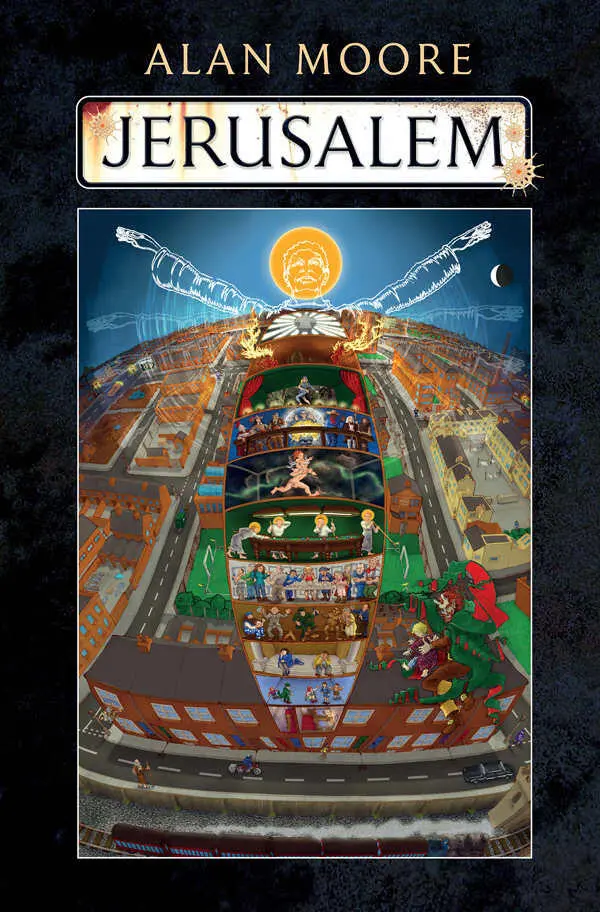
- Название:Jerusalem
- Автор:
- Издательство:Liveright Publishing Corporation
- Жанр:
- Год:2016
- ISBN:нет данных
- Рейтинг книги:4 / 5. Голосов: 1
-
Избранное:Добавить в избранное
- Отзывы:
-
Ваша оценка:
Jerusalem: краткое содержание, описание и аннотация
Предлагаем к чтению аннотацию, описание, краткое содержание или предисловие (зависит от того, что написал сам автор книги «Jerusalem»). Если вы не нашли необходимую информацию о книге — напишите в комментариях, мы постараемся отыскать её.
Disappeared lanes yield their own voices, built from lost words and forgotten dialect, to speak their broken legends and recount their startling genealogies, family histories of shame and madness and the marvellous. There is a conversation in the thunderstruck dome of St. Paul’s cathedral, childbirth on the cobblestones of Lambeth Walk, an estranged couple sitting all night on the cold steps of a Gothic church-front, and an infant choking on a cough drop for eleven chapters. An art exhibition is in preparation, and above the world a naked old man and a beautiful dead baby race along the Attics of the Breath towards the heat death of the universe.
An opulent mythology for those without a pot to piss in, through the labyrinthine streets and pages of Jerusalem tread ghosts that sing of wealth and poverty; of Africa, and hymns, and our threadbare millennium. They discuss English as a visionary language from John Bunyan to James Joyce, hold forth on the illusion of mortality post-Einstein, and insist upon the meanest slum as Blake’s eternal holy city. Fierce in its imagining and stupefying in its scope, this is the tale of everything, told from a vanished gutter.
Jerusalem — читать онлайн бесплатно полную книгу (весь текст) целиком
Ниже представлен текст книги, разбитый по страницам. Система сохранения места последней прочитанной страницы, позволяет с удобством читать онлайн бесплатно книгу «Jerusalem», без необходимости каждый раз заново искать на чём Вы остановились. Поставьте закладку, и сможете в любой момент перейти на страницу, на которой закончили чтение.
Интервал:
Закладка:
“You’re right. I like the light here, and I like the atmosphere. It could be really, really good. It’d be nice to see this place filled up again with crowds of people, all in fancy dress. It’d be like the dreams you have when you’re a kid.”
They talk for a few minutes longer, then they hug goodbye and carry on their individual trajectories. As Alma leaves the market, pushing open the glass swing door at its rear and stepping out into the muddled area at the top of Silver Street, she feels elated both by the encounter and the prospects for her little art-show of the following day. Perhaps her pictures can do what she wants them to. Perhaps they can live up to her unreasonable demands and do something to salve the wounded Boroughs, if it’s only by drawing the right kind of attention to the place. At very least she’ll have discharged the obligations that she’d taken on after her brother’s afterlife experience, and laid some ghosts to rest for both of them, possibly literally. That isn’t bad for a year’s work.
Alma’s descent of the wide road that narrow Silver Street became during the 1970s is her descent into the past, into the Boroughs, and inevitably the cheap pre-war scent of the locale’s charisma wells up to surround her, colouring her thoughts and her perceptions. This is the paved-over ground she grew between the cracks of. This is where whatever vision she possesses came from, these thin lanes that trickle downhill to St. Andrew’s Road like dirty bathwater. Across the busy road the Multi-storey car park squats upon two or three vanished streets and a few hundred hours of Alma’s childhood: the Electric Light Working Men’s Club in Bearward Street where she’d go with her parents and her brother on a Sunday night, the Judo club in Silver Street where she’d learned self-defence until she’d realised that she was too big and unpredictable for anyone to pick on. All the memories are crushed beneath the vast weight of the car park and compressed to a prismatic form of anthracite, a fuel that she’s been running on for more than fifty years.
The view from this point, high upon the area’s eastern slopes, has stayed essentially unchanged for all that time, if by ‘essentially’ you mean that the fleeced sky is in the same place and the angle of the sweeping incline remains constant. Nearly every other feature of the landscape has been altered or removed. The recently refurbished NEWLIFE buildings dominate the stepped-on vista, the surrounding circuit board of flats and maisonettes, communal cubes that have replaced the terraces of individual homes. Though greatly simplified, the neighbourhood’s original main thoroughfares are visible in their archaic tangle, Bath Street, Scarletwell, Spring Lane. Some patches of the panorama are dispirited and overcast while others briefly glory in their sudden spotlight as the afternoon sun pours down through a threadbare sheet of cloud. The graduations of the distance appear much the same as ever, or at least they do to Alma’s blurring eyesight. She sees bands of brick or concrete housing giving way to stripes of railway track with overhead wires, and then finally resolving to the grey-green smoulder of Victoria Park in the far west. Despite the shabby overlay of the last half-a-century, she knows the golden template of the district is still there somewhere. The buried heart still beats under the rubble. Forking off from Silver Street into the incline of an underpass below the roaring Mayorhold, Alma draws in a deep breath and ducks her head beneath the mottled surface of the present.
She emerges from the tunnel’s orange murk onto a sunken walkway lined with thirty-year-old tiling that suggests to Alma a bulimic Mondrian after a Spanish omelette. Turning left she climbs the ramp towards Horsemarket (West) and makes her way down into the bollard-occluded mouth of Bath Street, past the Kingdom Life building that was erected as a Boy’s Brigade Hall in the 60s. Alma’s brother had belonged to that peculiar Baptist paramilitary, the Baden-Powell Youth. He had marched with them and their cacophonous percussion-heavy band on Sunday mornings, an eleven-year-old with a brass badge and a lanyard, with a jaunty cadet cap atop his girly golden curls, a happiness and innocence in his blue eyes that Alma thought looked borderline subnormal. He’d have made a perfect paediatric Nazi if he could have carried off a decent goose-step without skipping like a cartoon milkmaid. Alma’s fairly certain he attended the odd torchlight rally at the pebble-dashed pavilion across the way, him and his mates all chanting “Arbeit Macht Frei” or “Be Prepared” or whatever their motto was.
She idly wonders if the former Boy’s Brigade Headquarters is located near where Moseley’s Blackshirts had their offices back in the ‘30s. This provokes a trailing strand of thought relating to an article by Roman Thompson, which the grizzled lefty veteran had photocopied for her, all about the B.U.F.’s activities around the Mayorhold. There’d been grainy reproductions from newspaper photographs of leading local fascists posing with Sir Oswald while he toured the provinces, with one name in the captions underneath the pictures whited out, presumably by somebody in the archive department. Roman hadn’t noticed the deletion and had no clue as to what the missing name might be, though Alma had heard unsubstantiated rumours about Mr. Bassett-Lowkes, the erstwhile local footwear manufacturer and former owner of a house in Derngate with interiors by Rennie Mackintosh. Who knows? If World War Two had gone a different way he might have launched a line of sporty jack-brogues to commemorate the Führer’s victory.
Alma carries on down Bath Street with the corned beef-coloured Moseley-vintage flat-blocks on her left, the NEWLIFE towers and their attendant modern terraced houses coming up on Alma’s right. Her inner musings still have a large National Socialist component, very like the winter scheduling on Channel Five. She’s heard, relatively recently, that Hitler’s planned invasion of the British Isles had ended with the capture of Northampton, as if once the centre of the country had been taken then the rest was a foregone conclusion. Alma giggles to herself. Say what you like about the Third Reich, at least they recognised places of historical strategic import when they saw them. And the area has ended up with all the brutal and intimidating Nazi architecture anyway. Albert Speer might have stuck eagles and swastikas up on the tower-blocks, but would that necessarily have made the locals feel more subjugated and discouraged than the cheesy sideways silver lettering that’s up there currently? Quite frankly, either way the message would be much the same: tomorrow, most assuredly, does not belong to you.
The further down the hill she goes the more subdued and shadowy her mood becomes, as though Bath Street were an emotional gradient. She’s thinking about history’s celebrated victims, thinking of the holocaust, the blight of slavery, female suppression and the persecution of sexual minorities. She can recall her own Spare Rib days in the 1970s and how she’d briefly entertained the idea that a woman leader might make all the difference. This had obviously been back in the early seventies. Her point is that despite the very real continuing abuses born of anti-Semitism, born of racism and sexism and homophobia, there are MPs and leaders who are female, Jewish, black or gay. There are none who are poor. There never have been, and there never will be. Every decade since society’s inception has been witness to a holocaust of paupers, so enormous and perpetual that it has become wallpaper, unnoticed, unreported. The mass graves at Dachau and at Auschwitz are, rightly, remembered and repeatedly deplored, but what about the one in Bunhill Fields that William Blake and his beloved Catherine were shovelled into? What about the one under the car park in Chalk Lane, across the road from Doddridge Church? What of the countless generations that have lived poor and have in one way or other died of that condition, uncommemorated and anonymous? Where are their fucking monuments and special ringed dates on the calendar? Where are their Spielberg films? Part of the problem is, no doubt, that poverty lacks a dramatic arc. From rags to rags to rags to rags to dust has never been an Oscar-winning formula.
Читать дальшеИнтервал:
Закладка:
Похожие книги на «Jerusalem»
Представляем Вашему вниманию похожие книги на «Jerusalem» списком для выбора. Мы отобрали схожую по названию и смыслу литературу в надежде предоставить читателям больше вариантов отыскать новые, интересные, ещё непрочитанные произведения.






Обсуждение, отзывы о книге «Jerusalem» и просто собственные мнения читателей. Оставьте ваши комментарии, напишите, что Вы думаете о произведении, его смысле или главных героях. Укажите что конкретно понравилось, а что нет, и почему Вы так считаете.