Alan Moore - Jerusalem
Здесь есть возможность читать онлайн «Alan Moore - Jerusalem» весь текст электронной книги совершенно бесплатно (целиком полную версию без сокращений). В некоторых случаях можно слушать аудио, скачать через торрент в формате fb2 и присутствует краткое содержание. Год выпуска: 2016, Издательство: Liveright Publishing Corporation, Жанр: Современная проза, на английском языке. Описание произведения, (предисловие) а так же отзывы посетителей доступны на портале библиотеки ЛибКат.
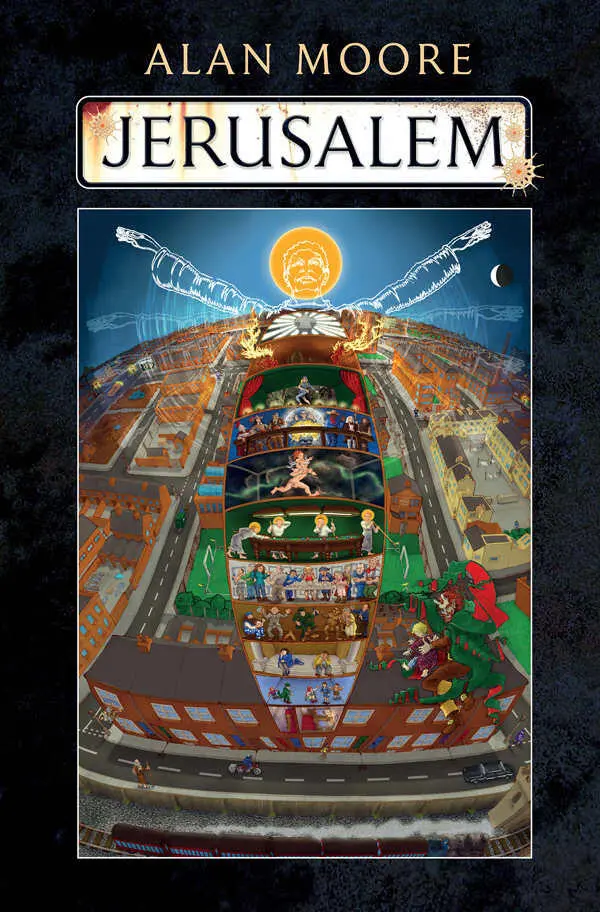
- Название:Jerusalem
- Автор:
- Издательство:Liveright Publishing Corporation
- Жанр:
- Год:2016
- ISBN:нет данных
- Рейтинг книги:4 / 5. Голосов: 1
-
Избранное:Добавить в избранное
- Отзывы:
-
Ваша оценка:
Jerusalem: краткое содержание, описание и аннотация
Предлагаем к чтению аннотацию, описание, краткое содержание или предисловие (зависит от того, что написал сам автор книги «Jerusalem»). Если вы не нашли необходимую информацию о книге — напишите в комментариях, мы постараемся отыскать её.
Disappeared lanes yield their own voices, built from lost words and forgotten dialect, to speak their broken legends and recount their startling genealogies, family histories of shame and madness and the marvellous. There is a conversation in the thunderstruck dome of St. Paul’s cathedral, childbirth on the cobblestones of Lambeth Walk, an estranged couple sitting all night on the cold steps of a Gothic church-front, and an infant choking on a cough drop for eleven chapters. An art exhibition is in preparation, and above the world a naked old man and a beautiful dead baby race along the Attics of the Breath towards the heat death of the universe.
An opulent mythology for those without a pot to piss in, through the labyrinthine streets and pages of Jerusalem tread ghosts that sing of wealth and poverty; of Africa, and hymns, and our threadbare millennium. They discuss English as a visionary language from John Bunyan to James Joyce, hold forth on the illusion of mortality post-Einstein, and insist upon the meanest slum as Blake’s eternal holy city. Fierce in its imagining and stupefying in its scope, this is the tale of everything, told from a vanished gutter.
Jerusalem — читать онлайн бесплатно полную книгу (весь текст) целиком
Ниже представлен текст книги, разбитый по страницам. Система сохранения места последней прочитанной страницы, позволяет с удобством читать онлайн бесплатно книгу «Jerusalem», без необходимости каждый раз заново искать на чём Вы остановились. Поставьте закладку, и сможете в любой момент перейти на страницу, на которой закончили чтение.
Интервал:
Закладка:
Across the street a door opens in Simons Walk, one of the modern terraces that crouch beneath the high-rise buildings, and a fat bloke with a shaven head and internet-porn eyes emerges. He looks flatly and dismissively at Alma and quite blatantly hits the ‘Delete’ key on his Wank Bank before lumbering off along the walkway, probably towards the chip shop in St. Andrew’s Street. Alma lets her attention linger for a moment on the tree-walled ‘pocket park’ that’s just over the road, one of the only genuinely nice additions to the neighbourhood. She’s got an artist friend called Claire who lives down here in Bath Street flats and makes a point of keeping the small green enclosure litter-free and weeded. Claire had painted an intensely-felt cartoon depiction of her threatened acre with carnivorous tower blocks encroaching on it from all sides which she’d insisted upon giving Alma after Alma fell in love with it, refusing any money and deeply embarrassing the nouveau-riche celebrity, who is forever in her fellow artist’s debt. Claire’s brave and lovely and a bit bipolar. She makes Alma smile just thinking of her, with a psilocybin mushroom and the legend ‘MAGIC’ tattooed on one forearm; ‘FUCK OFF’ on the other. Both of these, to Alma’s mind, are worthy creeds to live by.
She considers the made-over bulks of Claremont Court and Beaumont Court, the NEWLIFE towers engaging in their double penetration of the sky. About ten days ago, knowing the renovations for the publicly-loathed swindle that they really were, the council had attempted a stealth opening event. Ruth Kelly’s deputy as Minister for Housing, Yvette Cooper, had been ferried in to cut the ribbon early on a Wednesday morning with no prior announcements made, in order to avoid alerting organised protesters. Roman Thompson, obviously, heard all about the covert visit on the night before it happened. Requisitioning a megaphone from local union premises, Roman had turned up bright and early with a hastily convened posse of local anarchists and activists, bringing the sleepy tenants of the maisonettes on Crispin Street out to their balconies by bellowing “GOOD MOOOOOOOORNING, SPRING BOROUGHS” through his borrowed loudhailer. When the pencil-necked Deputy Minister and partner of Brown-aide Ed Balls arrived with the attendant local dignitaries, Roman’s vastly-amplified Old Man of the Sea voice had gleefully regaled them with their recent improprieties. He’d sympathetically asked Labour MP Sally Keeble how well she was sleeping these days, after voting for the Iraq War. He’d loudly paid another councillor a compliment upon how smart he looked and speculated that this might be due to all the backhanders he’d recently received. At this point a policeman had rushed up to Roman and informed him that he couldn’t say that, to which Roman had replied by pointing out, with logic that was unassailable, that he already had. Alma is grinning. It had been an entertaining morning in the Boroughs, from the sound of it.
Reluctantly she turns her gaze back to the side of Bath Street that she’s walking down, the 1930s flat-blocks with the entrance to their central walkway on her left and just ahead. Alma stares at the spot where she is fairly certain that the hulking chimneystack of the Destructor had once stood and instantly her cheerful mental image of Claire’s painting shatters into shellac flakes of green and yellow. These immediately scatter on the wind to be replaced by Alma’s previous notion of the Boroughs and the other districts like it everywhere across the world as concentration neighbourhoods: zones where the population could be readily identified by prison uniforms of apron or shiny demob suit if they strayed beyond the boundaries, zones where the inmates could be safely worked, starved or simply depressed to death with no fear of a public outcry. Here in Bath Street they’d even provided the continually smoking tower of an incinerator chimney to enhance the death-camp ambience.
Alma, who makes little distinction between internal and external reality, doesn’t much care if the Destructor in her brother’s vision is the awful supernatural force that he described it as, or if it’s some hallucinatory and visionary metaphor. As Alma sees things, it’s the metaphors that do all the most serious damage: Jews as rats, or car-thieves as hyenas. Asian countries as a line of dominoes that communist ideas could topple. Workers thinking of themselves as cogs in a machine, creationists imagining existence as a Swiss watch mechanism and then presupposing a white-haired and twinkle-eyed old clockmaker behind it all. Alma believes that the Destructor, even as a metaphor, especially as a metaphor, could easily cremate a neighbourhood, a class, a district of the human heart. By the same token then, she must believe that art, her art, anyone’s art, is capable of finally demolishing the mind-set and ideas that the Destructor represents if expressed with sufficient force and savagery; sufficient brutal beauty. Alma has no other choice than to believe this. It’s what keeps her going. Hardening her eyes to the eroded Bauhaus balconies and arches, bricks the colour of dried blood, she turns left and begins to head up the long path that separates the two halves of the flats, towards the walled ramp that leads into Castle Street.
The sun absconds behind a cloud and the green lawns turn grey. The ornamental stepped edge of the brickwork, grass-cracked and distressed, takes on a different character. The architecture, neat and modern and efficient in its time, now looks its age, a pre-war civil servant who’d once had a promising career ahead of him but now is in his eighties, haunted and incontinent, incapable of recognising his surroundings. Past the flats’ drawn curtains are the chambers of a crumbling mind through which the tenants shamble like unfathomable dreams. Outpatients, rock-heads, migrant workers, prostitutes and refugees and transposed flowers like Claire somehow still painting pictures in amidst it all, the way that Richard Dadd had laboured on his tiny fairy visions in the screaming, defecating hells of Bedlam and of Broadmoor.
Alma realises that the place is like a grindstone on which reason, sense of self, and sanity are milled to an undifferentiated flour of madness. Mental illness and depression have been stirred into the mortar of these buildings, or have seeped into the plaster as a type of melancholic damp. Attempting to sustain even the ordinary notion of a purpose to existence in this bleak environment would slowly drive you round the bend, would send you cornery. She realises, wading through the thick air of the central walkway, that insanity occurs most often where a human vision meets the social brickwork. She remembers Pastor Newton’s old hymn-writing colleague, madhouse veteran William Cowper, in 1819, addressing William Blake: “You retain health and yet are as mad as any of us all — over us all — mad as a refuge from the unbelief of Bacon, Newton and Locke.”
This was a different Newton that the fragile poet was condemning, obviously, not hymn-composing and slave-trading John but Isaac, architect of a material scientific certainty that would supplant the levelling moral apocalypse of his contemporary John Bunyan. Isaac Newton, founding member of the Royal Society and of Freemasonry’s Grand Lodge, brutal commander of the Mint and therefore engineer to a financial system rife with Darien Disasters, South Sea Bubbles, Wall Street Crashes and Black Wednesdays. Instigator of the gold standard and thus of Britain’s gold reserves, which Blair’s chancellor Gordon Brown has quietly sold off just this last year. Sir Isaac, the inventor of an utterly imaginary colour, indigo, and the creator of the modern world’s materialistic rat-trap on so many different levels. The great tranquilliser of the spirit, the inducer of what Blake called, accurately, “Newton’s Sleep”. In Bath Street flats, amongst the destitute and desperate and depressed, she can see all the dreams with which that sleep is troubled.
Читать дальшеИнтервал:
Закладка:
Похожие книги на «Jerusalem»
Представляем Вашему вниманию похожие книги на «Jerusalem» списком для выбора. Мы отобрали схожую по названию и смыслу литературу в надежде предоставить читателям больше вариантов отыскать новые, интересные, ещё непрочитанные произведения.






Обсуждение, отзывы о книге «Jerusalem» и просто собственные мнения читателей. Оставьте ваши комментарии, напишите, что Вы думаете о произведении, его смысле или главных героях. Укажите что конкретно понравилось, а что нет, и почему Вы так считаете.