Alan Moore - Jerusalem
Здесь есть возможность читать онлайн «Alan Moore - Jerusalem» весь текст электронной книги совершенно бесплатно (целиком полную версию без сокращений). В некоторых случаях можно слушать аудио, скачать через торрент в формате fb2 и присутствует краткое содержание. Год выпуска: 2016, Издательство: Liveright Publishing Corporation, Жанр: Современная проза, на английском языке. Описание произведения, (предисловие) а так же отзывы посетителей доступны на портале библиотеки ЛибКат.
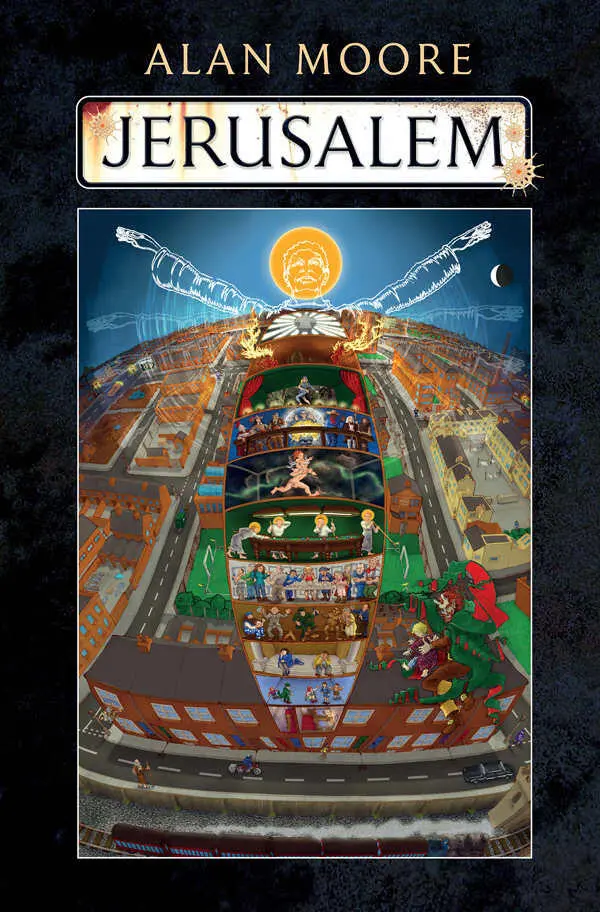
- Название:Jerusalem
- Автор:
- Издательство:Liveright Publishing Corporation
- Жанр:
- Год:2016
- ISBN:нет данных
- Рейтинг книги:4 / 5. Голосов: 1
-
Избранное:Добавить в избранное
- Отзывы:
-
Ваша оценка:
Jerusalem: краткое содержание, описание и аннотация
Предлагаем к чтению аннотацию, описание, краткое содержание или предисловие (зависит от того, что написал сам автор книги «Jerusalem»). Если вы не нашли необходимую информацию о книге — напишите в комментариях, мы постараемся отыскать её.
Disappeared lanes yield their own voices, built from lost words and forgotten dialect, to speak their broken legends and recount their startling genealogies, family histories of shame and madness and the marvellous. There is a conversation in the thunderstruck dome of St. Paul’s cathedral, childbirth on the cobblestones of Lambeth Walk, an estranged couple sitting all night on the cold steps of a Gothic church-front, and an infant choking on a cough drop for eleven chapters. An art exhibition is in preparation, and above the world a naked old man and a beautiful dead baby race along the Attics of the Breath towards the heat death of the universe.
An opulent mythology for those without a pot to piss in, through the labyrinthine streets and pages of Jerusalem tread ghosts that sing of wealth and poverty; of Africa, and hymns, and our threadbare millennium. They discuss English as a visionary language from John Bunyan to James Joyce, hold forth on the illusion of mortality post-Einstein, and insist upon the meanest slum as Blake’s eternal holy city. Fierce in its imagining and stupefying in its scope, this is the tale of everything, told from a vanished gutter.
Jerusalem — читать онлайн бесплатно полную книгу (весь текст) целиком
Ниже представлен текст книги, разбитый по страницам. Система сохранения места последней прочитанной страницы, позволяет с удобством читать онлайн бесплатно книгу «Jerusalem», без необходимости каждый раз заново искать на чём Вы остановились. Поставьте закладку, и сможете в любой момент перейти на страницу, на которой закончили чтение.
Интервал:
Закладка:
In the middle of the room there are four tables pushed together to support the papier-mâché model that she’d made with all those Rizla papers, chewing them and spitting them into a suitable receptacle. Melinda Gebbie, her best mate, had looked a bit revolted when Alma had demonstrated her technique, which had made Alma try to justify her processes by referencing the book-devouring 1960s visionary John Latham, whom she’d met once and was an admirer of. She’d also tried explaining the importance of using her own saliva, so that in a literal sense her DNA would be part of the complicated structure she was building. In the end she’d given up and confessed that she just liked gobbing.
If she is honest with herself, the model is the only item in the exhibition that she isn’t wholly sure about. It doesn’t seem as if it’s saying much, just sitting there like that, solid and unambiguous. Maybe she’ll see how it goes down tomorrow at the preview and then leave it out of the ensuing London show if she’s not pleased with the response. There’s no point worrying about it now, at any rate. Things tend to sort themselves out, Alma thinks, although she knows that this directly contradicts the laws of physics, common sense, and her political experience of the last forty years.
She looks up from the tabletop display, out through the nursery’s front picture-window, where she notices that Chalk Lane teeters on the brink of dusk. A skinny little mixed-race girl with corn-row hair and a fire-engine red PVC mac is clacking through the umbra, her arms crossed defensively across her chest and a preoccupied expression on her face. Alma thinks ‘crack whore’, then berates herself for her descent into class-profiling and for her lazy and mean-spirited assumptions. By then the young woman has departed, tottering away into the twilight that is gathering in the east, spilling out from Horsemarket and down Castle Street in an obscuring violet avalanche.
Alma stands chatting in the borrowed space with Roman, Burt and Lucy for a little longer. Roman tells her that he’s been out door to door, drumming up interest in tomorrow’s exhibition from amongst the local populace. She asks him how the cartoon poster that she knocked off for his Defend Council Houses group is selling, and is told that it’s still moving steadily. This image, which depicts a Godzilla-sized ‘fat cat’ looming from behind the NEWLIFE towers to rake through Scarletwell Street’s surface with its monstrous talons, while not a well-drawn piece by her usual standards, had provoked some small controversy. With his keen eye for free publicity Rome had involved the local Chronicle & Echo , thus affiliating Alma publicly with his extremely worthy cause. In the accompanying article had been some rather piqued, dismissive comments from a Conservative councillor, one Derek Palehorse, who’d insisted that he couldn’t see what all the fuss was over when so much was being done to help the neighbourhood already. Alma smiles now at the memory. How nice of him to stick his head above the parapet. She can recall the recent scandal when through Roman Thompson’s machinations, the town council’s very generous remuneration of a former colleague had been published in the local paper, prompting councillors to protest that their dealings should never have been made public. When the newspaper had polled its readers to see what their feelings were upon the issue, they’d been startled to discover that most of the votes supported the town council’s right to secrecy. Then they’d found that almost all of these votes had issued from Councillor Palehorse in one way or other. It was mentioned on the “Rotten Boroughs” page of Private Eye , to the deserved embarrassment of everyone concerned. Honestly, Alma thinks. These people. What a bunch of shitclowns. This is a new word that she’s picked up from columnist and splendidly ill-humoured television writer Charlie Brooker, whom she wants to marry, and a term which she already can’t imagine how she got along without for all those years, for all that endless line of shitclowns climbing out of history’s collapsing car. Don’t bother, they’re here.
Taking a sudden fancy to the thought of walking home through her old neighbourhood, she waves aside the offer of a lift from Burt and kisses everyone goodbye. Rome Thompson hints mysteriously of something that he’s got to tell her but first wants to check his facts; something about the stretch of river next to the gas-holder down on Tanner Street. He says he’ll let her know tomorrow morning at the show. Leaving the others to arrange the last few details and lock up, she zips her jacket to the neck and exits by the swing door, shuffling down the stone steps onto Phoenix Street. Glancing towards her left and down Chalk Lane she can see Doddridge Church, with that bizarre door halfway up its western wall. Alma imagines the celestial flyover, the Ultraduct, as she’s depicted it in one of the works that she’s just been looking at, an elevated walkway that seems to be chiselled out of light emerging from the blocked-off loading bay to curve away towards the west, with phosphorescent figures blurring back and forth across its span.
The church itself seems, in her eye, to sum up the combined political and spiritual upheavals that have typified Northampton’s history. It occurs to her that most of these have been linguistic in their origins. John Wycliffe had begun the process in the 14th century with his translation of the Bible into English. Right there, by insisting that the English peasant classes had a right to worship in their own tongue, Wycliffe and his Lollards were establishing an element of class-war politics in the religious altercation. In Northampton, Lollards and other religious radicals seem to have found a natural home, so that by Queen Elizabeth’s reign in the fifteen-hundreds there are Northamptonshire congregations singing home-made hymns in English rather than just listening to chanted psalms in Latin as the Church demanded. Lacking any earlier examples that spring readily to mind, she wonders if her town is where the English hymn originates. That would explain a lot, now that she thinks about it.
Within fifty years of Queen Elizabeth’s demise, of course, the Civil War kicked off with Parliament greatly emboldened by the radical sects that seemed to be clustered in the English Midlands, all the Ranters, Anabaptists, Antinomians, Fifth Monarchists and Quakers, most of them engaged in publishing inflammatory texts or fiery flying rolls. Some of the openly seditious ‘Martin Marprelate’ tracts had been published secretly here in the Boroughs, and in general it seemed that the Protestant revolution hinged upon the word, with painting and the visual arts perceived as the preserve of Papists and elitists. To become a painter would require materials and means, while writing, strictly speaking, required only the most rudimentary education. Obviously, literature was still seen as the sole preserve of the elite, which is just one of many reasons why John Bunyan’s writings, crystal-clear allegories conveyed in common speech, were so incendiary in their day. His hymn, To Be a Pilgrim , was the anthem for the disenchanted Puritans migrating for America, while Pilgrim’s Progress would become a source of inspiration for the New World settlers second only to the Bible, and these weren’t the rakish, courtly witticisms or the fawning tributes of contemporaries such as Rochester or Dryden. These were written by a member of that new and dangerous breed, the literate commoner. They were composed by someone who insisted that plain English was a holy tongue, a language with which to express the sacred.
Of course, they’d banged Bunyan up in Bedford nick for getting on a dozen years, while art and literature are still most usually a product of the middle class, of a Rochester mind-set that sees earnestness as simply gauche and visionary passion as anathema. William Blake would follow Bunyan and, closer to home, John Clare, but both of these had spent their days impoverished, marginalised as lunatics, committed to asylums or plagued by sedition hearings. All of them are heirs to Wycliffe, part of a great insurrectionary tradition, of a burning stream of words, of an apocalyptic narrative that speaks the language of the poor. At the stone meeting house in Chalk Lane, Philip Doddridge pulled all the diverse strands of that narrative together. Hanging out with Swedenborgians and Baptists, taking up his ministry here in the poorest quarter, writing Hark! The Glad Sound! , championing the dissenting cause, all from this scruffy little mound … Doddridge is Alma’s foremost local hero. It’ll be an honour staging her show in the shadow of his church. Alma elects to walk down Little Cross Street and then follow Bath Street round to Scarletwell and her beloved strip of bare grass on St. Andrew’s Road.
Читать дальшеИнтервал:
Закладка:
Похожие книги на «Jerusalem»
Представляем Вашему вниманию похожие книги на «Jerusalem» списком для выбора. Мы отобрали схожую по названию и смыслу литературу в надежде предоставить читателям больше вариантов отыскать новые, интересные, ещё непрочитанные произведения.







Обсуждение, отзывы о книге «Jerusalem» и просто собственные мнения читателей. Оставьте ваши комментарии, напишите, что Вы думаете о произведении, его смысле или главных героях. Укажите что конкретно понравилось, а что нет, и почему Вы так считаете.