Alan Moore - Jerusalem
Здесь есть возможность читать онлайн «Alan Moore - Jerusalem» весь текст электронной книги совершенно бесплатно (целиком полную версию без сокращений). В некоторых случаях можно слушать аудио, скачать через торрент в формате fb2 и присутствует краткое содержание. Год выпуска: 2016, Издательство: Liveright Publishing Corporation, Жанр: Современная проза, на английском языке. Описание произведения, (предисловие) а так же отзывы посетителей доступны на портале библиотеки ЛибКат.
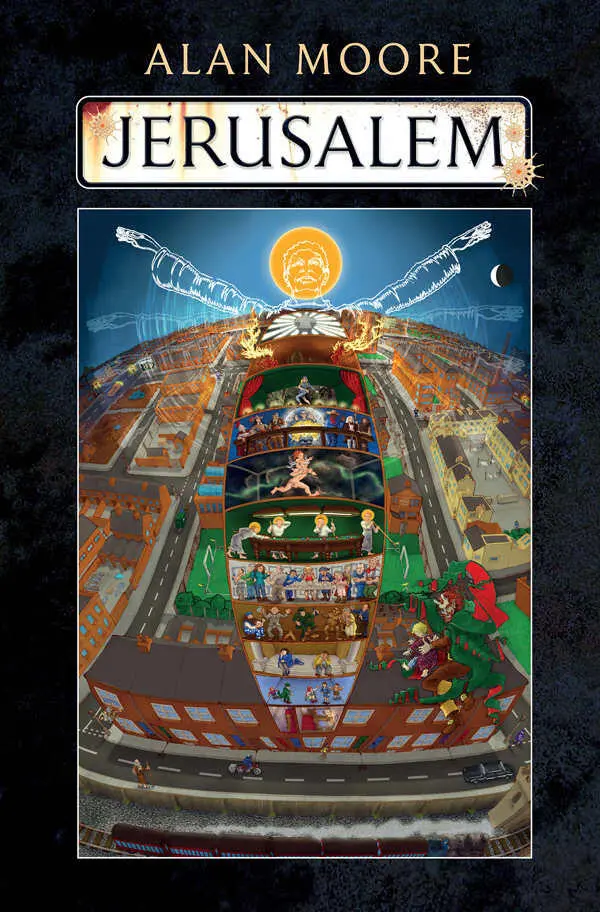
- Название:Jerusalem
- Автор:
- Издательство:Liveright Publishing Corporation
- Жанр:
- Год:2016
- ISBN:нет данных
- Рейтинг книги:4 / 5. Голосов: 1
-
Избранное:Добавить в избранное
- Отзывы:
-
Ваша оценка:
Jerusalem: краткое содержание, описание и аннотация
Предлагаем к чтению аннотацию, описание, краткое содержание или предисловие (зависит от того, что написал сам автор книги «Jerusalem»). Если вы не нашли необходимую информацию о книге — напишите в комментариях, мы постараемся отыскать её.
Disappeared lanes yield their own voices, built from lost words and forgotten dialect, to speak their broken legends and recount their startling genealogies, family histories of shame and madness and the marvellous. There is a conversation in the thunderstruck dome of St. Paul’s cathedral, childbirth on the cobblestones of Lambeth Walk, an estranged couple sitting all night on the cold steps of a Gothic church-front, and an infant choking on a cough drop for eleven chapters. An art exhibition is in preparation, and above the world a naked old man and a beautiful dead baby race along the Attics of the Breath towards the heat death of the universe.
An opulent mythology for those without a pot to piss in, through the labyrinthine streets and pages of Jerusalem tread ghosts that sing of wealth and poverty; of Africa, and hymns, and our threadbare millennium. They discuss English as a visionary language from John Bunyan to James Joyce, hold forth on the illusion of mortality post-Einstein, and insist upon the meanest slum as Blake’s eternal holy city. Fierce in its imagining and stupefying in its scope, this is the tale of everything, told from a vanished gutter.
Jerusalem — читать онлайн бесплатно полную книгу (весь текст) целиком
Ниже представлен текст книги, разбитый по страницам. Система сохранения места последней прочитанной страницы, позволяет с удобством читать онлайн бесплатно книгу «Jerusalem», без необходимости каждый раз заново искать на чём Вы остановились. Поставьте закладку, и сможете в любой момент перейти на страницу, на которой закончили чтение.
Интервал:
Закладка:
She lopes down through the failing light with blocks of flats to either side of her, the Bath Street buildings’ west face on her right and to her left the 1960s landings and the sunken walkways of Moat Place, Fort Place, outlying features of a long-demolished castle become streets where Alma’s great-grandfather Snowy Vernall had lived, getting on a hundred years ago. Mad Snowy, marrying the landlord’s daughter from the long-since disappeared Blue Anchor pub in Chalk Lane, which he’d visited on one of his improbably long strolls from Lambeth. All these chance events, these people and their complicated lives, the trillion small occurrences without which she would not be her; would not be here.
Across the street, incontinent lamps stand apologetically in puddles of their own piss-coloured light. She just about remembers when Moat Street and Fort Street were still standing, and when Mrs. Coleman’s gingerbread-house sweetshop was down at the lower end of Bath Street, although Alma was no more than four or five back then. A much more vivid memory remains from slightly later, when the maze of red brick terraces had been demolished and there was just wasteland here, before the blocks of flats had been erected. She remembers playing with the first of many best friends, Janet Cooper, on vast fields of rubble and black mud beneath a dirty fleece of Boroughs sky. For some reason there had been industrial off-cuts scattered everywhere and gingering the puddles, L-shaped bits of metal which Alma and Janet had discovered could be plaited into rusty orange swastikas and skimmed across the demolition site like Nazi throwing-stars. Just as with the abandoned Morris Minor, the brick scree and piled-up devastation were regarded as civic amenities, play areas provided for the district’s young, tetanus crèches of a kind then common in the neighbourhood. Mind you, this had been back in the Macmillan years, the later 1950s. Alma and her little pals, flying kites into power lines, opening veins climbing through ragged gaps in corrugated tin, had never had it so good.
She turns left at Little Cross Street’s end, into the bottom part of Bath Street. Now the 1960s housing blocks are on her left, the shabby 1930s elegance of Greyfriars Flats across the darkening road upon her right. As she descends the flow of time becomes more viscous, thickened by historic sediments that have collected near the bottom of the valley. In the settling obscurity around her there are windows lighting up, weak colour washes filtered through thin curtains, faded postage stamps fixed to the night with unseen hinges. Everywhere is gluey with mythology.
The district’s different blocks of flats, which were already crowding out the terraced houses even forty years ago, had been no different to the district’s dumped cars or demolished buildings from a child’s perspective. All of it was landscape, meant to be inhabited and climbed and hidden in, its hulks transformed by juvenile imagination into frontier forts, unheard-of planets, a perpetually mutating Gormenghast of slates and splinters. Greyfriars Flats, being the nearest to their house down on St. Andrew’s Road, had always been a second, more expansive back yard to her for as long as Alma can remember, practically an annex to her tombstone-cold front doorstep. One of her two almost-murders had occurred here, the attempted strangling in a dustbin cul-de-sac, and she’s had dreams about the place that were more vivid than her memories. There was the dream where she was dead and confined to the inner washing-line enclosure of the flats, pursued by a mercury-poisoned and moth-eaten version of Carroll’s Mad Hatter round the overcast and dismal purgatory until the end of time. There was the dream with a tall, futuristic tower of blue glass erupting from the flats’ top end on Lower Cross Street, where Alma remembers being shown a quietly humming oblong mechanism with a small display screen upon which all of the universe’s particles were being counted. And of course, this was where Alma had been visited by her first life-transforming vision. Smiling to herself in the congealing twilight, Alma crosses the deserted road to Greyfriars’ southwest corner, carrier-bags swinging from one ornamented fist.
The bottom entrance to the inner rectangle is gated off with black iron rails and has been for some years. Residents only, which she finds entirely understandable. She can still stand there at the gate and peer along the path to where the little patch of shrubbery is partly visible. As she recalls, it had been on a chilly day in early Spring when she’d been eight or nine, sauntering home for lunch from Spring Lane School up at the top of Scarletwell Street. On a whim, she’d taken a diversion through the flats purely because she’d thought it might make a more interesting view than the plain slope of the old hill, the empty playing fields that bordered it, the rear windows of their surviving terrace on St. Andrew’s Road. Idling down the concrete pathways of the block’s interior amongst the flapping sheets and baby-clothing, she had reached the triangle where all the bushes grew down at the bottom end. She might have walked past and paid the familiar vegetation no attention were it not for the intriguing detail that had caught her junior miniaturist’s eye.
Hung from the thinnest needle of a twig, there on a waxy evergreen, was a translucent white grub that appeared to levitate, so fine was the material by which it was suspended, its minute head blind and glistening. Dangling in the cold crystal of the morning air it curled and shimmied like an escapologist, albeit one whose act worked in reverse and hinged upon secreting his own straitjacket. Twisting and contorting it deliberately wound itself up in the near-invisible strands that it was somehow producing. Alma had stooped closer to the bush in awe, her nose only an inch or two from the dependent caterpillar. She remembers wondering if it was thinking anything and making up her mind that probably it was, if only squishy little caterpillar thoughts.
She’d never witnessed this precise form of activity before, and she had puzzled over why the tiny creature was alone in its pursuit. She’d realised that she must be looking at the manufacture of a rice-grain sized cocoon, but hadn’t previously understood that this was such a solitary operation. It was then that Alma had observed to her relief that the grub had at least one little friend, another pallid maggot that laboriously inched along a nearby shoot, where there were …
Alma had gasped noisily and taken a step back. Reality had shivered, reconfiguring itself before her startled eyes. On every branch, on every twig and under every leaf of the coniferous shrub had been a thousand more identical white worms, all patiently engaged in the same task. The bush itself was an immense white cobweb, suddenly alive with writhing threads of alien purpose. How could she have stood there for five minutes and not noticed this spectacular and otherworldly sight? The moment had been an apocalypse, in the sense that the poets of that school might use the term, people like Henry Treece or Alma’s favourite, Nicholas Moore. She’d realised in that instant that the world about her was not necessarily the way she saw it, that amazing things might constantly be happening under everybody’s noses, things that people’s mundane expectations stopped them from perceiving. Watching what she’d later realised must be silkworms colonise what she’d belatedly construed to be a mulberry bush, she’d formed a vision of the world as glorious and mutable, liable to explode into unlikely new arrangements if you simply paid enough attention; if your eye was in.
She stands there, a suspicious figure peering through black bars and evening murk into the Greyfriars courtyard, and feels phantoms swarming everywhere around her. She is always here at this precise location and this moment, her ordained position in the simultaneous and unchanging 4D gem of space-time. Life is on an endless loop, her consciousness revisiting the same occasions for eternity and always having the experience for the first time. Human existence is a grand recurrence. Nothing dies or disappears and each discarded condom, every dented bottle-top in every alleyway is as immortal as Shamballah or Olympus. She feels the unending marvel of a beautiful and dirty world swell to include her in its fanfare music. Lowering her caked lashes, she imagines everything around her wriggling and alive, suddenly made out of a billion glossy organisms that she has not previously noticed, the whole landscape covered in a spectral gauze, a fresh-spun silk of circumstance.
Читать дальшеИнтервал:
Закладка:
Похожие книги на «Jerusalem»
Представляем Вашему вниманию похожие книги на «Jerusalem» списком для выбора. Мы отобрали схожую по названию и смыслу литературу в надежде предоставить читателям больше вариантов отыскать новые, интересные, ещё непрочитанные произведения.







Обсуждение, отзывы о книге «Jerusalem» и просто собственные мнения читателей. Оставьте ваши комментарии, напишите, что Вы думаете о произведении, его смысле или главных героях. Укажите что конкретно понравилось, а что нет, и почему Вы так считаете.