Харуки Мураками - Absolutely on Music
Здесь есть возможность читать онлайн «Харуки Мураками - Absolutely on Music» весь текст электронной книги совершенно бесплатно (целиком полную версию без сокращений). В некоторых случаях можно слушать аудио, скачать через торрент в формате fb2 и присутствует краткое содержание. Год выпуска: 2016, Издательство: Random House, Жанр: Современная проза, на английском языке. Описание произведения, (предисловие) а так же отзывы посетителей доступны на портале библиотеки ЛибКат.
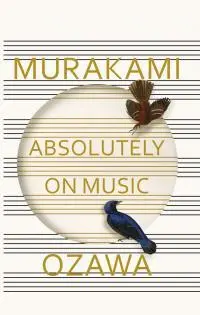
- Название:Absolutely on Music
- Автор:
- Издательство:Random House
- Жанр:
- Год:2016
- ISBN:нет данных
- Рейтинг книги:3 / 5. Голосов: 1
-
Избранное:Добавить в избранное
- Отзывы:
-
Ваша оценка:
Absolutely on Music: краткое содержание, описание и аннотация
Предлагаем к чтению аннотацию, описание, краткое содержание или предисловие (зависит от того, что написал сам автор книги «Absolutely on Music»). Если вы не нашли необходимую информацию о книге — напишите в комментариях, мы постараемся отыскать её.
Haruki Murakami's passion for music runs deep. Before turning his hand to writing, he ran a jazz club in Tokyo, and the aesthetic and emotional power of music permeates every one of his much-loved books. Now, in *Absolutely on Music,* Murakami fulfills a personal dream, sitting down with his friend, acclaimed conductor Seiji Ozawa, to talk about their shared interest.
They discuss everything from Brahms to Beethoven, from Leonard Bernstein to Glenn Gould, from record collecting to pop-up orchestras, and much more.
Absolutely on Music — читать онлайн бесплатно полную книгу (весь текст) целиком
Ниже представлен текст книги, разбитый по страницам. Система сохранения места последней прочитанной страницы, позволяет с удобством читать онлайн бесплатно книгу «Absolutely on Music», без необходимости каждый раз заново искать на чём Вы остановились. Поставьте закладку, и сможете в любой момент перейти на страницу, на которой закончили чтение.
Интервал:
Закладка:
I’m a jazz lover, so that’s how I set down a rhythm first. Then I add chords to it and start improvising, making it up freely as I go along. I write as if I’m making music.
OZAWA: I never knew that there could be rhythm in writing. I’m still not that clear on what you mean by it.
MURAKAMI: Well, rhythm is an important element for both reader and writer. If you’re writing a piece of fiction and you haven’t established a rhythm, the next sentence won’t come out, which means the story can’t move ahead. The rhythm in the writing, the rhythm of the story: if you’ve got those, the next sentence will come out naturally. When I’m writing a sentence, I automatically sound it out in my head, and a rhythm takes hold, kind of like in jazz: you ad-lib a chorus, and that leads organically to the next chorus.
OZAWA: I live in the Seijo neighborhood of Tokyo, and I was recently given a pamphlet for a candidate running for office there. I opened it up and found some kind of pledge or manifesto, so I started reading it because I had nothing better to do at the time, and I found myself thinking, “This guy will never make it.” And I felt this because I couldn’t read more than three lines of this document, no matter how hard I tried. This guy seemed to be saying something important, but I just couldn’t read it.
MURAKAMI: And that’s probably because his writing had no rhythm to it.
OZAWA: You think so? Is that what it was? What about somebody like Natsume Sōseki?
MURAKAMI: I think Sōseki’s style is tremendously musical. It makes for very smooth reading. It’s quite wonderful even now, a century after his death. I’m pretty sure he was less influenced by Western music than by the long narrative chants of the Edo period [1603– 1868], but he had a great ear. I don’t know how deeply versed he was in Western music, but he spent a couple of years studying in London, so I suspect he familiarized himself with it to some degree. I’ll look into it.
OZAWA: He was also a professor of English, wasn’t he?
MURAKAMI: He probably had a good ear in that sense, too, with a good combination of Japanese and Western elements. Hidekazu Yoshida was another writer with a musical style. His Japanese flows beautifully, is very easy to read, and is quite personal in tone.
OZAWA: You may be right about that.
MURAKAMI: Speaking of professors of literature, I gather your English professor at the Toho Gakuen School of Music was the novelist Saiichi Maruya.
OZAWA: That’s true. He had us read James Joyce’s Dubliners. There was no way I could understand a book like that. [ Laughter. ] I sat next to a girl who was good at English and she told me what it was about. I didn’t study at all. Which meant that I didn’t know any English when I went to America. [ Laughter. ]
MURAKAMI: So it was just that you didn’t study, not that Mr. Maruya was a bad teacher.
OZAWA: No, I really didn’t study.
Third Conversation
What Happened in the 1960s
THE FIRST HALF of this conversation took place on January 13th, 2011, following the previous section’s Second Conversation on the Carnegie Hall concert. There wasn’t enough time that day to complete the conversation, so the second half took place on February 10th, also in my Tokyo office. At one point the maestro exclaimed, “I’ve forgotten so much!” but his recollections were in fact quite vivid and interesting.
Working as Assistant Conductor
Under Leonard Bernstein
MURAKAMI: Today I’d like to focus on your experiences in the 1960s.
OZAWA: I wonder how much I’ll remember. I get the feeling I’ve forgotten just about everything. [ Laughter. ]
MURAKAMI: You mentioned before that you had been assistant conductor under Leonard Bernstein in New York. I was planning to ask you—but at the time forgot—exactly what kind of work an assistant conductor does.
OZAWA: Just about all orchestras have one assistant conductor, but Bernstein was unusual—he had three. I suppose they had some extra source of money to pay for three assistants. Each year they hired three new people for the position, to stay for one-year terms. Claudio Abbado did it, and Edo de Waart, and Lorin Maazel, and lots of other famous conductors. I was interviewed for the position while I was still in Berlin, when the New York Philharmonic happened to come to Germany on tour. Lenny and maybe ten committee members did the interview. After a concert, we all piled into cabs and went to this sort of strange bar called Rififi where we drank and did the interview. They used the bar’s piano and did a kind of test of my ear. Lenny had just conducted the Beethoven First Piano Concerto from the keyboard and was feeling very relaxed after a job well done. My English was terrible at the time, so I could hardly understand what anybody was saying, but somehow I managed to pass [ laughter ] and become an assistant. The other two had already been chosen for that year, so I was the last of the three. The others were John Canarina and Maurice Peress.
MURAKAMI: So you went from Berlin to New York?
OZAWA: That was in the fall, and six months later, in the spring of 1961, the New York Philharmonic was set to go to Japan. There was some kind of big event going on in Tokyo—“East Meets West” or “West Meets East” or something—and the orchestra was invited to participate. They decided that I should be the assistant conductor to go, which made sense since I was Japanese. Normally each of us was responsible for a third of the repertory—with three assistant conductors, we would each prepare one of Lenny’s three performance pieces, in case he got sick and needed someone to fill in.
MURAKAMI: So if something happened, you’d come on stage and conduct in his place.
OZAWA: Right. Also, in those days, often the conductor couldn’t make it to a rehearsal. I wonder why, come to think of it. Maybe plane schedules weren’t as dependable as they are now. Lenny often didn’t show up for the beginning of a rehearsal, so the three of us would decide which of us would go first and rehearse with the orchestra.
MURAKAMI: In his place, you mean.
OZAWA: Yes. Lenny was rather fond of me, so I was often treated better than the others. Long before the Japan trip, the New York Philharmonic had commissioned a work by Toshiro Mayuzumi, who produced his Bacchanale for them. Mayuzumi naturally assumed that Bernstein would be conducting it, but Bernstein told me, as the assistant for that piece, to take charge of the rehearsal at Carnegie Hall. So I ran through the rehearsal with both Bernstein and Mayuzumi looking on. I assumed it was just for that one day, and that Lenny would take over after that, but the next day he told me to do it again. So I ended up conducting the work’s New York debut.
MURAKAMI: Incredible.
OZAWA: We went to Japan after the New York performance. In my mind, of course Lenny would be conducting the piece in Japan, but on the plane, he told me that I would be conducting it for the Japan performance—that my name was already printed in the program.
MURAKAMI: So they were planning to have you perform it in Japan all along.
OZAWA: And that’s exactly what happened.
MURAKAMI: Was that your first public appearance conducting the New York Philharmonic?
OZAWA: I think it was. No, actually, I had done it once before. The orchestra was on a national tour and—was it in Detroit?—I conducted an encore, probably in an outdoor performance. Lenny liked to play the finale of Stravinsky’s Firebird as an encore. It’s a short piece, maybe five or six minutes long. So when he was called back to the stage, he took my hand and led me out and announced to the audience, “Here’s a young conductor. I’d love to have you listen to him perform.” The audience probably wasn’t too happy about that, though fortunately no one went so far as to boo me.
Читать дальшеИнтервал:
Закладка:
Похожие книги на «Absolutely on Music»
Представляем Вашему вниманию похожие книги на «Absolutely on Music» списком для выбора. Мы отобрали схожую по названию и смыслу литературу в надежде предоставить читателям больше вариантов отыскать новые, интересные, ещё непрочитанные произведения.


Обсуждение, отзывы о книге «Absolutely on Music» и просто собственные мнения читателей. Оставьте ваши комментарии, напишите, что Вы думаете о произведении, его смысле или главных героях. Укажите что конкретно понравилось, а что нет, и почему Вы так считаете.