Харуки Мураками - Absolutely on Music
Здесь есть возможность читать онлайн «Харуки Мураками - Absolutely on Music» весь текст электронной книги совершенно бесплатно (целиком полную версию без сокращений). В некоторых случаях можно слушать аудио, скачать через торрент в формате fb2 и присутствует краткое содержание. Год выпуска: 2016, Издательство: Random House, Жанр: Современная проза, на английском языке. Описание произведения, (предисловие) а так же отзывы посетителей доступны на портале библиотеки ЛибКат.
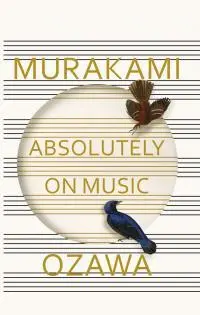
- Название:Absolutely on Music
- Автор:
- Издательство:Random House
- Жанр:
- Год:2016
- ISBN:нет данных
- Рейтинг книги:3 / 5. Голосов: 1
-
Избранное:Добавить в избранное
- Отзывы:
-
Ваша оценка:
Absolutely on Music: краткое содержание, описание и аннотация
Предлагаем к чтению аннотацию, описание, краткое содержание или предисловие (зависит от того, что написал сам автор книги «Absolutely on Music»). Если вы не нашли необходимую информацию о книге — напишите в комментариях, мы постараемся отыскать её.
Haruki Murakami's passion for music runs deep. Before turning his hand to writing, he ran a jazz club in Tokyo, and the aesthetic and emotional power of music permeates every one of his much-loved books. Now, in *Absolutely on Music,* Murakami fulfills a personal dream, sitting down with his friend, acclaimed conductor Seiji Ozawa, to talk about their shared interest.
They discuss everything from Brahms to Beethoven, from Leonard Bernstein to Glenn Gould, from record collecting to pop-up orchestras, and much more.
Absolutely on Music — читать онлайн бесплатно полную книгу (весь текст) целиком
Ниже представлен текст книги, разбитый по страницам. Система сохранения места последней прочитанной страницы, позволяет с удобством читать онлайн бесплатно книгу «Absolutely on Music», без необходимости каждый раз заново искать на чём Вы остановились. Поставьте закладку, и сможете в любой момент перейти на страницу, на которой закончили чтение.
Интервал:
Закладка:
OZAWA: No, this is the work of Dominic Fyfe, the English recording engineer. He’s terrific. In any case, 99 percent of the performance is straight from the live recording. As I said before, most of the edits were simply to remove audience noise.
Performing Brahms
with the Saito Kinen Orchestra
MURAKAMI: Listening to this CD has made me wonder if the sound at Carnegie Hall has changed over the years.
OZAWA: It has. When we recorded this, I hadn’t been there for some time, and I’m pretty sure it changed during that time. It got a lot better.
MURAKAMI: I heard it was renovated.
OZAWA: Oh, really? That makes sense. When I brought the Boston Symphony there thirty years ago, you could hear the subway rumbling underground. It passes right underneath. You’d get the subway going by four or five times in the space of one symphony. [ Laughter. ]
MURAKAMI: At least from listening to this recording, it seems to me that the sound is better.
OZAWA: You’re right, it’s much better than it used to be. The live recording came out a lot better than I thought it would. Hmm … when was I last at Carnegie before this? Probably five years ago when I conducted the Vienna Philharmonic there. I remember then thinking that the sound had improved. It certainly hadn’t when I was there with the Boston Symphony.
MURAKAMI: As I mentioned earlier, I heard you do the Brahms First with the Boston Symphony in 1986; and later with the Saito Kinen Orchestra on DVD. Now there’s this new performance at Carnegie Hall, and listening to them all, I get the impression the sound is very different from one recording to the next. Why do you think they’re so different?
OZAWA [ after a lot of thought ]: Well, first of all, the biggest difference might be that the Saito Kinen string sound has changed. How should I put it? The strings are more “talkative”? They’ve brought expression more to the foreground. The strings have made their expression so rich that some people might say they’re overdoing it.
MURAKAMI: You mean their expressiveness is more overt?
OZAWA: Yes, and the wind instruments have joined them in being more expressive. For comparison, we listened to the same part of the Brahms First played by Karajan and the Berlin Philharmonic a few minutes ago, and of course it was very fine and well balanced and solidly symmetrical, but the Saito Kinen musicians are not that concerned about balance. Just listen to this Carnegie Hall performance we’re discussing, and you can tell their mind-set is probably very different from that of the usual professional orchestra.
MURAKAMI: Their mind-set?
OZAWA: In other words, say you’ve got a dozen or more people in a section of the orchestra. Each one of them, from the one in front to the one all the way in back, is thinking, “I’m the one who’s going to make this work,” “I’m number one,” and they’re playing up a storm.
MURAKAMI: That’s incredible. But even if there has been this change in expressiveness, the actual sound of the strings hasn’t changed direction all that much since the beginning.
OZAWA: Not at all. It’s exactly the same.
MURAKAMI: I’d like to hear a little about the origins of the Saito Kinen Orchestra. It’s not a typical permanent orchestra, is it? People who normally work in other places get together once a year and perform as a unit.
OZAWA: That’s right.
MURAKAMI: In other words, they take off from work to join forces?
OZAWA: Well, there’s the string section, for example. I won’t say most of its members, but a good number of them, do not perform in other orchestras. True, we have people such as the concertmaster of a famous orchestra, but I’m pretty sure the greater proportion of our members are people who do not belong to specific orchestras, people who play chamber music or who teach.
MURAKAMI: I guess there are a lot of musicians like that.
OZAWA: I think there are more and more people, especially lately, who want to make music but who don’t want to play in an orchestra all year.
MURAKAMI: You mean, they want to make music more freely—they don’t want to submit to the restrictions involved in belonging to a fixed organization.
OZAWA: Right. For example, there’s Claudio Abbado’s Mahler Chamber Orchestra. It’s the same thing with them. A lot of leading musicians gather together from all over to form the group, but most of them are active in music without belonging to specific orchestras.
MURAKAMI: That is an outstanding orchestra, isn’t it?
OZAWA: Yes, they’re terrific.
MURAKAMI: Lately, it seems, new organizations like that, very high-quality orchestras separate from the established, so-called distinguished orchestras, have been on the increase throughout the world. Since the members of these new groups gather spontaneously, do you think that naturally leads to a certain kind of spontaneity in the sounds they produce?
OZAWA: That could very well be the case, because these are not people who belong to an orchestra and play with the same people week after week. And even if some of them are musicians who play with the same people week after week, they see all new faces in these new groupings, and so they come to the music with a different mind-set. Of course, there are people who call these new orchestras “once-a-year wonders,” and not always with a good meaning. [ Laughter. ]
MURAKAMI: Which means the musicians are not your employees, so if they happen not to like the music you are making, they can decide not to participate next time. It’s not a job for them that requires them to do work they don’t like. They can just up and quit.
OZAWA: Well, true, but we do have people who come all that distance for the chance to work with me. Musicians who normally play in Berlin or Vienna or in some American orchestra will make the trip to the hills of Matsumoto. It’s hard for people like that to take time off, and while they’re in Matsumoto, they can’t do side jobs or take students.
MURAKAMI: Are you saying you can’t pay them very well?
OZAWA: We’re always struggling to pay them as much as possible, but quite frankly, we have our limits.
MURAKAMI: But still, the number of orchestras worldwide that are organized in such a fluid way, with people freely coming and going, has been increasing, hasn’t it? It’s quite a contrast to traditional established orchestras operating under a strict management system. And that way the musicians can enjoy spontaneously “talking” with each other.
OZAWA: Yes, Claudio Abbado’s Lucerne Festival Orchestra is like that, and so is the Deutsche Kammerphilharmonie.
MURAKAMI: Oh, that’s the Bremen orchestra that Paavo Järvi directs, isn’t it? I heard it the other day.
OZAWA: Each one of them is active for three or four months out of the year, and after that the musicians have to fend for themselves—“Sorry, everybody, we can’t pay your salary while you’re away, so you’re on your own now.” That’s the new system.
MURAKAMI: It’s different for the conductors, too, I suppose. Your attitude must be a little different when you’re conducting one of these orchestras as opposed to conducting an established orchestra—say, when you were conductor of the Boston Symphony.
OZAWA: Oh, yes, very different, of course. You’re a little tense, for one thing, and you bring a different kind of enthusiasm to it. Everybody—a group of friends—gets together in the hall for the “once-a-year wonder,” so you’d better stay alert or you hear them saying, “You’re not your usual self this year, Seiji. Maybe your strength is waning,” or “Maybe you haven’t been doing your homework.” It can be tough. I’ve had a lot of occasions where they could be pretty nasty—or at least blunt. [ Laughter. ] Well, anyway, most of my buddies from the old days have retired or whatnot. There aren’t too many of them left.
Читать дальшеИнтервал:
Закладка:
Похожие книги на «Absolutely on Music»
Представляем Вашему вниманию похожие книги на «Absolutely on Music» списком для выбора. Мы отобрали схожую по названию и смыслу литературу в надежде предоставить читателям больше вариантов отыскать новые, интересные, ещё непрочитанные произведения.




Обсуждение, отзывы о книге «Absolutely on Music» и просто собственные мнения читателей. Оставьте ваши комментарии, напишите, что Вы думаете о произведении, его смысле или главных героях. Укажите что конкретно понравилось, а что нет, и почему Вы так считаете.