Харуки Мураками - Absolutely on Music
Здесь есть возможность читать онлайн «Харуки Мураками - Absolutely on Music» весь текст электронной книги совершенно бесплатно (целиком полную версию без сокращений). В некоторых случаях можно слушать аудио, скачать через торрент в формате fb2 и присутствует краткое содержание. Год выпуска: 2016, Издательство: Random House, Жанр: Современная проза, на английском языке. Описание произведения, (предисловие) а так же отзывы посетителей доступны на портале библиотеки ЛибКат.
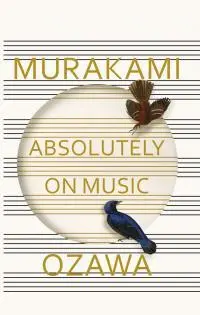
- Название:Absolutely on Music
- Автор:
- Издательство:Random House
- Жанр:
- Год:2016
- ISBN:нет данных
- Рейтинг книги:3 / 5. Голосов: 1
-
Избранное:Добавить в избранное
- Отзывы:
-
Ваша оценка:
Absolutely on Music: краткое содержание, описание и аннотация
Предлагаем к чтению аннотацию, описание, краткое содержание или предисловие (зависит от того, что написал сам автор книги «Absolutely on Music»). Если вы не нашли необходимую информацию о книге — напишите в комментариях, мы постараемся отыскать её.
Haruki Murakami's passion for music runs deep. Before turning his hand to writing, he ran a jazz club in Tokyo, and the aesthetic and emotional power of music permeates every one of his much-loved books. Now, in *Absolutely on Music,* Murakami fulfills a personal dream, sitting down with his friend, acclaimed conductor Seiji Ozawa, to talk about their shared interest.
They discuss everything from Brahms to Beethoven, from Leonard Bernstein to Glenn Gould, from record collecting to pop-up orchestras, and much more.
Absolutely on Music — читать онлайн бесплатно полную книгу (весь текст) целиком
Ниже представлен текст книги, разбитый по страницам. Система сохранения места последней прочитанной страницы, позволяет с удобством читать онлайн бесплатно книгу «Absolutely on Music», без необходимости каждый раз заново искать на чём Вы остановились. Поставьте закладку, и сможете в любой момент перейти на страницу, на которой закончили чтение.
Интервал:
Закладка:
MURAKAMI: You’ve played the Brahms First at the Matsumoto festival, too, with the Saito Kinen Orchestra, haven’t you?
OZAWA: Yes, we’ve done all four Brahms symphonies, but the First we did way back in the early period of the orchestra. It must have been a good twenty years ago.
MURAKAMI: So the membership of the orchestra at Carnegie Hall must have been very different from that time.
OZAWA: Oh, sure, very different, practically a different orchestra. There are a few string players left, but I wonder about the wind instruments. Hmm, maybe one or two left, that’s about all.
MURAKAMI: Speaking of wind instruments, I thought the horn player was awfully good in the Carnegie recording.
OZAWA: Yes, he’s great. His name is Radek Baborák. He’s a real genius, probably the best horn player in the world. He’s Czech. I first met him when he was still in Munich. After that he moved to the Berlin Philharmonic as first horn, and he often comes to play with the Saito Kinen. I think he first came to Japan the year of the Nagano Olympics—what’s that, 1998? We did the Beethoven Ninth for the Winter Olympics with him as fourth horn. The fourth horn is the one with the most solos. That was his first time, and he’s been coming ever since.
MURAKAMI: That horn solo really stuck with me.
OZAWA: Yes, it’s wonderful. He comes to Japan to play with both the Saito Kinen and the Mito Chamber Orchestra. I get along tremendously well with him. I’ve heard he’s quit the Berlin and gone back to the Czech Republic, though.
MURAKAMI: This CD of the Carnegie concert is a live recording, of course, but they’ve scrubbed it to remove stray noises, haven’t they? I was amazed the first time I heard it, it was so quiet. I could hardly believe it was live.
OZAWA: You’re right, it’s almost impossible to get such a clean live recording. They’ve taken out the audience’s coughs and wheezes and filled the gaps with rehearsal takes.
MURAKAMI: This feels like backstage gossip, but what they basically did was patch the blemishes?
OZAWA: That is correct.
MURAKAMI: But you told me that in the introductory part of the fourth movement there are also two unusual spots where they made a switch, for performance reasons, and it was not just to remove background noise. I should explain to our readers that you let me have a copy of the original recording and gave me a kind of homework assignment, asking me to find where it was different from the edited version. So I spent all of yesterday evening comparing the two recordings in every detail. [ Laughter. ]
I put the unedited CD of the symphony on, beginning with the fourth movement. While it plays, Ozawa eats a dried persimmon for nourishment. The orchestra reaches a long, diminishing roll of the timpani (2:28).
MURAKAMI: It starts here, right?
OZAWA: Yes, this is it.
The French horn begins to play the theme of the introductory section. The sound of the horn is deep and soft.
OZAWA: This is Baborák.
MURAKAMI: A beautiful, leisurely sound. How many horn players are there altogether?
OZAWA: There are four horns, but only two are playing here. They’re not playing in unison, though, but in alternating measures, and they overlap slightly where one ends and the other begins [ 2:39– 43 ]. That way, there’s no break where they take a breath. Brahms indicated in his score that it should be done that way.
The horn solo ends, and the flute picks up the theme.
OZAWA: Now the flute takes it. This is Jacques Zoon. He was principal flautist in Boston about ten years ago. Now he’s teaching in Switzerland. The flutes alternate—the first flute [ 3:13 ], and now the second flute takes over [ 3:17 ]. Now here’s the first flute again [ 3:21 ]. Brahms specifies these small details so the audience won’t hear the instrumentalists taking a breath.
MURAKAMI: Here the flute solo ends, and now the theme is taken up by a wind ensemble [ 3:50 ].
OZAWA: Yes, three trombones, two bassoons, and there’s a contrabassoon in the mix, too.
The trombones here are playing for the first time in the movement, as if they have been waiting for their chance. Then, as if rising through a break in the clouds, the horns find their way through the quietly celebratory, majestic wind ensemble for another short solo (4:13).
MURAKAMI: This is where the part that’s different in the two versions ends, correct?
OZAWA: We’re listening to the first version now, right?
MURAKAMI: That’s right. In the first version, the horns seem to come strongly to the foreground, bright and clear.
OZAWA: Yes, while in the revised CD, the horns sound—
MURAKAMI: Farther back.
OZAWA: You’ve got it.
MURAKAMI: Well, I worked hard at comparing the two. [ Laughter. ] The horns are pulled back in the edited version, and the sound is duller and more restrained.
OZAWA: Right. The horns in the original are just a little too bold, so they replaced this part with another take, and that’s what you hear in the new version. Actually, though, there’s one more part where they switched takes.
MURAKAMI: That one I couldn’t find.
After a breathtakingly beautiful moment of silence, the strings ease into the fourth movement’s famous main theme (4:52). The introductory section, centered on the horn solos, has performed its important role—they lead right into this famous section.
MURAKAMI: All right, let’s now listen to the revised version, starting from the roll of the timpani.
The first horn solo begins.
OZAWA: Here is the first horn, then the second, then first, then second. See what I mean? You can’t hear the horn pausing for breath.
MURAKAMI: Not at all.
OZAWA: Now the flutes. First flute, one measure, second flute, then first, then second. Right at this point, in the other recording, you could hear him taking a breath. The flute actually requires more breath than the horn, you know. So they switched takes on this part.
MURAKAMI: Oh, really? I see what you mean. A layman would never notice something like that.
After the wind ensemble, the horn solo rises up again.
OZAWA: Here, see what I was talking about? The horns are softer in this recording.
MURAKAMI: They are softer. They sound very different. They were almost brash on the other recording, but here they have a more restrained, deeper quality.
Brahms uses the horns with great skill, as if calling the audience deep into a German forest. The sound carries with it an important part of Brahms’s internal spiritual world. Behind the horns, the timpani pulsate softly but insistently, as if secretly waiting for something with great meaning. This is a part well worth the great care that has been lavished on its editing.
OZAWA: The other instruments gradually join with the soloists.
MURAKAMI: You can hear the strings clearly.
OZAWA: Yes.
The introductory section ends, and the beautiful main theme begins, a melody that almost makes you want to add words.
MURAKAMI: I get the feeling that the switch in the horn segment somehow improved the balance, or the coherence of the music, over the unedited version. But this is something you can only get by concentrating very closely on every detail. The first version is also a wonderful performance. I’m sure I wouldn’t have noticed the difference if you hadn’t made me listen for it. In literary terms, this would be about equivalent to the difference in nuance introduced by one tiny modifier, which the overwhelming majority of readers would read through without noticing a thing. Still, the editorial skill here is amazing. There’s nothing odd going on in the sound.
Читать дальшеИнтервал:
Закладка:
Похожие книги на «Absolutely on Music»
Представляем Вашему вниманию похожие книги на «Absolutely on Music» списком для выбора. Мы отобрали схожую по названию и смыслу литературу в надежде предоставить читателям больше вариантов отыскать новые, интересные, ещё непрочитанные произведения.


Обсуждение, отзывы о книге «Absolutely on Music» и просто собственные мнения читателей. Оставьте ваши комментарии, напишите, что Вы думаете о произведении, его смысле или главных героях. Укажите что конкретно понравилось, а что нет, и почему Вы так считаете.