Харуки Мураками - Absolutely on Music
Здесь есть возможность читать онлайн «Харуки Мураками - Absolutely on Music» весь текст электронной книги совершенно бесплатно (целиком полную версию без сокращений). В некоторых случаях можно слушать аудио, скачать через торрент в формате fb2 и присутствует краткое содержание. Год выпуска: 2016, Издательство: Random House, Жанр: Современная проза, на английском языке. Описание произведения, (предисловие) а так же отзывы посетителей доступны на портале библиотеки ЛибКат.
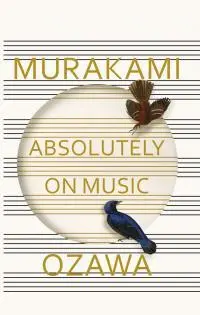
- Название:Absolutely on Music
- Автор:
- Издательство:Random House
- Жанр:
- Год:2016
- ISBN:нет данных
- Рейтинг книги:3 / 5. Голосов: 1
-
Избранное:Добавить в избранное
- Отзывы:
-
Ваша оценка:
Absolutely on Music: краткое содержание, описание и аннотация
Предлагаем к чтению аннотацию, описание, краткое содержание или предисловие (зависит от того, что написал сам автор книги «Absolutely on Music»). Если вы не нашли необходимую информацию о книге — напишите в комментариях, мы постараемся отыскать её.
Haruki Murakami's passion for music runs deep. Before turning his hand to writing, he ran a jazz club in Tokyo, and the aesthetic and emotional power of music permeates every one of his much-loved books. Now, in *Absolutely on Music,* Murakami fulfills a personal dream, sitting down with his friend, acclaimed conductor Seiji Ozawa, to talk about their shared interest.
They discuss everything from Brahms to Beethoven, from Leonard Bernstein to Glenn Gould, from record collecting to pop-up orchestras, and much more.
Absolutely on Music — читать онлайн бесплатно полную книгу (весь текст) целиком
Ниже представлен текст книги, разбитый по страницам. Система сохранения места последней прочитанной страницы, позволяет с удобством читать онлайн бесплатно книгу «Absolutely on Music», без необходимости каждый раз заново искать на чём Вы остановились. Поставьте закладку, и сможете в любой момент перейти на страницу, на которой закончили чтение.
Интервал:
Закладка:
MURAKAMI: How do you decide what to play?
OZAWA: At first it was nothing but Brahms. We’d add maybe Bartók’s Concerto for Orchestra or Toru Takemitsu’s November Steps, but the core of the repertory was always the four Brahms symphonies. Sticking close to Brahms, we’d add other pieces little by little. We did one of the four Brahms symphonies each year, and then the Matsumoto music festival began. In Matsumoto, too, we did Brahms and went on to Beethoven.
MURAKAMI: First, let there be Brahms.
OZAWA: Exactly.
MURAKAMI: But why? Why Brahms?
OZAWA: Well, we—or rather I—felt that Brahms best conveyed the sense of Professor Saito. You’ve heard of the conductor Kazuyoshi Akiyama, I’m sure. He saw things differently. He thought we should be doing a little lighter repertory—Mozart and Schumann. I’m pretty sure he first conducted Schumann with the Saito Kinen. But I thought we should do Brahms. I asked the others about it, and I think that’s how we decided. We felt that Brahms was more suited than Beethoven to Professor Saito’s idea of “talkative strings,” a richer expressiveness in the string section. So then we started touringEurope with the idea of doing the complete Brahms. We’ve done four European tours now. The first Brahms symphony we played was … I’m pretty sure … the First.
MURAKAMI: Professor Saito’s main repertory consisted of Brahms, Beethoven, and Mozart, I believe.
OZAWA: Yes, and Haydn.
MURAKAMI: Mainly German music.
OZAWA: Yes, and Tchaikovsky, of course. The symphonies and the Serenade for Strings. We had our longest and best training for the Serenade at the Toho Gakuen School of Music. And do you know why? Because the Toho orchestra hardly had any wind instruments! [ Laughter. ] We’d play Mozart with only one oboe and one flute, and the organ would fill in for the rest. Sometimes I played the timpani, and then Professor Saito would conduct; or if it was a piece without timpani, I would conduct. Yes, there really was a time like that!
MURAKAMI: When you say the orchestra was suited to Brahms, how do you mean? Was it the timbre, or the sound?
OZAWA: No, it’s not so much the sound as … how should I put this? Its style of playing, the string section’s use of the bow, their direction, their phrasing are probably just suited to Brahms. Professor Saito taught us that music is expression, and that is also my view. When he taught us a Brahms symphony, he was especially fervent about this. He had to be practical, though, and so, in part because of the available instrumentation, he tended to teach pieces such as Tchaikovsky’s Serenade for Strings, Mozart’s Divertimento, some of Handel’s Concerti Grossi, a Bach Brandenburg concerto, or Schoenberg’s Verklärte Nacht.
MURAKAMI: But even with that dearth of wind instruments, he’d forge ahead energetically with a Brahms symphony?
OZAWA: That’s right. He’d manage, one way or another, to make up for the thin ranks of wind players.
MURAKAMI: I’m not very knowledgeable about technical matters, but aren’t Brahms’s orchestrations a good deal more complex than Beethoven’s?
OZAWA: No, not really. They were working with practically the same instruments. Something like the contrabassoon was not so common in Beethoven’s day, but otherwise they were not that different. There are only the tiniest differences in orchestration.
MURAKAMI: So what you’re saying is that Brahms and Beethoven are pretty much the same when it comes to the way they integrate the sounds of the orchestra?
OZAWA: Yes. There’s a lot more breadth to the sound of Brahms, but for Brahms and Beethoven, the instrumentation itself is pretty much the same.
MURAKAMI: Why is it, then, that when I listen, their sound is very different?
OZAWA: That is true. [ Pause. ] Look, Beethoven himself changes a lot in the Ninth. His orchestrations were quite limited until he got to his Ninth Symphony.
MURAKAMI: My impression is that when Brahms and Beethoven use a similar group of instruments, the result is still something very different. With Brahms, it’s as if a new sound comes in between any two sounds, making the whole thing one level denser. Maybe that’s why it’s so much easier to grasp the musical structure in a Beethoven piece.
OZAWA: Yes, of course. The structure is much easier to see in a piece by Beethoven. You can hear the winds and the strings talking to each other. But Brahms creates his unique sound by blending the two together.
MURAKAMI: Ah, that helps me understand the difference.
OZAWA: This is clear even in Brahms’s First Symphony. That’s the reason everybody says that Brahms’s First Symphony is like Beethoven’s Tenth. That’s where the connection lies.
MURAKAMI: So where orchestration is concerned, Brahms continued with the reforms that Beethoven began with his Ninth, and final, Symphony.
OZAWA: That’s the idea.
MURAKAMI: And after Brahms, the Saito Kinen goes on to make Beethoven symphonies central to its repertoire.
OZAWA: Yes, and after Beethoven we’ve been doing Mahler—the Second, the Ninth, the Fifth, and the First, I think. And recently we did our first French piece, the Symphonie fantastique. As for opera, we did Poulenc and Honegger. I used to consult with William Bernell, a guy in San Francisco who made programs. The two of us would get together and decide what to perform. I got his advice when I was in Boston, too, and all the way from the beginning with the Saito Kinen. He died last year at the age of eighty-four. We worked together for almost fifty years.
MURAKAMI: If you ever felt like playing some Sibelius, that would make me very happy. I love his symphonies. I’ve never heard a Sibelius by you other than the Violin Concerto you recorded with Viktoria Mullova.
OZAWA: Which of his symphonies do you like? The Third? The Fifth?
MURAKAMI: The Fifth is my favorite.
OZAWA: That last movement is good, isn’t it? When I was taking lessons from Maestro Karajan in 1960– 61, I conducted the finale of the Sibelius Fifth. That and Mahler’s Das Lied von der Erde. He gave me those as an assignment in big, romantic pieces.
MURAKAMI: Maestro Karajan was very fond of the Sibelius Fifth, wasn’t he? I think he must have recorded it four times.
OZAWA: Yes, he liked it a lot. His performances were wonderful, of course, but he also used it to teach his disciples. He always told us that it was the job of the conductor to create long phrases. “Read what’s behind the score,” he would say. “Don’t just read individual measures; read in longer units.” We were accustomed to reading four-or eight-measure phrases, but he saw the music in terms of very long units—sixteen measures, or, in extreme cases, up to thirty-two measures. None of this is written in the score, of course, but he insisted that it was the conductor’s job to read that way. The composer was always writing with those long phrases in mind, so it was up to us to find them. That was one of the most important things he taught us.
MURAKAMI: Karajan’s performances always have this very solid narrative that comes from his creation of those long phrases. I’m often amazed to hear how his old recordings, in particular, have this element of storytelling or persuasiveness that has survived the years without the least sense of aging—though every now and then, I admit, there will be something that strikes me as a little old-fashioned.
OZAWA: There are those moments, it’s true.
MURAKAMI: It seems to me that in Karajan’s music, there’s a fairly clear dividing line between the two. It can go either way, with little compromise in either case.
OZAWA: You may be right. Furtwängler was the same way.
MURAKAMI: Now we’re talking about a national treasure.
Читать дальшеИнтервал:
Закладка:
Похожие книги на «Absolutely on Music»
Представляем Вашему вниманию похожие книги на «Absolutely on Music» списком для выбора. Мы отобрали схожую по названию и смыслу литературу в надежде предоставить читателям больше вариантов отыскать новые, интересные, ещё непрочитанные произведения.



Обсуждение, отзывы о книге «Absolutely on Music» и просто собственные мнения читателей. Оставьте ваши комментарии, напишите, что Вы думаете о произведении, его смысле или главных героях. Укажите что конкретно понравилось, а что нет, и почему Вы так считаете.