Харуки Мураками - Absolutely on Music
Здесь есть возможность читать онлайн «Харуки Мураками - Absolutely on Music» весь текст электронной книги совершенно бесплатно (целиком полную версию без сокращений). В некоторых случаях можно слушать аудио, скачать через торрент в формате fb2 и присутствует краткое содержание. Год выпуска: 2016, Издательство: Random House, Жанр: Современная проза, на английском языке. Описание произведения, (предисловие) а так же отзывы посетителей доступны на портале библиотеки ЛибКат.
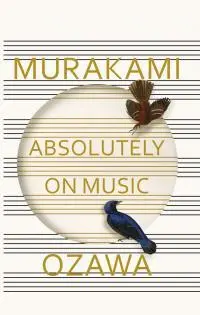
- Название:Absolutely on Music
- Автор:
- Издательство:Random House
- Жанр:
- Год:2016
- ISBN:нет данных
- Рейтинг книги:3 / 5. Голосов: 1
-
Избранное:Добавить в избранное
- Отзывы:
-
Ваша оценка:
Absolutely on Music: краткое содержание, описание и аннотация
Предлагаем к чтению аннотацию, описание, краткое содержание или предисловие (зависит от того, что написал сам автор книги «Absolutely on Music»). Если вы не нашли необходимую информацию о книге — напишите в комментариях, мы постараемся отыскать её.
Haruki Murakami's passion for music runs deep. Before turning his hand to writing, he ran a jazz club in Tokyo, and the aesthetic and emotional power of music permeates every one of his much-loved books. Now, in *Absolutely on Music,* Murakami fulfills a personal dream, sitting down with his friend, acclaimed conductor Seiji Ozawa, to talk about their shared interest.
They discuss everything from Brahms to Beethoven, from Leonard Bernstein to Glenn Gould, from record collecting to pop-up orchestras, and much more.
Absolutely on Music — читать онлайн бесплатно полную книгу (весь текст) целиком
Ниже представлен текст книги, разбитый по страницам. Система сохранения места последней прочитанной страницы, позволяет с удобством читать онлайн бесплатно книгу «Absolutely on Music», без необходимости каждый раз заново искать на чём Вы остановились. Поставьте закладку, и сможете в любой момент перейти на страницу, на которой закончили чтение.
Интервал:
Закладка:
MURAKAMI: People with money are usually busy.
OZAWA: True. But throughout our conversations, I’ve been so impressed by how deeply you have listened to each piece of music. Or so it seems to me. In your case, you have collected a lot of records, but you don’t listen to them like one of those collectors.
MURAKAMI: Well, I’ve got lots of free time and I’m mostly at home, so luckily I can listen to music from morning to night, not just collect records.
OZAWA: You’re not concerned with the record jackets—you’re listening to what’s inside them. That’s what I’ve been finding so interesting in our talks, right from the first discussion of Glenn Gould. I found myself thinking, “Hey, this is not bad.” The other day, though, I had to go to a major record store in downtown Tokyo, and after looking around for a while, I felt the old distaste coming back.
MURAKAMI: Distaste? You mean, toward records and CDs and stuff as things —as commodities?
OZAWA: Yes. I had let myself forget all about those things. I don’t have anything to do with them anymore. But spending time in the record store, I felt that old, unpleasant feeling coming back. Now, you are not a musician, and if anything, you’re closer to one of those record collectors, wouldn’t you say?
MURAKAMI: It’s true. I just collect records and listen to them. Sure, I go to a lot of concerts, but since I don’t actually make music, I’m more or less a dilettante.
OZAWA: But I’m enjoying talking to you about music like this because your perspective is so different from mine. It’s that difference that has been making it a learning experience for me, something fresh and unexpected.
MURAKAMI: I’m very glad to hear that. Listening to recorded music has been one of the greatest joys of my life.
OZAWA: It occurred to me while I was in the record store that I don’t want to have these conversations be for record collectors. I want them to be something that people who really love music will enjoy reading. I’d like that to be our guideline.
MURAKAMI: Absolutely! Let’s make sure to keep our conversations as un -interesting as possible for collectors! [ Laughter. ]
Murakami note: I thought about this afterward and realized that part of me has always derived a lot of joy from collecting records, which maybe makes me like one of those “manic record collectors” that Ozawa was talking about. I don’t see my own collecting as “manic,” but I’m fairly obsessive, so I do have a tendency to become more or less obsessed with certain things. For example, in my teens I fell in love with Mozart’s String Quartet no. 15 in D Minor (K. 421), one of the six “Haydn” quartets, in a set recorded by the Juilliard String Quartet, and for a time I listened to it exclusively, again and again. So even now, if someone mentions K. 421, I automatically start hearing the Juilliard’s keen-edged performance in my head and picture the album cover. It’s imprinted there, and it tends to be the internal standard by which I judge other performances. Records were expensive back then, and I would give my undivided attention to each precious disc, so in my mind (and with a degree of fetishism) a piece of music and the material thing on which it was recorded often comprised an indivisible unit. This may not be entirely natural, but since I didn’t play music myself, it was the only way I could engage with it. Once I had made a little money, I started buying other records and enthusiastically attending concerts. Then I discovered the joy of comparing performances by different musicians—of relativizing the music, in other words. In this way, over time, I gave shape to what each piece of music meant to me.
By contrast, when one relates to music, as Ozawa does, primarily by reading scores, music must become purer, more internalized. Or at least it is not so readily identified with tangible things. The difference may be quite substantial. I imagine that relating to music like that must be very free and open. It may be a bit like the enjoyment and freedom of being able to read foreign literature in the original, rather than in translation. Arnold Schoenberg has said that “music is not a sound but an idea,” but ordinary people can’t listen to it that way. When I told Ozawa that I envied his ability to do so, he suggested that I study to the point of being able to read a score. “Music would become even more interesting for you than it is now,” he said. I took some piano lessons many years ago, so I can read a simple piece of music, but I would be lost in a complex score such as a Brahms symphony. “If you studied for a few months with a good instructor, I’m sure you could learn to read that well,” he urged me, but I’m not ready to go that far. I do feel I’d like to give it a try someday, but I have no idea when that will happen.
We were chatting along these lines one day before an interview session when it struck me, in a precise, three-dimensional way, that there is a fundamental difference that separates the way we understand music. This was an extremely important realization. It’s hardly for me to point out how very high the wall is that separates the pro from the amateur, the music maker from the listener. The wall is especially high and thick when that music maker is a world-class professional. But still, that fact doesn’t have to hamper our ability to have an honest, direct conversation. At least that’s how I feel about it, because music itself is a thing of such breadth and generosity. Our most important task is to search for an effective passageway through the wall—and two people who share a natural affinity for an art, any art, will be sure to find that passageway.
Second Conversation
Brahms at Carnegie Hall
THIS SECOND CONVERSATION took place during two hours spent in my Tokyo office on January 13, 2011. Ozawa was scheduled to undergo endoscopic surgery on his lower back a week later. Unable to remain seated for long, he would often leave his chair and talk while he walked slowly around the room. He also needed to periodically stop to eat. His December performances at Carnegie Hall with the Saito Kinen Orchestra had been an overwhelming success, but this apparently had come at great cost to him physically.
The Emotionally Charged Carnegie Hall Concert
MURAKAMI: I recently listened to the live CD of your performance of the Brahms First Symphony at Carnegie Hall, and it was truly wonderful—so full of life, so perfect in every detail. You know, I actually heard you conduct the Brahms First when you brought the Boston Symphony to Tokyo in 1986.
OZAWA: No kidding?
MURAKAMI: That was twenty-five years ago, but I remember what a great performance that was. The sound was beautiful in every way, and the music seemed to rise up vividly before my eyes. I can still hear it. But to tell you the truth, I felt this recent performance was still more amazing. It had a special something, a kind of passionate urgency that felt like a once-in-a-lifetime experience. Quite honestly, I was worried that your recent illness might have left you physically weakened, and that would have an adverse effect on the music, but …
OZAWA: No, it was just the opposite. Something had been building up inside me and it burst out all at once. For a long time before that performance, I was dying to make music, but I couldn’t. I had badly wanted to conduct at the Matsumoto music festival in the summer, but I didn’t have the strength. All that was building up inside me.
There was also the fact that the orchestra had been charging ahead without me. We had a full four-day rehearsal in Boston before the Carnegie performance, during which time the orchestra made very minute adjustments in their work schedule to accommodate my strength and physical restrictions—to a degree that was almost inconceivable with a professional orchestra. For example, we’d rehearse for twenty-five minutes and take a fifteen-minute break, or work for twenty minutes and break for ten. Their concern was really something special. We couldn’t use Symphony Hall for the rehearsals, so we practiced in a small classroom at the Boston Conservatory.
Читать дальшеИнтервал:
Закладка:
Похожие книги на «Absolutely on Music»
Представляем Вашему вниманию похожие книги на «Absolutely on Music» списком для выбора. Мы отобрали схожую по названию и смыслу литературу в надежде предоставить читателям больше вариантов отыскать новые, интересные, ещё непрочитанные произведения.




Обсуждение, отзывы о книге «Absolutely on Music» и просто собственные мнения читателей. Оставьте ваши комментарии, напишите, что Вы думаете о произведении, его смысле или главных героях. Укажите что конкретно понравилось, а что нет, и почему Вы так считаете.