Харуки Мураками - Absolutely on Music
Здесь есть возможность читать онлайн «Харуки Мураками - Absolutely on Music» весь текст электронной книги совершенно бесплатно (целиком полную версию без сокращений). В некоторых случаях можно слушать аудио, скачать через торрент в формате fb2 и присутствует краткое содержание. Год выпуска: 2016, Издательство: Random House, Жанр: Современная проза, на английском языке. Описание произведения, (предисловие) а так же отзывы посетителей доступны на портале библиотеки ЛибКат.
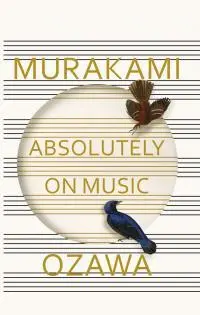
- Название:Absolutely on Music
- Автор:
- Издательство:Random House
- Жанр:
- Год:2016
- ISBN:нет данных
- Рейтинг книги:3 / 5. Голосов: 1
-
Избранное:Добавить в избранное
- Отзывы:
-
Ваша оценка:
Absolutely on Music: краткое содержание, описание и аннотация
Предлагаем к чтению аннотацию, описание, краткое содержание или предисловие (зависит от того, что написал сам автор книги «Absolutely on Music»). Если вы не нашли необходимую информацию о книге — напишите в комментариях, мы постараемся отыскать её.
Haruki Murakami's passion for music runs deep. Before turning his hand to writing, he ran a jazz club in Tokyo, and the aesthetic and emotional power of music permeates every one of his much-loved books. Now, in *Absolutely on Music,* Murakami fulfills a personal dream, sitting down with his friend, acclaimed conductor Seiji Ozawa, to talk about their shared interest.
They discuss everything from Brahms to Beethoven, from Leonard Bernstein to Glenn Gould, from record collecting to pop-up orchestras, and much more.
Absolutely on Music — читать онлайн бесплатно полную книгу (весь текст) целиком
Ниже представлен текст книги, разбитый по страницам. Система сохранения места последней прочитанной страницы, позволяет с удобством читать онлайн бесплатно книгу «Absolutely on Music», без необходимости каждый раз заново искать на чём Вы остановились. Поставьте закладку, и сможете в любой момент перейти на страницу, на которой закончили чтение.
Интервал:
Закладка:
MURAKAMI: But your approach here with the orchestra is very serious, isn’t it?
OZAWA: You think so? [ Laughs. ]
MURAKAMI: Serkin is making music the way he wants to.
Behind the piano, the strings play in spiccato (with lightly springing bows).
MURAKAMI: Isn’t this a little too slow, this part?
OZAWA: True, both of us are playing too cautiously—both Serkin and I. This should be livelier, as if we’re chatting with each other.
The cadenza begins (12:50).
MURAKAMI: I’m particularly fond of Serkin’s approach to this cadenza. It’s like he’s climbing a hill with a load on his back. There’s nothing fluent here; it’s almost as though he’s stuttering—you have to admire him for it. Will he be okay? Will he make it all the way to the top? You worry for him as you listen, and the music gets to you.
OZAWA: Nowadays, everybody just tears right through it. It’s nice to have one like this, too.
The pianist’s fingers seem to falter for a split second (14:56).
MURAKAMI: Ooh, he was kind of flirting with danger there, wasn’t he? That can be nice, too, though.
OZAWA: Ha ha, really, it was touch-and-go.
The cadenza ends, and the orchestra slowly begins to play (16:02).
MURAKAMI: The orchestra’s entry here is so delicate, I tense up.
OZAWA: Mmm, I see what you mean. But the timpanist here is excellent. He’s very good—Vic Firth. He was with the Saito Kinen Orchestra from the beginning for almost twenty years.
The first movement ends (16:53).
OZAWA: It was a lot better toward the end.
MURAKAMI: I think so. Really working together.
OZAWA: Fine cadenza, though, you’re right.
MURAKAMI: I get this sudden wave of exhaustion whenever I hear it. It’s good, though. It brings out his personality.
OZAWA: How many years before his death was this, I wonder?
MURAKAMI: Well, the recording was made in 1982, and Serkin died in ’91, so nine years before. He was seventy-nine at the time.
OZAWA: So he died at eighty-eight.
MURAKAMI: Who set the tempo in this recording, I wonder—him or you?
OZAWA: He was the old maestro in this one, of course, so we did it exactly as he wanted it. Straight through from rehearsals. I did my best to match his approach from the very first tutti. Here, I’m conducting strictly as an accompanist.
MURAKAMI: Did you do a lot of rehearsing?
OZAWA: Two solid days. Then the performance, and then we recorded.
MURAKAMI: So what you’re saying is that Mr. Serkin decided a lot of stuff beforehand.
OZAWA: The most important thing is the character of the piece. That was for him to decide. But listening to it again now, I can see I wasn’t bold enough. I should have plunged right in. It’s such a well-defined piece, I should have taken a more positive approach, but I don’t know, it’s not that I was too restrained, exactly …
MURAKAMI: As a listener, it did seem to me to have a certain indefinable air of restraint about it.
OZAWA: Well, it’s true I was trying not to overdo it. But listening to it now, with him playing so freely, making exactly the kind of music he wanted to do, I can’t help thinking I should have tried more to match him, to conduct with a little more freedom.
MURAKAMI: He’s like an old master of classical rakugo storytelling, just going along with his instincts.
OZAWA: Yes, he’s completely at ease, not the least bit concerned if his fingers stumble a little. That part where you said he was kind of flirting with danger—he really was. But that just adds to the overall flavor when you’re that good.
MURAKAMI: When I first heard this recording, I worried that his action or touch or whatever you call it was just a bit slower than it used to be—but, strangely enough, the more I listened to it, the less it bothered me.
OZAWA: That’s because a musician’s special flavor comes out with age. His playing at that stage may have more interesting qualities than at the height of his career.
MURAKAMI: That was certainly true of Rubinstein when he recorded the complete Beethoven piano concertos with Barenboim and the London Philharmonic in his eighties. His touch is the tiniest bit slower than it used to be, but the music is so rich you eventually forget about that.
OZAWA: Speaking of Rubinstein, he was very fond of me.
MURAKAMI: I didn’t know that.
OZAWA: I went all around the world with him for maybe three years, conducting accompaniment for him. It was while I was still in Toronto, so it was a very long time ago. I remember he played a recital at La Scala that I conducted using the La Scala Orchestra. Hmm, let’s see, what did we play then? A Tchaikovsky concerto and maybe a Mozart or the Beethoven Third or Fourth. He would usually play a Tchaikovsky after the intermission, though sometimes it would be a Rachmaninoff. No, I think it was a Chopin concerto, not Rachmaninoff. Yes, we went all over, performing together. He’d always take me with him. We’d meet at his place in Paris and leave from there. It was always quite a trip, but the pace was relaxed—say, a whole week at La Scala. We went to San Francisco, too. We would go to places he liked, have two or three rehearsals with the local orchestra, and give a performance. I always had the most marvelous meals with him.
MURAKAMI: So you were always playing with different orchestras. Isn’t that hard?
OZAWA: No, no, I got used to it. It’s fun being a hired conductor. As I said, I think I did it for three years. I especially remember one Italian vermouth … Carpano … Punt e Mes Carpano. I learned about it from him.
MURAKAMI: He enjoyed living well, didn’t he?
OZAWA: Very much so. He had this personal secretary he took everywhere with him, a tall, slim woman. His wife was always complaining about his ways. He was quite the ladies’ man. And he loved to eat well. In Milan he’d go to this incredibly high-end restaurant and order stuff they made especially for him. I never had to look at the menu—I’d just let him do all the ordering, and they’d bring out these special dishes. That’s when I learned what real luxury living could be.
MURAKAMI: He was probably very different from Serkin.
OZAWA: Like night and day. They were complete opposites. Serkin was totally serious, a man of simple tastes. He was a devout Jew.
MURAKAMI: You’re close to his son Peter, aren’t you?
OZAWA: Peter was a real rebel in his youth and caused his father a lot of problems. So Rudolf asked me to look after him. I saw a lot of Peter from the time he was eighteen or so. I guess Rudolf had faith in me, felt that I’d know how to deal with his son. Peter and I did a lot of things together at first. We’re still friends, but in those days we’d go to Toronto or Ravinia and places like that every year and perform together. We often performed the Beethoven Violin Concerto arranged for piano.
MURAKAMI: There’s a recording of that, with the New Philharmonia Orchestra.
OZAWA: Hmm, now that you mention it, there was a recording, wasn’t there? That was the first and last time I did that, it’s such an odd piece, the Piano Concerto op. 61a.
MURAKAMI: You never recorded with Rubinstein, did you?
OZAWA: No, never. I was so young then, and I wasn’t signed to any record company. I hardly recorded anything in those days.
MURAKAMI: It’d be nice to have some new recordings of the Beethoven piano concertos with the Saito Kinen Orchestra. Come to think of it, though, I can’t think of an appropriate pianist offhand. Lots of people have already done the complete concertos.
OZAWA: How about Krystian Zimerman?
MURAKAMI: He was doing the complete concertos with Bernstein—and the Vienna Philharmonic, I think. Bernstein died before they could finish, though, so he did double duty on the rest of them, both playing and conducting. He ended up doing all the concertos. They’re on DVD, too.
Читать дальшеИнтервал:
Закладка:
Похожие книги на «Absolutely on Music»
Представляем Вашему вниманию похожие книги на «Absolutely on Music» списком для выбора. Мы отобрали схожую по названию и смыслу литературу в надежде предоставить читателям больше вариантов отыскать новые, интересные, ещё непрочитанные произведения.



Обсуждение, отзывы о книге «Absolutely on Music» и просто собственные мнения читателей. Оставьте ваши комментарии, напишите, что Вы думаете о произведении, его смысле или главных героях. Укажите что конкретно понравилось, а что нет, и почему Вы так считаете.