Харуки Мураками - Absolutely on Music
Здесь есть возможность читать онлайн «Харуки Мураками - Absolutely on Music» весь текст электронной книги совершенно бесплатно (целиком полную версию без сокращений). В некоторых случаях можно слушать аудио, скачать через торрент в формате fb2 и присутствует краткое содержание. Год выпуска: 2016, Издательство: Random House, Жанр: Современная проза, на английском языке. Описание произведения, (предисловие) а так же отзывы посетителей доступны на портале библиотеки ЛибКат.
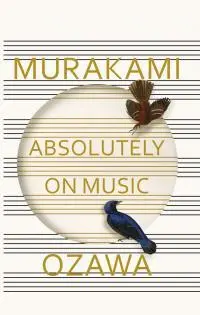
- Название:Absolutely on Music
- Автор:
- Издательство:Random House
- Жанр:
- Год:2016
- ISBN:нет данных
- Рейтинг книги:3 / 5. Голосов: 1
-
Избранное:Добавить в избранное
- Отзывы:
-
Ваша оценка:
Absolutely on Music: краткое содержание, описание и аннотация
Предлагаем к чтению аннотацию, описание, краткое содержание или предисловие (зависит от того, что написал сам автор книги «Absolutely on Music»). Если вы не нашли необходимую информацию о книге — напишите в комментариях, мы постараемся отыскать её.
Haruki Murakami's passion for music runs deep. Before turning his hand to writing, he ran a jazz club in Tokyo, and the aesthetic and emotional power of music permeates every one of his much-loved books. Now, in *Absolutely on Music,* Murakami fulfills a personal dream, sitting down with his friend, acclaimed conductor Seiji Ozawa, to talk about their shared interest.
They discuss everything from Brahms to Beethoven, from Leonard Bernstein to Glenn Gould, from record collecting to pop-up orchestras, and much more.
Absolutely on Music — читать онлайн бесплатно полную книгу (весь текст) целиком
Ниже представлен текст книги, разбитый по страницам. Система сохранения места последней прочитанной страницы, позволяет с удобством читать онлайн бесплатно книгу «Absolutely on Music», без необходимости каждый раз заново искать на чём Вы остановились. Поставьте закладку, и сможете в любой момент перейти на страницу, на которой закончили чтение.
Интервал:
Закладка:
MURAKAMI: I suppose orchestras in Beethoven’s day had fewer strings.
OZAWA: Yes, of course. So for example in the Third Symphony, the Eroica, some conductors will cut the number of strings way down, with, like, six first violins. I don’t go that far.
Beethoven with Period Instruments,
Immerseel at the Fortepiano
MURAKAMI: Now let’s listen to Beethoven’s Third Piano Concerto played on period instruments.
Jos van Immerseel plays the fortepiano with the Tafelmusik Baroque Orchestra, conducted by Bruno Weil, in a 1996 recording.
OZAWA: This has such a strong reverberation! Listen, right here, the way the next note comes in before the previous one dies. That shouldn’t be happening, ordinarily.
MURAKAMI: The reverberation is strong.
The three-note figure sounds in the orchestra’s introductory part.
OZAWA: Now here, Maestro Karajan would have played that tahn, taahn, taaahn, adding “direction,” but this orchestra just goes tahn, tahn, tahn. It’s a huge difference. Of course, this is interesting in its own way.
MURAKAMI: You can hear the sound of each instrument independently.
OZAWA: Right. Like that—the sound of the oboe stands out. That’s how it’s done.
MURAKAMI: It’s getting close to chamber music.
OZAWA: Exactly. This kind of performance has its own persuasiveness.
MURAKAMI: The Saito Kinen Orchestra tends to be like this, too.
OZAWA: It does. Everybody has his say—each of the instruments.
MURAKAMI: In many subtle ways, it sounds very different from earlier orchestras.
OZAWA: Yes, but you can’t hear the consonants in this orchestra we’re listening to.
MURAKAMI: The consonants?
OZAWA: The leading edge of each sound.
MURAKAMI: I still don’t get it.
OZAWA: Hmm, how can I put it? If you sing a-a-a, it’s all vowel. But if you add consonants to each of the a’ s, you get something like ta-ka-ka or ha-sa-sa. It’s a question of which consonants you add. It’s easy enough to make the first ta or ha, but the hard part is what follows. If it’s all consonant— ta-t-t —the melody falls apart. But the expression of the notes changes depending on whether you go ta-raa-raa or ta-waa-waa. To have a good musical ear means having control over the consonants and vowels. When the instruments of this orchestra talk to each other, the consonants don’t come out. It’s not unpleasant, though.
MURAKAMI: I see what you mean. But if they didn’t have the reverberation, it might be tiring to listen to.
OZAWA: True. Which may be why they chose the hall they did for recording.
MURAKAMI: I do find period instrument performances fresh and interesting, but you don’t actually hear many of them aside from genuine baroque music, especially with a Beethoven or a Schubert. More often, you hear orchestras using modern instruments that have been indirectly influenced by period performances.
OZAWA: You may be right. In that sense, these are interesting times for music.
On Gould Again
MURAKAMI: What interests me when I’m listening to Gould is the way he deliberately brings contrapuntal elements into performances of Beethoven. He doesn’t just try to harmonize with the orchestra but deliberately overlays their music with his, and, as a result, creates a natural tension between the two. This was a fresh interpretation of Beethoven.
OZAWA: That’s true, but what’s strange is that no one has emerged since his death to carry on and develop that stance of his. Really, no one. I guess Gould was a genius. He may have influenced others, but the way I see it, there is nobody like him, nobody with that kind of courage.
MURAKAMI: Even those few who bring a lot of invention to their performances seem to do so without a genuine sense of necessity and substance.
OZAWA: Mitsuko Uchida is a courageous pianist. And Martha Argerich has a lot of that quality.
MURAKAMI: Do you think female pianists have more of it?
OZAWA: Yes, the women are bolder.
MURAKAMI: There’s a male pianist named Valery Afanassiev.
OZAWA: Never heard of him.
MURAKAMI: He’s a contemporary musician who brings a lot of inventiveness to his playing—and he performs this Third Piano Concerto. Very interesting, intellectual, passionate—unique. But you get tired listening to him. His second movement is just too slow. “All right, I get it, I get it!” you want to say. He thinks too much. Gould never had that. Even when his playing is weirdly slow, he makes you listen to the end. You don’t get tired of him halfway through. His inner rhythms must be terrifically strong.
OZAWA: It’s those empty moments of his—the way he puts in ma. He’s amazing. Listening to him today for the first time in a long time, I realized all over again how well he does that. It’s sheer guts, something he was born with, and absolutely not an act.
MURAKAMI: But there’s no one like him. You watch a video of him playing, and he’ll suspend a hand in the air and twitch his fingers slightly to add vibrato to the sound of the piano—which is of course a physical impossibility.
OZAWA: There’s no question he was an eccentric. When I first met him, I was just getting started, and my English was terrible. Thinking back on it now, it seems like such a wasted opportunity! If only I could have talked to him more! I could even have had conversations with Bruno Walter back then if my English had been halfway decent. Think of all the things I could have talked about with Glenn! What a shame! Lenny was a tremendously kind man and he could accommodate my broken English, so we had wonderful long conversations.
Rudolf Serkin and Ozawa,
Beethoven Piano Concerto no. 3 in C Minor
MURAKAMI: Now I’d like to listen to your 1982 recording of the Third Piano Concerto with Rudolf Serkin. You don’t mind, do you?
OZAWA: No, not at all.
MURAKAMI: Because some people don’t like to listen to recordings of their own performances.
OZAWA: No, I’m fine. I haven’t heard it for a long time, so I don’t remember what it was like. It’ll probably sound heavy to me now.
MURAKAMI: No, it’s not heavy at all.
OZAWA: I wonder.
I lower the needle to the record. The orchestra’s introduction begins.
OZAWA: Very quiet opening, isn’t it?
The tranquil opening gradually begins to modulate.
OZAWA: Now, this is “direction.” Hear those four notes? Tahn-tahn-tahn-tahn. It’s the first fortissimo of the piece. I put it together that way quite consciously.
The orchestra swells and comes to the foreground.
OZAWA: I should have done more of that, given it still clearer “direction”—like tah-tah-taahn with a more emphatic accent, more boldly. Of course the score doesn’t say “more boldly” anywhere. You have to read that in for yourself.
The orchestra creates a clearer musical structure.
OZAWA: There, the “direction” is taking shape, though it’s still not bold enough.
The piano enters (3:22).
MURAKAMI: Serkin is really moving the sound along, isn’t he—taking a very positive approach toward adding his own articulation?
OZAWA: Yes, he knows that this is probably his last performance of this piece, that he won’t have another chance to record it while he’s alive, and so he’s going to play it the way he wants to. Period.
MURAKAMI: The mood is totally different from the high-strung performance he gave with Bernstein, isn’t it?
OZAWA: Pure elegance, his sound.
Читать дальшеИнтервал:
Закладка:
Похожие книги на «Absolutely on Music»
Представляем Вашему вниманию похожие книги на «Absolutely on Music» списком для выбора. Мы отобрали схожую по названию и смыслу литературу в надежде предоставить читателям больше вариантов отыскать новые, интересные, ещё непрочитанные произведения.



Обсуждение, отзывы о книге «Absolutely on Music» и просто собственные мнения читателей. Оставьте ваши комментарии, напишите, что Вы думаете о произведении, его смысле или главных героях. Укажите что конкретно понравилось, а что нет, и почему Вы так считаете.