Харуки Мураками - Absolutely on Music
Здесь есть возможность читать онлайн «Харуки Мураками - Absolutely on Music» весь текст электронной книги совершенно бесплатно (целиком полную версию без сокращений). В некоторых случаях можно слушать аудио, скачать через торрент в формате fb2 и присутствует краткое содержание. Год выпуска: 2016, Издательство: Random House, Жанр: Современная проза, на английском языке. Описание произведения, (предисловие) а так же отзывы посетителей доступны на портале библиотеки ЛибКат.
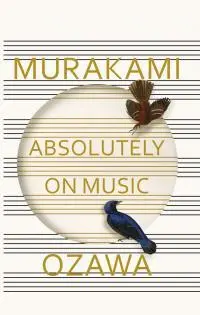
- Название:Absolutely on Music
- Автор:
- Издательство:Random House
- Жанр:
- Год:2016
- ISBN:нет данных
- Рейтинг книги:3 / 5. Голосов: 1
-
Избранное:Добавить в избранное
- Отзывы:
-
Ваша оценка:
Absolutely on Music: краткое содержание, описание и аннотация
Предлагаем к чтению аннотацию, описание, краткое содержание или предисловие (зависит от того, что написал сам автор книги «Absolutely on Music»). Если вы не нашли необходимую информацию о книге — напишите в комментариях, мы постараемся отыскать её.
Haruki Murakami's passion for music runs deep. Before turning his hand to writing, he ran a jazz club in Tokyo, and the aesthetic and emotional power of music permeates every one of his much-loved books. Now, in *Absolutely on Music,* Murakami fulfills a personal dream, sitting down with his friend, acclaimed conductor Seiji Ozawa, to talk about their shared interest.
They discuss everything from Brahms to Beethoven, from Leonard Bernstein to Glenn Gould, from record collecting to pop-up orchestras, and much more.
Absolutely on Music — читать онлайн бесплатно полную книгу (весь текст) целиком
Ниже представлен текст книги, разбитый по страницам. Система сохранения места последней прочитанной страницы, позволяет с удобством читать онлайн бесплатно книгу «Absolutely on Music», без необходимости каждый раз заново искать на чём Вы остановились. Поставьте закладку, и сможете в любой момент перейти на страницу, на которой закончили чтение.
Интервал:
Закладка:
OZAWA: It’s true. [ Laughter. ] And then there was Karl Böhm. You know, from Vienna. I once saw him conduct Richard Strauss’s opera Elektra at Salzburg. He looked as though he was conducting with little twitches of his fingertips, barely moving his arms, but the orchestra—it was really like magic—produced this huge sound. [ Ozawa spreads his arms wide. ] I’m sure there must have been some special, historical tie between him and the orchestra. I mean, he was really old when I saw him, and he conducted with small movements and no big cues to speak of, but the sound he got out of them was amazingly large.
MURAKAMI: Do you think that means he was not keeping them under tight control but instead letting them play freely?
OZAWA: Hmm, not even I know the answer to that. Maybe so … I wonder. I wish I had a better explanation for it. In Maestro Karajan’s case, you could see it happening. Most of the time he would leave it up to the orchestra to play as they wished, and he would only take charge at the important points. But in Maestro Böhm’s case … hmm … he’s up there giving these tiny little cues, but every now and then this huge phrase leapt out. I don’t know how he did it.
MURAKAMI: Maybe there was something special about the Vienna Philharmonic?
OZAWA: Maybe so. Or it could have been their great respect for him. Maybe there was an unspoken understanding between them about the kind of music they would produce. It’s tremendously satisfying to see and hear music being made that way.
Follow-Up Interview:
The Truth about Horn Players’ Breathing
MURAKAMI: I’d like to ask you a little more about the part of the Brahms First Symphony we heard the other day, where the solo horns trade measures in the fourth movement. Afterwards, I saw a video of your performance when you brought the Boston Symphony to Osaka in 1986, and as far as I can tell, the horn players don’t appear to be alternating.
We watch the horn solo passage.
OZAWA: Yes, it’s true, they are not alternating. You’re absolutely right. Oh, I remember now. The man playing the horn here is Chuck Kavalovski, a university professor. I think he’s a physicist or something, and a super-eccentric guy. Can you show me that part again?
We watch again.
OZAWA: One, two, three … there! You can’t hear the horn.
MURAKAMI: There’s a gap where the horn player takes a breath.
OZAWA: Exactly. The sound cuts out at that point. We’re doing a bad thing to Brahms here. That gap shouldn’t be there. But Kavalovski insisted on doing it his way. This was a real problem when we recorded. Here, listen to the flute solo that follows.
The horn solo ends, and the same theme is picked up by the flute.
OZAWA: One, two, three … there! See, there’s no break in the sound. While the first flute is taking a breath, the second flute continues the note, so there’s no gap. Which is exactly the way Brahms wrote it. The horns are supposed to do the same thing.
The video shows clearly that the note continues even while the musician takes his mouth from the instrument to breathe. This would not be obvious to anyone listening to the recording.
MURAKAMI: So the second flute plays backup while the first flute breathes. I suppose that is the reason for alternating measures.
OZAWA: Exactly. It’s great that you noticed this! Probably because of what I told you the other day.
MURAKAMI: Yes, of course. I never would have noticed on my own. Now let me show you the DVD of the Saito Kinen’s 1990 London performance.
OZAWA: One, two, three … there! The note continues the way it’s supposed to, even while the horn player takes a breath. No gap. And at the head of the second and fourth measures, they’re playing in unison, as indicated in the score. Brahms does interesting stuff like this.
MURAKAMI: But the horn player in Boston ignored the instruction, you say?
OZAWA: Yes, he decided on his own, and he absolutely insisted on doing it his way. In other words, he rejected Brahms’s little trick.
MURAKAMI: Why do you think he did that?
OZAWA: I’m sure he disliked the change in timbre that came from switching horns. I remember this was a big problem for us at the time. Here, let’s look at the score you brought.
Ozawa marks the score with a pencil as he carefully explains each detail to me, clarifying what I had been unable to grasp.
OZAWA: See? Here it is. You have to read this part closely or you could miss it completely. The second horn enters here and plays to here, and while he is playing, the first horn takes a breath. This instructs the first horn to play two beats; and the second to stretch it out to four beats. Look, there’s even a dot here.
MURAKAMI: Oh, I see. That’s why the same note is written twice in parallel. I was wondering what that was all about.
OZAWA: Brahms was the first one to do this. To bring it off, though, the two horns have to sound the same.
MURAKAMI: Well, sure.
OZAWA: Brahms wrote it like this on that assumption. Before Brahms, though, you probably couldn’t make that assumption. That’s because everybody was playing the so-called “natural horn,” without valves, and the sound could be very different from one instrument to the next. If you tried this trick with different-sounding horns, it could be a mess. Or maybe it was just that nobody thought of doing it. In the end it’s a pretty simple matter.
MURAKAMI: It certainly is. So that horn player in Boston was quite the exception, wasn’t he? This was not just another way of interpreting the music.
OZAWA: Not at all. You’re not supposed to play it that way, but he’s a very unusual guy, and he was going to do it that way no matter what anybody said. I wouldn’t have recalled that if you hadn’t brought it up. He’s an absolutely brilliant guy, and we were very close friends when I was in Boston.
Interlude 2
The Relationship of Writing to Music
MURAKAMI: I’ve been listening to music since my teens, but lately I’ve come to feel that I understand music a little better now than I used to—that maybe I can hear the fine differences in musical detail—and that writing fiction has gradually and naturally given me a better ear. Conversely, you can’t write well if you don’t have an ear for music. The two sides complement each other: listening to music improves your style; by improving your style, you improve your ability to listen to music.
OZAWA: Interesting …
MURAKAMI: No one ever taught me how to write, and I’ve never made a study of writing techniques. So how did I learn to write? From listening to music. And what’s the most important thing in writing? It’s rhythm. No one’s going to read what you write unless it’s got rhythm. It has to have an inner rhythmic feel that propels the reader forward. You know how painful it can be to read a mechanical instruction manual. Pamphlets like that are classic examples of writing without rhythm.
You can usually tell whether a new writer’s work is going to last by whether or not the style has a sense of rhythm. From what I’ve seen, though, most literary critics ignore that element. They mainly talk about the subtlety of the style, the newness of the writer’s vocabulary, the narrative momentum, the quality of the themes, the use of interesting techniques, and so forth. But I think that someone who writes without rhythm lacks the talent to be a writer. That’s just my opinion, of course.
OZAWA: Do you think we can feel that kind of rhythm when we read it?
MURAKAMI: Yes, the rhythm comes from the combination of words, the combination of the sentences and paragraphs, the pairings of hard and soft, light and heavy, balance and imbalance, the punctuation, the combination of different tones. “Polyrhythm” might be the right word for it, as in music. You need a good ear to do it. You either can do it or you can’t. You either get it or you don’t. Of course, it is possible to extend one’s talent for rhythm through hard work and study.
Читать дальшеИнтервал:
Закладка:
Похожие книги на «Absolutely on Music»
Представляем Вашему вниманию похожие книги на «Absolutely on Music» списком для выбора. Мы отобрали схожую по названию и смыслу литературу в надежде предоставить читателям больше вариантов отыскать новые, интересные, ещё непрочитанные произведения.

Обсуждение, отзывы о книге «Absolutely on Music» и просто собственные мнения читателей. Оставьте ваши комментарии, напишите, что Вы думаете о произведении, его смысле или главных героях. Укажите что конкретно понравилось, а что нет, и почему Вы так считаете.