Харуки Мураками - Absolutely on Music
Здесь есть возможность читать онлайн «Харуки Мураками - Absolutely on Music» весь текст электронной книги совершенно бесплатно (целиком полную версию без сокращений). В некоторых случаях можно слушать аудио, скачать через торрент в формате fb2 и присутствует краткое содержание. Год выпуска: 2016, Издательство: Random House, Жанр: Современная проза, на английском языке. Описание произведения, (предисловие) а так же отзывы посетителей доступны на портале библиотеки ЛибКат.
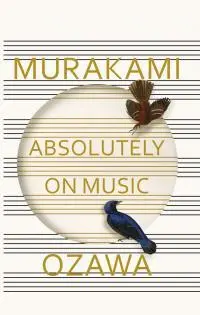
- Название:Absolutely on Music
- Автор:
- Издательство:Random House
- Жанр:
- Год:2016
- ISBN:нет данных
- Рейтинг книги:3 / 5. Голосов: 1
-
Избранное:Добавить в избранное
- Отзывы:
-
Ваша оценка:
Absolutely on Music: краткое содержание, описание и аннотация
Предлагаем к чтению аннотацию, описание, краткое содержание или предисловие (зависит от того, что написал сам автор книги «Absolutely on Music»). Если вы не нашли необходимую информацию о книге — напишите в комментариях, мы постараемся отыскать её.
Haruki Murakami's passion for music runs deep. Before turning his hand to writing, he ran a jazz club in Tokyo, and the aesthetic and emotional power of music permeates every one of his much-loved books. Now, in *Absolutely on Music,* Murakami fulfills a personal dream, sitting down with his friend, acclaimed conductor Seiji Ozawa, to talk about their shared interest.
They discuss everything from Brahms to Beethoven, from Leonard Bernstein to Glenn Gould, from record collecting to pop-up orchestras, and much more.
Absolutely on Music — читать онлайн бесплатно полную книгу (весь текст) целиком
Ниже представлен текст книги, разбитый по страницам. Система сохранения места последней прочитанной страницы, позволяет с удобством читать онлайн бесплатно книгу «Absolutely on Music», без необходимости каждый раз заново искать на чём Вы остановились. Поставьте закладку, и сможете в любой момент перейти на страницу, на которой закончили чтение.
Интервал:
Закладка:
MURAKAMI: I guess that’s because explanatory comments are usually kept to a minimum in a musical score, and the rest is indicated with these pure symbolic notations, right?
OZAWA: Sure, there’s basically nothing written in words in the score that tells you what to do. The first time I had it really tough was with the opera Wozzeck. You know it, I suppose?
MURAKAMI: By Alban Berg.
OZAWA: Right. The first time I conducted that, I read the score and figured I pretty much understood it. And then I started rehearsals. With the New Japan Philharmonic. My schedule wasn’t going to allow me much time for rehearsals just prior to the performance itself, so I made special arrangements to rehearse with the orchestra some three or four months ahead of time. I figured I’d take a few days to work with them while I was briefly in Japan before returning to—I think it was Boston, back then. And then I’d come back to Tokyo just before the performance, for the actual rehearsals. I was so glad I did that! Those three or four months in between were a lifesaver! By which I mean that once I got started with the orchestra, one thing after another came up that I didn’t know how to deal with. It was full of stuff that I just couldn’t sort out.
MURAKAMI: You mean, you assumed you understood everything when you were reading the score, but in fact you didn’t?
OZAWA: Right. I understood for the first time that I didn’t understand what I thought I understood.
MURAKAMI: And you came to that understanding when, at your direction, the orchestra actually produced the sounds that were in the score?
OZAWA: When I read the score and translated what was written into the sounds of the piano, I thought I understood it. But when I made those sounds with the orchestra, it was one “Oh no!” moment after another. In other words, I’m conducting, and all the while the sound is moving around like crazy. And once that starts to happen, I get totally lost.
MURAKAMI: Huh!
OZAWA: What a shock that was! So in my panic, I started rereading the score from scratch. And that’s when I got it. I had understood the “language” of the music well enough when I was just reading the score—what the music was trying to say. And I had been able to grasp things having to do with rhythm. But what I didn’t understand were the harmonies. No, I guess I had understood the harmonies, too, intellectually. But the second they started to move through time, I was lost. Music, of course, is an art that occurs through time.
MURAKAMI: Yes, of course.
OZAWA: When I played the music exactly as Berg had written it, using the tempi that he had indicated in the score, my ear simply couldn’t keep up with the time. No, not my ear—my ability to understand. My understanding couldn’t keep up. Mind you, we were playing exactly as Berg had written it down on paper. And the musicians were all quite capable of playing the music as written. In spite of that, there were several passages that I simply couldn’t understand. Not a lot of them, but a significant number. That was the first time I ever experienced such a thing, which is what got me to start studying the score again in such a panic. It was just plain lucky for me that I happened to have those few months in between to study the score again.
MURAKAMI: So what you’re saying is that there are cases in which the harmonic flow of a composition can’t be understood unless you sound it out with the orchestra?
OZAWA: That’s the idea. You know, up to about the time of Brahms, whom we’ve been talking about, or Richard Strauss, you can pretty much tell what kind of harmonies you’re going to get just by looking at the score. From experience. But you get to somebody like Charles Ives, and you have absolutely no idea what the harmonies will be like without actually producing the sound. After all, he was making music in a deliberate attempt to destroy such things. You might try to produce the sound of the orchestra on the piano, but ten fingers on a keyboard are not enough for some things. You’ve got to hear the actual sound. Of course, when you become accustomed to such music, you kind of get the hang of which chords to leave out to play it on the piano. Or, to put it the opposite way, you begin to see which sounds you can’t leave out.
MURAKAMI: When do you read scores?
OZAWA: You mean, what time of day?
MURAKAMI: Yes.
OZAWA: In the morning. Very early. I have to concentrate, and I can’t have a drop of alcohol in my system.
MURAKAMI: I’m not presuming to compare my work with yours, but I also work early in the morning. That’s when I can concentrate best. I always get up at four o’clock in the morning when I’m writing a novel. I prepare myself to get completely absorbed in the writing while everything is dark.
OZAWA: How long do you work?
MURAKAMI: About five hours.
OZAWA: I can’t last that long. I might get up at four o’clock, but by eight o’clock I’m hungry for breakfast. [ Laughter. ] In Boston, rehearsals used to start around ten-thirty, so I’d have to eat by nine at the latest.
MURAKAMI: Is reading scores fun?
OZAWA: Fun? Sure, I suppose so. Especially when it goes well, it’s lots of fun. But when it doesn’t, I hate it.
MURAKAMI: Can you give me a concrete example of when it hasn’t gone well?
OZAWA: When I can’t get the music into my head. Say, when I’m tired, or when my understanding or my concentration is off. I may be revealing trade secrets again here, but it often happens that the music you are going to perform at night is very different from the music you need to study that same morning. Say, in Boston, I’d have four programs to play in four weeks, so after the opening night of one program, I’d have to start studying for the next one. That was the toughest thing, now that I think back on it.
MURAKAMI: You get overwhelmed by the schedule.
OZAWA: Ideally, you’d have two weeks between the end of one concert series and the start of the next one to study, but there was never quite enough time for that.
MURAKAMI: I suppose you must have had a lot of busywork—or should I say administrative duties?—as music director of the Boston Symphony.
OZAWA: Yes, of course, a lot. There would be at least two meetings a week, and those would inevitably be long when there were complicated things to discuss. Some of them could be quite enjoyable, though. What I liked most was putting together programs. I also enjoyed the meetings where we’d choose guest conductors and soloists. The worst were discussions of personnel matters—what to do about so-and-so’s salary, who gets promoted, who gets demoted: we had to decide things like that. And the Boston Symphony had no mandatory retirement age, which meant that if there were older players members whose playing had begun to decline, I’d find myself in the position of having to urge someone older than me to start thinking about retirement. That was the most painful thing. I had a few cases like that during my time as music director, some of them good friends. That was really hard.
From Telemann to Bartók
MURAKAMI: Let’s talk about the sixties again. I believe your first American recording was an accompaniment for the oboist Harold Gomberg. It contains concertos by Vivaldi and Telemann, and the recording date is listed as May 1965. I happened to come across this copy at a used-record store in the US.
OZAWA: How incredible that you found this thing. Wow, it brings back memories!
MURAKAMI: I guess there was still no real consensus back then as to the meaning of “baroque music.” Listening to these performances, I got that impression. The oboe’s phrasing sounds more romantic than baroque to me.
OZAWA: Well, sure, in those days nobody knew how to perform this music. We knew there was something called “baroque music” and that there were some musicians who played it, but we hadn’t really heard the repertory. This was my very first time performing it.
Читать дальшеИнтервал:
Закладка:
Похожие книги на «Absolutely on Music»
Представляем Вашему вниманию похожие книги на «Absolutely on Music» списком для выбора. Мы отобрали схожую по названию и смыслу литературу в надежде предоставить читателям больше вариантов отыскать новые, интересные, ещё непрочитанные произведения.


Обсуждение, отзывы о книге «Absolutely on Music» и просто собственные мнения читателей. Оставьте ваши комментарии, напишите, что Вы думаете о произведении, его смысле или главных героях. Укажите что конкретно понравилось, а что нет, и почему Вы так считаете.