Харуки Мураками - Absolutely on Music
Здесь есть возможность читать онлайн «Харуки Мураками - Absolutely on Music» весь текст электронной книги совершенно бесплатно (целиком полную версию без сокращений). В некоторых случаях можно слушать аудио, скачать через торрент в формате fb2 и присутствует краткое содержание. Год выпуска: 2016, Издательство: Random House, Жанр: Современная проза, на английском языке. Описание произведения, (предисловие) а так же отзывы посетителей доступны на портале библиотеки ЛибКат.
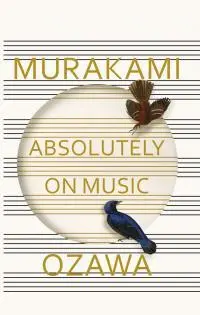
- Название:Absolutely on Music
- Автор:
- Издательство:Random House
- Жанр:
- Год:2016
- ISBN:нет данных
- Рейтинг книги:3 / 5. Голосов: 1
-
Избранное:Добавить в избранное
- Отзывы:
-
Ваша оценка:
Absolutely on Music: краткое содержание, описание и аннотация
Предлагаем к чтению аннотацию, описание, краткое содержание или предисловие (зависит от того, что написал сам автор книги «Absolutely on Music»). Если вы не нашли необходимую информацию о книге — напишите в комментариях, мы постараемся отыскать её.
Haruki Murakami's passion for music runs deep. Before turning his hand to writing, he ran a jazz club in Tokyo, and the aesthetic and emotional power of music permeates every one of his much-loved books. Now, in *Absolutely on Music,* Murakami fulfills a personal dream, sitting down with his friend, acclaimed conductor Seiji Ozawa, to talk about their shared interest.
They discuss everything from Brahms to Beethoven, from Leonard Bernstein to Glenn Gould, from record collecting to pop-up orchestras, and much more.
Absolutely on Music — читать онлайн бесплатно полную книгу (весь текст) целиком
Ниже представлен текст книги, разбитый по страницам. Система сохранения места последней прочитанной страницы, позволяет с удобством читать онлайн бесплатно книгу «Absolutely on Music», без необходимости каждый раз заново искать на чём Вы остановились. Поставьте закладку, и сможете в любой момент перейти на страницу, на которой закончили чтение.
Интервал:
Закладка:
MURAKAMI: But with tremendous enthusiasm.
OZAWA: Yes, they had plenty of enthusiasm!
We listen to the music for a while.
MURAKAMI: It’s amazing how different the music is with only seven years separating the performances.
OZAWA: But that was a big seven years for me. I changed a lot. After Toronto, I became the San Francisco Symphony’s music director, and then moved to Boston.
MURAKAMI: Different orchestra, different sound: it’s only natural for the music to be different.
OZAWA: And the Fantastique I just did with the Saito Kinen [December 2010] was, again, totally different. I myself have changed, for one thing. I purposely avoided playing the piece for a long time, to leave some space between performances. This new one might be a little too rich.
MURAKAMI: Too rich?
Ozawa laughs.
MURAKAMI: This next one is a DVD of a live performance of the Fantastique by the Saito Kinen in Matsumoto, in 2007.
Again, we hear “March to the Scaffold,” and again there are small differences from the previous two. The music still visibly seems to dance, but its “undulation” is different. It has a different “groove,” as might be said in jazz.
OZAWA: That trumpeter on the left is first trumpet in Berlin … and this person plays third trombone with the Vienna Philharmonic.
Ozawa stands and moves with the music. Looking at himself conducting on screen, he sighs.
OZAWA: This is how I ruined my hips. After I broke my shoulder, I couldn’t use it properly, so I forced my body to move in an unnatural posture, which then threw my hips out. This body part doesn’t move, so that one ends up a mess. It’s stupid!
MURAKAMI: Your conducting is so dynamic. It’s hard work, swaying with the music like that.
OZAWA: But comparing performances this way, they’re really different! This is the first time I’ve ever done anything like this. I’m shocked at how different they are.
MURAKAMI: The differences are very obvious to me, too. You were only thirty-one when you conducted the Toronto in that powerful performance that keeps on surging forward, forward. As I said before with the Stravinsky, the music leaps and dances on the palms of your hands. But then you went to Boston and took over a major orchestra, and it feels as though you’re cupping your hands, embracing the music, carefully letting it ripen. And now comes the recent Saito Kinen performance, and I get the impression you’re unfolding your hands a little, letting the air in, freeing it up. Possibly you’re giving the music itself a chance to develop more spontaneously, kind of like letting out whatever will come, maybe—to put it simply, taking a more natural approach?
OZAWA: Hmm, you may be right … but in that sense the December 2010 Carnegie performance of the Fantastique went even farther in that direction. It was pretty intense for me.
MURAKAMI: Maybe the sound of the Saito Kinen is more suited to that approach.
OZAWA: True. Watching this performance on the screen, I’m obviously not worrying about every little detail.
MURAKAMI: Which is exactly what you used to do in your Boston days. As if you were carefully tightening one screw after another.
OZAWA: Right. Like I said before, I’m constantly trying to improve the quality of an orchestra, increasing its value.
MURAKAMI: In the Boston version of the Fantastique we heard before, you’re constantly adjusting every little detail: the tempo changes from one part to the next, the color of the sound changes. It’s marvelous, and though I wouldn’t call it ornate, it’s like looking at a moving miniature. With the Toronto or the Chicago versions, the music itself breaks into a run before there’s any question of adjusting anything.
OZAWA: They’re raw, aren’t they? I had a lot of energy back then.
MURAKAMI: Listening to these three very different performances of the Fantastique, I could feel the three different phases of your musical life.
OZAWA: Well, sure, those things change with age. Your approach to an orchestra changes as you get older. And, in my particular case, as I mentioned before, there was the sheer technical matter, after I broke my shoulder, of not being able to move my arms as energetically as I had in the sixties and seventies.
MURAKAMI: And in the case of Boston, the fact that you were the permanent music director must have meant that you were constantly seeing the same people during the off-season, too. Wouldn’t that enhance your relationship with the orchestra and make you want to start tweaking it in all kinds of little ways?
OZAWA: Sure, that’s unavoidable.
MURAKAMI: In the case of the Saito Kinen, though, the orchestra is not always together, so you can’t do too much tweaking. To some extent, you have to give them their independence and let them run with it. Am I right about that?
OZAWA: You certainly are. But the fact that we get together only for a month in the summer and for occasional concert tours keeps us fresh. We’re always surprising each other. Like lovers who can only meet once a year. [ Laughter. ]
MURAKAMI: How about your time in Vienna?
OZAWA: Vienna was like best friends getting together to make music. It was so easy for me!
MURAKAMI: You were director of the Vienna State Opera, but its orchestra is essentially the Vienna Philharmonic, isn’t it?
OZAWA: Yes, 100 percent the same. But I wasn’t the director of the Vienna Philharmonic, just of the Staatsoper. The Vienna Philharmonic doesn’t have a music director. Members of the Vienna Philharmonic join the Staatsoper orchestra first, and then they get into the Philharmonic. You can’t join the Philharmonic from the outset.
MURAKAMI: Oh, really? I had no idea.
OZAWA: You audition for the Staatsoper orchestra first, and after two or three years you move into the Philharmonic. A few musicians do play for the Philharmonic as soon as they join the Staatsoper, though.
MURAKAMI: So, unlike your time in Boston, you didn’t need to deal with management or training?
OZAWA: Correct. Of course I would be there for the auditions, but I was just one vote out of several. I had almost nothing to do with personnel matters. Singers were another matter. I had a lot to say about choosing the company.
MURAKAMI: But you simply used the orchestra you were given?
OZAWA: Correct.
MURAKAMI: In other words, the orchestra was viewed as just one component of opera as a comprehensive art form?
OZAWA: Correct. So that raises the question of exactly what the director of the Staatsoper does. I wish I had settled in there for a long stay and conducted a lot more operas, but when my health deteriorated, I couldn’t do very many. But, boy, I enjoyed myself there! I’m so glad I lived long enough to have that experience. I think of it as a wonderful opportunity that the gods gave me. I had no idea what it was like to be in an opera company. Just finding that out was terrific in itself. It was so much fun! I love opera, and they would let me conduct anything I wanted, unconditionally.
MURAKAMI: I went to Vienna two years ago and heard you conduct Tchaikovsky’s Eugene Onegin. The stage production was very good, of course, but I was electrified by the polished perfection of the orchestra. Viewed from the balcony, the orchestra looked like a single living thing, swaying with the music. The Eugene Onegin you conducted in Tokyo in 2008 was very enjoyable, but this was something special. I heard a few other operas in Vienna at that time—sheer bliss!
Getting back to the 1960s, RCA had you doing a huge variety of recordings, didn’t they? There was Mussorgsky’s Pictures at an Exhibition [1967], Tchaikovsky’s Fifth Symphony [1968], Mozart’s Haffner Symphony [1969], Bartók’s Concerto for Orchestra [1969], Orff’s Carmina Burana [1969], Stravinsky’s Firebird and Petrushka [1969]. Add to those the standard coupling of Beethoven’s Fifth and Schubert’s “Unfinished” [1969], and you’re all over the map.
Читать дальшеИнтервал:
Закладка:
Похожие книги на «Absolutely on Music»
Представляем Вашему вниманию похожие книги на «Absolutely on Music» списком для выбора. Мы отобрали схожую по названию и смыслу литературу в надежде предоставить читателям больше вариантов отыскать новые, интересные, ещё непрочитанные произведения.




Обсуждение, отзывы о книге «Absolutely on Music» и просто собственные мнения читателей. Оставьте ваши комментарии, напишите, что Вы думаете о произведении, его смысле или главных героях. Укажите что конкретно понравилось, а что нет, и почему Вы так считаете.