Харуки Мураками - Absolutely on Music
Здесь есть возможность читать онлайн «Харуки Мураками - Absolutely on Music» весь текст электронной книги совершенно бесплатно (целиком полную версию без сокращений). В некоторых случаях можно слушать аудио, скачать через торрент в формате fb2 и присутствует краткое содержание. Год выпуска: 2016, Издательство: Random House, Жанр: Современная проза, на английском языке. Описание произведения, (предисловие) а так же отзывы посетителей доступны на портале библиотеки ЛибКат.
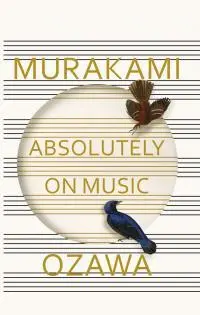
- Название:Absolutely on Music
- Автор:
- Издательство:Random House
- Жанр:
- Год:2016
- ISBN:нет данных
- Рейтинг книги:3 / 5. Голосов: 1
-
Избранное:Добавить в избранное
- Отзывы:
-
Ваша оценка:
Absolutely on Music: краткое содержание, описание и аннотация
Предлагаем к чтению аннотацию, описание, краткое содержание или предисловие (зависит от того, что написал сам автор книги «Absolutely on Music»). Если вы не нашли необходимую информацию о книге — напишите в комментариях, мы постараемся отыскать её.
Haruki Murakami's passion for music runs deep. Before turning his hand to writing, he ran a jazz club in Tokyo, and the aesthetic and emotional power of music permeates every one of his much-loved books. Now, in *Absolutely on Music,* Murakami fulfills a personal dream, sitting down with his friend, acclaimed conductor Seiji Ozawa, to talk about their shared interest.
They discuss everything from Brahms to Beethoven, from Leonard Bernstein to Glenn Gould, from record collecting to pop-up orchestras, and much more.
Absolutely on Music — читать онлайн бесплатно полную книгу (весь текст) целиком
Ниже представлен текст книги, разбитый по страницам. Система сохранения места последней прочитанной страницы, позволяет с удобством читать онлайн бесплатно книгу «Absolutely on Music», без необходимости каждый раз заново искать на чём Вы остановились. Поставьте закладку, и сможете в любой момент перейти на страницу, на которой закончили чтение.
Интервал:
Закладка:
MURAKAMI: At first, the idea was to make it a one-time appearance, wasn’t it?
OZAWA: That’s true. In 1984, former students of Professor Saito put the orchestra together to commemorate the tenth anniversary of his death. We performed in Tokyo’s Bunka Kaikan and the brand-new Osaka Symphony Hall. Then it was like, “Hey, this is good! We can keep going! We can take this orchestra anywhere in the world!”
MURAKAMI: You mean when you first started, there was never any thought of reorganizing every year and doing foreign performance tours?
OZAWA: Not at all. It never crossed our minds.
MURAKAMI: But eventually the Saito “system” became a worldwide trend. You were truly pioneers, wouldn’t you say?
Back When Bernstein
Was Grappling with Mahler
MURAKAMI: By the way, you never worked on Mahler with Professor Saito, right?
OZAWA: No, never.
MURAKAMI: Was that just a matter of the period?
OZAWA: Well, you know, very few people were playing Mahler until Bernstein started grappling with him so passionately in the early sixties. Of course you had somebody like Bruno Walter, but almost no other conductors took a positive interest in Mahler besides him.
MURAKAMI: I started listing to classical music in the mid-sixties, but Mahler’s symphonies were not at all popular back then. About all you could find in the recording catalogs were the First [the Titan ], the Second [the Resurrection ], and Das Lied von der Erde. They were not widely listened to, and I think they were rarely performed. Young people nowadays are shocked when I tell them that.
OZAWA: It’s true, Mahler was not at all popular. Maestro Karajan was doing Das Lied von der Erde, and he used it to teach us, but he was not playing any of the other symphonies.
MURAKAMI: Böhm wasn’t playing the Mahler symphonies either, was he?
OZAWA: No, no, not at all.
MURAKAMI: And neither was Furtwängler.
OZAWA: No, it’s true. He was playing everything up to Bruckner … You know, I’ve never heard Bruno Walter’s Mahler.
MURAKAMI: The other day I was listening to a 1939 Mahler recording by Willem Mengelberg and the Concertgebouw Orchestra.
OZAWA: Ha, I didn’t know such a thing existed.
MURAKAMI: The Fourth Symphony. Not surprisingly, it sounds like a creaky old thing. I also listened to Bruno Walter doing the Ninth Symphony in Vienna in 1938, just before he fled from the Nazis. My main impression of both of them—the Walter and the Mengelberg—was how old they sounded. I don’t mean just the quality of the recording, but the tones they produced. Both men were direct disciples of Mahler, and their performances may be historically important, but you listen to them today and they’re kind of hard going. Then a new period comes along, and Walter makes stereo recordings and builds the foundation for a Mahler revival, and Leonard Bernstein makes it happen with his passionate recordings.
OZAWA: Which is exactly when I was his assistant conductor, when he was recording the complete Mahler with the New York Philharmonic and the London Symphony.
MURAKAMI: Back then, ordinary music fans were not listening to Mahler, even in America?
OZAWA: No, hardly anybody listened to Mahler. So then Lenny became absolutely relentless, performing Mahler cycles and recording everything. He may not have done the complete works in performance, but he cycled through nearly everything at least twice. Then he went to Vienna and did the same thing with the Vienna Philharmonic, sometime in the late sixties.
MURAKAMI: After he left the New York Philharmonic?
OZAWA: Yes, but even before that, he went to Vienna and did it with them—when he was on sabbatical.
MURAKAMI: Which reminds me, you said before that you were house-sitting for him when he was on sabbatical. You mean actually taking care of his house?
OZAWA: No, I was “house-sitting” the orchestra.
MURAKAMI: “House-sitting” the orchestra?
OZAWA: That included some conducting, though not a lot. Mainly, I was doing various chores for the orchestra, inviting lots of guest conductors, like Josef Krips, or William Steinberg, or what’s-his-name, that handsome American fellow who died young …?
MURAKAMI: Handsome young American conductor …?
OZAWA: You know … Thomas …
MURAKAMI: Schippers?
OZAWA: That’s him. Thomas Schippers. He was an incredibly good-looking guy, a good friend of Lenny’s, married to a beautiful young heiress from Florida. He founded the Spoleto Festival with Gian Carlo Menotti, but he died young. I think he was still in his forties. Krips, Steinberg, Schippers, and there was one other conductor … I can’t remember who … but anyway, there were four guest conductors, and I made all the arrangements. For example, when Steinberg did the Beethoven Ninth, I went and arranged for the chorus, that kind of thing. Each of the four guest conductors took the podium for six weeks, and I got to do two of the regular-season concerts that year. So I was both assistant conductor and the one who filled in the gaps. I learned a lot from that experience! I became good friends with Thomas Schippers, and Steinberg used to treat me to dinner all the time. And Krips—I think it was because of our time together back then that he recommended me to become conductor of the San Francisco Symphony. Of course, you know I went to Toronto after New York. Krips spent seven years as music director of the San Francisco, and when he left suggested that I succeed him. So I quit as music director of the Toronto Symphony and moved to San Francisco.
MURAKAMI: Was Lenny on a year-long sabbatical?
OZAWA: Yes, he was off for a whole year, the ’64 to ’65 season.
MURAKAMI: And you were basically managing the orchestra while he was gone.
OZAWA: Right. I was like a replacement music director. But not personnel. I refused to do that. And I didn’t do auditions. All I did was the busywork. But that was more than enough, let me tell you!
MURAKAMI: That was before you went to Toronto, right?
OZAWA: Right. I think it was the year before I went to Toronto. I probably got all of that business taken care of before I left.
MURAKAMI: And Bernstein was in Vienna the whole time?
OZAWA: Yes, he supposedly took the year off because he wanted to take a break from conducting and concentrate instead on composing, but in fact he did a lot of conducting in Vienna. I remember there was an awful lot of grumbling about that in New York. Then all of a sudden Vienna made him an offer, and that was it—he went. It might have been at that time that he conducted Beethoven’s opera Fidelio. In an old theater called Theater an der Wien, which was where Fidelio had had its first performance, in 1805. I had some kind of work in Vienna at the time of Lenny’s performance, I forget what it was, but I went to hear it—sitting right next to Karl Böhm!
MURAKAMI: Amazing!
OZAWA: I seem to recall he gave me the ticket. Yes, it was his wife’s. I didn’t have any money in those days. I was traveling to Vienna to conduct, but their fees were incredibly small, and it cost a lot to go there from America. Maybe that’s why I got a free ticket. So anyway, after the performance, I went with Böhm to Lenny’s dressing room. I was very curious to hear what the two of them would talk about, but neither of them said a word about Fidelio. I mean, Böhm was the world’s leading conductor of Fidelio, after all.
MURAKAMI: True.
OZAWA: I had worked as his assistant when he came to Japan and conducted Fidelio at the Nissay Theatre, so I figured they’d have a ton of things to say about the opera, but neither of them said a word about it. [ Laughter. ] I don’t remember exactly what they talked about, but I think it was, like, food, and remarks about the theater, stuff like that.
Читать дальшеИнтервал:
Закладка:
Похожие книги на «Absolutely on Music»
Представляем Вашему вниманию похожие книги на «Absolutely on Music» списком для выбора. Мы отобрали схожую по названию и смыслу литературу в надежде предоставить читателям больше вариантов отыскать новые, интересные, ещё непрочитанные произведения.



Обсуждение, отзывы о книге «Absolutely on Music» и просто собственные мнения читателей. Оставьте ваши комментарии, напишите, что Вы думаете о произведении, его смысле или главных героях. Укажите что конкретно понравилось, а что нет, и почему Вы так считаете.