Харуки Мураками - Absolutely on Music
Здесь есть возможность читать онлайн «Харуки Мураками - Absolutely on Music» весь текст электронной книги совершенно бесплатно (целиком полную версию без сокращений). В некоторых случаях можно слушать аудио, скачать через торрент в формате fb2 и присутствует краткое содержание. Год выпуска: 2016, Издательство: Random House, Жанр: Современная проза, на английском языке. Описание произведения, (предисловие) а так же отзывы посетителей доступны на портале библиотеки ЛибКат.
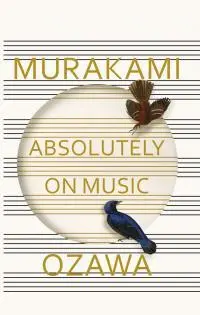
- Название:Absolutely on Music
- Автор:
- Издательство:Random House
- Жанр:
- Год:2016
- ISBN:нет данных
- Рейтинг книги:3 / 5. Голосов: 1
-
Избранное:Добавить в избранное
- Отзывы:
-
Ваша оценка:
Absolutely on Music: краткое содержание, описание и аннотация
Предлагаем к чтению аннотацию, описание, краткое содержание или предисловие (зависит от того, что написал сам автор книги «Absolutely on Music»). Если вы не нашли необходимую информацию о книге — напишите в комментариях, мы постараемся отыскать её.
Haruki Murakami's passion for music runs deep. Before turning his hand to writing, he ran a jazz club in Tokyo, and the aesthetic and emotional power of music permeates every one of his much-loved books. Now, in *Absolutely on Music,* Murakami fulfills a personal dream, sitting down with his friend, acclaimed conductor Seiji Ozawa, to talk about their shared interest.
They discuss everything from Brahms to Beethoven, from Leonard Bernstein to Glenn Gould, from record collecting to pop-up orchestras, and much more.
Absolutely on Music — читать онлайн бесплатно полную книгу (весь текст) целиком
Ниже представлен текст книги, разбитый по страницам. Система сохранения места последней прочитанной страницы, позволяет с удобством читать онлайн бесплатно книгу «Absolutely on Music», без необходимости каждый раз заново искать на чём Вы остановились. Поставьте закладку, и сможете в любой момент перейти на страницу, на которой закончили чтение.
Интервал:
Закладка:
OZAWA: That’s how I remember it. But the orchestra gave it everything they had. I mean, Mahler is tough to perform. The musicians were all studying hard to master it. In those days, we used to play maybe three Mahler symphonies a year. I used to see how hard they worked at rehearsals. They’d give a concert, and right away they’d go to Manhattan Center and make a recording.
MURAKAMI: So two or three of those Mahler symphony records were coming out per year?
OZAWA: Yes, pretty much.
I Never Even Knew
Music Like That Existed
MURAKAMI: Had you been listening to Mahler before Bernstein got you started?
OZAWA: No, not at all. When I was a student at Tanglewood, my roommate, the Uruguayan conductor José Serebrier, was studying the Mahler First and Fifth. Serebrier was a truly outstanding student. I still see him now and then. He’ll drop in to visit me backstage, that sort of thing. I saw him in London, I saw him in Berlin. Well, anyway, back then I asked to look at the scores he was studying, and that was the first time in my life I found out about Mahler. Afterward, I sent for the scores of both those pieces and studied them. There was no way a student orchestra could play them, but I put tremendous effort into studying the scores.
MURAKAMI: Just the scores? You didn’t listen to them on records?
OZAWA: No, I had never heard them on records. I didn’t have the money to buy records then, and I didn’t even have a machine to play them on.
MURAKAMI: What was it like, reading the scores for the first time?
OZAWA: It was a huge shock for me—until then I never even knew music like that existed. I mean, here we were at Tanglewood, playing Tchaikovsky and Debussy, and meanwhile there’s this guy putting all his energy into studying Mahler. I could feel the blood draining from my face. I had to order my own copies right then and there. After that, I started reading Mahler like crazy—the First, the Second, the Fifth.
MURAKAMI: Did you enjoy just reading the scores?
OZAWA: Oh, tremendously. I mean, it was the first time in my life I had ever seen anything like them. To think there were scores like this!
MURAKAMI: Was it a completely different world from the music you had been playing until then?
OZAWA: First of all, I was amazed that there was someone who knew how to use an orchestra so well. It was extreme—his marvelous ability to put every component of the orchestra to use. And from the orchestra’s point of view, the Mahler symphonies are the most challenging pieces ever.
MURAKAMI: So when was the first time you actually heard, with your own ears, the sound of an orchestra playing Mahler—was that with Bernstein?
OZAWA: Yes, the first time I ever heard Mahler was as Bernstein’s assistant in New York.
MURAKAMI: What was it like for you, hearing the real thing for the first time?
OZAWA: It was a complete shock. At the same time, I felt overjoyed that I could be right there with him, in that time and place, when Bernstein was, quite literally, pioneering this kind of music. So I also did Mahler as soon as I got to Toronto. Then I could do it myself! And with the San Francisco Symphony, too, I played almost all of Mahler’s symphonies.
MURAKAMI: What kind of response did you get from the audiences?
OZAWA: Good, I think. By then, Mahler was, well, not exactly popular—but among the kind of people who come to listen to symphonies, Mahler was getting a lot of attention.
MURAKAMI: But Mahler symphonies are hard work—not just to perform but to listen to!
OZAWA: True, but by then he was popular enough. It was already starting, thanks in large part to Bernstein’s efforts. He put a huge amount of energy into getting the people of the world to listen to Mahler.
MURAKAMI: But still, for a long time, Mahler’s music was not listened to very widely. Why do think that was?
OZAWA: Hmm, I wonder …
MURAKAMI: First you’ve got Wagner, then you go from Brahms to Richard Strauss, which more or less brings the German romantic line to an end. Then you go straight through from Schoenberg’s twelve-tone music to, like, Stravinsky, Bartók, Prokofiev, and Shostakovich, and that’s more or less how the history of music flows, without much room to squeeze in Mahler or Bruckner. At least that’s how it was for a long time.
OZAWA: True.
MURAKAMI: But in Mahler’s case, you get this miraculous revival a half century after the composer’s death. What’s behind all that?
OZAWA: I suspect it probably started with the orchestra musicians themselves. Once they got a chance to actually play some Mahler, they found they liked it, and that led to the revival. And once the musicians started to think of Mahler as fun to play, the orchestras started vying with each other to perform the music. After Bernstein, orchestras from all over gladly adopted Mahler. Especially in the States, there came a point where you weren’t considered an orchestra if you couldn’t perform Mahler. And not just in America: in Vienna, too, they started playing Mahler like crazy, because, after all, they were Mahler’s home base.
MURAKAMI: Yes, but home base or not, the Vienna Philharmonic didn’t play Mahler for a very long time.
OZAWA: That’s true, they didn’t.
MURAKAMI: Do you think that was mainly because people like Böhm and Karajan didn’t take up the music?
OZAWA: Probably. Böhm especially.
MURAKAMI: Both of them often played, say, Bruckner or Richard Strauss, but they never touched Mahler. Mahler himself was the virtual music director of the Vienna Philharmonic for a long time, but I get the impression that the orchestra was cold toward his music for a very long time.
OZAWA: Yes, but the Vienna Philharmonic plays Mahler beautifully now. The orchestra and the music are really a perfect match. They can lay bare its very essence.
MURAKAMI: Last time we talked about this, you said that when the Berlin Philharmonic played Mahler, Maestro Karajan would often take a pass and hand the baton to you.
OZAWA: That’s true. I conducted the Mahler Eighth in Berlin. I think it might have been the first time the Berlin Philharmonic played that symphony. Maestro Karajan told me to do it. Normally, that’s a piece that the music director would conduct himself.
MURAKAMI: Of course, it’s such a big piece, a major event.
OZAWA: But for some reason, the task came to me, and I remember putting everything I had into it. They put together some wonderful soloists for me. And the chorus, too: it wasn’t just the Berlin chorus, but they called in some top professional groups like the Hamburg Norddeutscher Rundfunk Chorus, and the WDR Radio Choir of Cologne, and made a huge production out of it. It was a truly special event.
MURAKAMI: Well, it’s not the kind of symphony you can perform all the time.
OZAWA: I played it in Tanglewood, and then again in Paris—with the Orchestre National de France, in a place called Sandonie.
The Historical Evolution
of Mahler Performance
MURAKAMI: The style used to perform Mahler has changed a great deal, hasn’t it, from the sixties to now?
OZAWA: You could say that various different styles of performance have appeared. I was very fond of Lenny’s Mahler.
MURAKAMI: You can listen to those recordings he did with the New York Philharmonic today, and they’re still fresh. I listen to them fairly often even now.
OZAWA: And Maestro Karajan’s Ninth is just wonderful. He did it very late in his career, but it was great. The finale especially. I remember thinking how well suited the piece was to him.
MURAKAMI: The sound of the orchestra absolutely has to be beautiful and meticulous in that symphony.
Читать дальшеИнтервал:
Закладка:
Похожие книги на «Absolutely on Music»
Представляем Вашему вниманию похожие книги на «Absolutely on Music» списком для выбора. Мы отобрали схожую по названию и смыслу литературу в надежде предоставить читателям больше вариантов отыскать новые, интересные, ещё непрочитанные произведения.




Обсуждение, отзывы о книге «Absolutely on Music» и просто собственные мнения читателей. Оставьте ваши комментарии, напишите, что Вы думаете о произведении, его смысле или главных героях. Укажите что конкретно понравилось, а что нет, и почему Вы так считаете.