Харуки Мураками - Absolutely on Music
Здесь есть возможность читать онлайн «Харуки Мураками - Absolutely on Music» весь текст электронной книги совершенно бесплатно (целиком полную версию без сокращений). В некоторых случаях можно слушать аудио, скачать через торрент в формате fb2 и присутствует краткое содержание. Год выпуска: 2016, Издательство: Random House, Жанр: Современная проза, на английском языке. Описание произведения, (предисловие) а так же отзывы посетителей доступны на портале библиотеки ЛибКат.
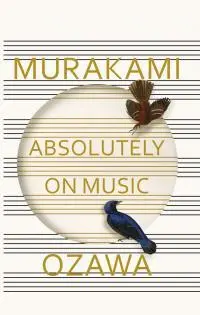
- Название:Absolutely on Music
- Автор:
- Издательство:Random House
- Жанр:
- Год:2016
- ISBN:нет данных
- Рейтинг книги:3 / 5. Голосов: 1
-
Избранное:Добавить в избранное
- Отзывы:
-
Ваша оценка:
Absolutely on Music: краткое содержание, описание и аннотация
Предлагаем к чтению аннотацию, описание, краткое содержание или предисловие (зависит от того, что написал сам автор книги «Absolutely on Music»). Если вы не нашли необходимую информацию о книге — напишите в комментариях, мы постараемся отыскать её.
Haruki Murakami's passion for music runs deep. Before turning his hand to writing, he ran a jazz club in Tokyo, and the aesthetic and emotional power of music permeates every one of his much-loved books. Now, in *Absolutely on Music,* Murakami fulfills a personal dream, sitting down with his friend, acclaimed conductor Seiji Ozawa, to talk about their shared interest.
They discuss everything from Brahms to Beethoven, from Leonard Bernstein to Glenn Gould, from record collecting to pop-up orchestras, and much more.
Absolutely on Music — читать онлайн бесплатно полную книгу (весь текст) целиком
Ниже представлен текст книги, разбитый по страницам. Система сохранения места последней прочитанной страницы, позволяет с удобством читать онлайн бесплатно книгу «Absolutely on Music», без необходимости каждый раз заново искать на чём Вы остановились. Поставьте закладку, и сможете в любой момент перейти на страницу, на которой закончили чтение.
Интервал:
Закладка:
OZAWA: Yes, well, the musicians themselves probably had that sort of mind-set back then. But nowadays the players are changing. That’s what I think. Their mentality has definitely been changing—their perceptions of what their roles are with regard to the whole. Recording techniques have also changed. In the old days, the dominant tendency was to record the overall sound. Things like the orchestra’s overall resonance were important. They tried to capture the whole rather than the details. Most of the recordings made in the sixties and seventies were like that.
MURAKAMI: With digitalization, those tendencies have changed. Mahler is not that interesting to listen to anymore unless you can hear each of the individual instruments.
OZAWA: You’re absolutely right about that. Digital recording made it possible to hear every little detail clearly, and that may have caused performances themselves to change. In the old days, we used to pay a lot of attention to things like how many seconds the reverberation lasted, but nobody talks about that anymore. Now, people aren’t satisfied unless they can hear the details.
MURAKAMI: Maybe the recording technology has a lot to do with it, but you can’t quite hear all those details in the Bernstein performances from the sixties, can you? The impression is more one of the sound of the orchestra en masse. So when you’re listening to those records, emotional elements tend to be given far greater emphasis than the accumulation of details.
OZAWA: That’s what the sound was like at the Manhattan Center, where they did the recording. Now they tend to record in performance halls, right up there on the stage. When they do that, you can hear the same reverberation from the record as you would at a concert.
Going Crazy in Vienna
MURAKAMI: Among musicians who perform Mahler—and maybe among his listeners, too—there are many who think a lot about the composer’s life or his worldview or his times or fin-de-siècle introspection. Where do you stand with regard to such things?
OZAWA: I don’t think about them all that much. I do read the scores closely, though. On the other hand, when I started working in Vienna more than thirty years ago, I made friends and started going to the art museums there. And when I first saw the work of Klimt and Egon Schiele, they came as a real shock to me. Since then, I’ve made it a point to go to art museums. When you look at the art of the time, you understand something about the music. Take Mahler’s music: it comes from the breakdown of traditional German music. You get a real sense of that breakdown from the art, and you can tell it was not some half-baked thing.
MURAKAMI: I know what you mean. The last time I went to Vienna, I went to a Klimt exhibit at an art museum. Seeing the art in the city where it was created, you really feel it.
OZAWA: Klimt’s work is beautiful and painted with minute attention to detail; but looking at it, don’t you think there’s something kind of crazy about it, too?
MURAKAMI: Yes, it’s certainly not what you’d call “normal.”
OZAWA: There’s something about it, I don’t know, that tells you about the importance of madness, or that transcends things like morality. And in fact, at the time, morality really was breaking down, and there was a lot of sickness going around.
MURAKAMI: A lot of syphilis and stuff. Vienna was more or less pervaded with this kind of mental and physical breakdown: it was the atmosphere of the age. The last time I went to Vienna, I had some time to kill, so I rented a car and spent four or five days driving around the southern part of the Czech Republic—the old Bohemian region where Mahler’s birthplace was located, the little village of Kalischt, or Kaliště as they call it now. I didn’t go there on purpose, just happened to pass through. It’s still tremendously rural out there, nothing but fields as far as the eye can see. It’s not that far from Vienna, but I was surprised at how different the two areas were. “So Mahler came from a place like this!” I thought. What a huge turnabout in values he must have experienced! Back then, Vienna was not only the capital of the Austro-Hungarian Empire, it was a colorful center of European culture and probably ripe to the point of being overripe. The Viennese must have looked upon Mahler as a real country bumpkin.
OZAWA: I see what you mean.
MURAKAMI: And on top of that, he was a Jew. But come to think of it, the city of Vienna gained a lot of its vitality by taking in culture from its surroundings. You can see this in the biographies of Rubinstein and Rudolf Serkin. Viewing it this way, it’s easy to see why popular songs and Jewish klezmer melodies pop up in Mahler’s music all of a sudden, mixing into his serious musicality and aesthetic melodies like intruders. This diverse quality is one of the real attractions of Mahler’s music. If he had been born and raised in Vienna, I doubt that his music would have turned out that way.
OZAWA: True.
MURAKAMI: All the great creators of that period—Kafka, Mahler, Proust—were Jews. They were shaking up the established cultural structure from the periphery. In that sense, it was important that Mahler was a Jew from the countryside. I felt that strongly when I was traveling around Bohemia.
There’s Something Funny
About the Third and the Seventh
MURAKAMI: Now, regarding Bernstein’s performances of Mahler in the sixties, the emotional input seems to be a major element in his case. He seems to be projecting himself onto Mahler with enormous passion.
OZAWA: Yes, the passion is there, no question.
MURAKAMI: He seems to have had tremendous empathy for Mahler’s music, a deep personal involvement. I’m sure it was important to him that Mahler was a Jew.
OZAWA: Yes, very important, I think. Lenny felt that element very deeply and was very conscious of it.
MURAKAMI: I get the feeling, though, that—for lack of a better way of putting it—there’s a kind of ethnic quality that has tended to diminish in recent Mahler performances. In yours, for example, or Claudio Abbado’s, such coloration is relatively pale.
OZAWA: It’s not an area of special concern to me, but Lenny felt that element very deeply and was very conscious of it.
MURAKAMI: And not just because Mahler’s music contains what might be called Jewish elements, I suppose?
OZAWA: No, I don’t think it was just because of that. In Lenny’s case, that kind of connection was probably very strong. It was the same for the violinist Isaac Stern. And Itzhak Perlman, of course, though more so when he was young. It’s the same with Daniel Barenboim, too. I’m close with all of these musicians, but there are areas deep down where I can’t fully grasp what they’re feeling or thinking. And I’m sure it’s the same for them where I’m concerned—a guy like me with a Buddhist father and a Christian mother and practically no religious feeling of my own: I suspect they think they can’t fully understand me!
MURAKAMI: But is there actually friction there, because of being just “Christians” and “Jews”?
OZAWA: No, none at all.
MURAKAMI: So you’re just saying that Bernstein felt a strong Jewish tie to Mahler and his music, right? And of course, in Bernstein’s case, there must have been a strong sense of commonality with Mahler in being both a conductor and a composer.
OZAWA: Looking back on it now, though, I feel I was in New York during the orchestra’s most interesting period. I was able to be right there, by Bernstein’s side as his assistant, when he was most feverishly grappling with Mahler. It was almost uncanny to see how he threw himself into the music—the total absorption. As I keep saying, I only wish I had had better command of English back then. He had so much to say during rehearsals, but I could only understand a fraction of it!
Читать дальшеИнтервал:
Закладка:
Похожие книги на «Absolutely on Music»
Представляем Вашему вниманию похожие книги на «Absolutely on Music» списком для выбора. Мы отобрали схожую по названию и смыслу литературу в надежде предоставить читателям больше вариантов отыскать новые, интересные, ещё непрочитанные произведения.





Обсуждение, отзывы о книге «Absolutely on Music» и просто собственные мнения читателей. Оставьте ваши комментарии, напишите, что Вы думаете о произведении, его смысле или главных героях. Укажите что конкретно понравилось, а что нет, и почему Вы так считаете.