Харуки Мураками - Absolutely on Music
Здесь есть возможность читать онлайн «Харуки Мураками - Absolutely on Music» весь текст электронной книги совершенно бесплатно (целиком полную версию без сокращений). В некоторых случаях можно слушать аудио, скачать через торрент в формате fb2 и присутствует краткое содержание. Год выпуска: 2016, Издательство: Random House, Жанр: Современная проза, на английском языке. Описание произведения, (предисловие) а так же отзывы посетителей доступны на портале библиотеки ЛибКат.
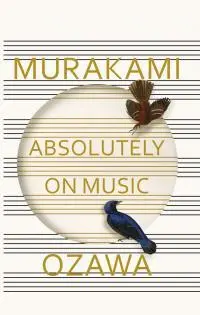
- Название:Absolutely on Music
- Автор:
- Издательство:Random House
- Жанр:
- Год:2016
- ISBN:нет данных
- Рейтинг книги:3 / 5. Голосов: 1
-
Избранное:Добавить в избранное
- Отзывы:
-
Ваша оценка:
Absolutely on Music: краткое содержание, описание и аннотация
Предлагаем к чтению аннотацию, описание, краткое содержание или предисловие (зависит от того, что написал сам автор книги «Absolutely on Music»). Если вы не нашли необходимую информацию о книге — напишите в комментариях, мы постараемся отыскать её.
Haruki Murakami's passion for music runs deep. Before turning his hand to writing, he ran a jazz club in Tokyo, and the aesthetic and emotional power of music permeates every one of his much-loved books. Now, in *Absolutely on Music,* Murakami fulfills a personal dream, sitting down with his friend, acclaimed conductor Seiji Ozawa, to talk about their shared interest.
They discuss everything from Brahms to Beethoven, from Leonard Bernstein to Glenn Gould, from record collecting to pop-up orchestras, and much more.
Absolutely on Music — читать онлайн бесплатно полную книгу (весь текст) целиком
Ниже представлен текст книги, разбитый по страницам. Система сохранения места последней прочитанной страницы, позволяет с удобством читать онлайн бесплатно книгу «Absolutely on Music», без необходимости каждый раз заново искать на чём Вы остановились. Поставьте закладку, и сможете в любой момент перейти на страницу, на которой закончили чтение.
Интервал:
Закладка:
OZAWA: That’s absolutely true. Which is precisely why his music makes such tremendous demands on the orchestra.
MURAKAMI: In the finale of Mahler’s First, all of the horn players stand up at one point, don’t they? Is that specified in the score?
OZAWA: Yes, right in the score it says, “All stand up holding instruments.”
MURAKAMI: I mean, does that really have some effect on the sound?
OZAWA: Hmm. [ He pauses to think. ] I suppose there might be some difference in sound with the instruments held aloft like that.
MURAKAMI: I thought it was maybe just for show.
OZAWA: Well, that may be the case, too. But don’t you think the sound of the instruments would come through more clearly with them held in a higher position like that?
MURAKAMI: Seeing it happen is powerful enough. I’m fine with it being just for show. I recently heard this Mahler First in a concert by the London Symphony Orchestra conducted by Valery Gergiev. They had ten horns, and when they sprang to their feet all at once, it was tremendously powerful. Do you ever feel that there can be this element of showmanship in Mahler’s music, a kind of lowbrow ornamentation?
OZAWA [ laughing ]: You may be right!
MURAKAMI: Come to think of it, wasn’t there some kind of direction for the horn players to raise their horns in the finale of the Second Symphony?
OZAWA: Hmm, you’re right, where they’re supposed to turn the horns so the bells face upward.
The Directions in the Score
Are Very Detailed
MURAKAMI: The directions are extremely detailed, aren’t they?
OZAWA: Yes, tremendously detailed. Every little thing is written into the score.
MURAKAMI: You mean, like, how to use the bow and things like that?
OZAWA: Exactly.
MURAKAMI: So I guess there’s not much to sort out when you’re performing Mahler—no sections where you can’t figure out how to play things?
OZAWA: No, there are very few places where the musicians have to wonder how to play their parts. Take a Bruckner or a Beethoven, for example—they’re full of passages like that. But in a Mahler score, there are tons of little directives for every single instrument. Just look at this. [ He points at a large page in a well-worn score. ] We call these symbols “pine needles” or “hairpins.” This one [<] indicates a crescendo, where the volume grows gradually louder, and this one [>] indicates a decrescendo, where the volume grows gradually softer. There are hundreds of these things. This line goes taa-ra-ra, taritara, raaa-ra. [ He sings the line aloud. ]
MURAKAMI: I see.
OZAWA: Beethoven wouldn’t put in so many directives. He’d just write “espressivo” in a passage like this. Now, here, you see this line. It’s not just a legato marker to make the notes link smoothly. It means play it like this: taa-aa-ri, rari-rari, raaa-ba. [ He sings expressively. ] Having this many directives means that the range of choice given to us performers is narrowed way down.
MURAKAMI: But won’t there be passages where you can’t agree with the directive, or where you wonder why it should be played that way?
OZAWA: There are some, especially where horn players think, “It couldn’t possibly be that way.”
MURAKAMI: But if that’s what the score says, I suppose the musician feels obliged to at least try to play it the way it’s written.
OZAWA: That’s what we all do, because we have to.
MURAKAMI: Are you talking about passages that are technically difficult?
OZAWA: There are lots of those. And there seem to be some in particular that musicians find impossible to play.
MURAKAMI: But impossible or not, if the score contains such detailed instructions that the performers are given hardly any choice, how are there so many different kinds of performances of Mahler with different conductors at the helm?
OZAWA: [ He takes a long while to think this one over. ] Hmm, that’s an interesting question. By which I mean that I’ve never thought of it before. As I said earlier, a Mahler score gives so much more information than a Bruckner or a Beethoven, so it only stands to reason that it should offer a narrower range of choice—but in actual practice, it doesn’t really work out that way.
MURAKAMI: No, I’m sure it doesn’t, because listening to all these various performances, I can tell that one sounds very different from another. The sound itself is different.
OZAWA: But still, I really have to think about it. You know, ultimately, the more information a composer supplies, the more each conductor has to agonize over how to put all that information together—over how to balance the various pieces of information.
MURAKAMI: You mean, for example, in instances where you’re given detailed instructions regarding two different instruments that are playing at the same time?
OZAWA: Sure, that’s it. How do you prioritize? Or rather, how do you bring the best out in both instruments? In Mahler, especially, you have to help both instruments rise to their full potential. But you get into rehearsals with your orchestra and you hear what it actually sounds like and you sense that you can’t bring both out to the fullest—so then you’ve got to strike a balance. So even though there is no composer who gives as much information in his scores as Mahler, there is also no composer whose sound changes as much depending on who is conducting.
MURAKAMI: It’s a real paradox, isn’t it? It seems that the richer the information given to your conscious mind, the more subconscious choices you have to make. I suppose that means that you, as the conductor, don’t take these bits of information as restrictions?
OZAWA: That’s true.
MURAKAMI: In fact, maybe you’d rather have some restrictions.
OZAWA: Well, sure. That would make the music easier to understand.
MURAKAMI: But even if you had some restrictions, you’d still have the sense of being free.
OZAWA: I think that’s true. It’s our job as conductors to convert the music exactly as it’s written into actual sound; and so execute these restrictions accurately. But above and beyond what is written, we are free.
MURAKAMI: If you think of being free as something that happens above and beyond the accurate transfer of the score into sound, then there’s no difference in the performer’s ability to be free, either. This would hold true whether we’re talking about the music of Beethoven—which has relatively few restrictions written into the score—and that of Mahler, which has a lot.
OZAWA: That is true, but only to an extent. Strauss, for example, provides information that is very consistent and indicates a single direction in which the music is meant to move. But Mahler is not like that at all. His instructions are often inconsistent and sometimes contradictory. He even has a few that may make perfect sense to him but not to anyone else. All are “restrictions” of one kind or another, but they can be very different in character.
MURAKAMI: I see what you mean. But for a composer who puts so many restrictions into his scores, Mahler has surprisingly little to say about metronome settings.
OZAWA: It’s true, he doesn’t write them in.
MURAKAMI: Why do you think that is?
OZAWA: There are all kinds of theories. Some people say he figures he’s given you so many detailed instructions that the tempo will take care of itself. Others say he wants to leave the tempo, at least, up to the judgment of the performers.
MURAKAMI: And yet with Mahler’s symphonies, you don’t find such extreme differences in tempo from one conductor to the next.
OZAWA: You may be right about that.
MURAKAMI: I can’t seem to recall any performances that struck me as extremely fast or extremely slow.
Читать дальшеИнтервал:
Закладка:
Похожие книги на «Absolutely on Music»
Представляем Вашему вниманию похожие книги на «Absolutely on Music» списком для выбора. Мы отобрали схожую по названию и смыслу литературу в надежде предоставить читателям больше вариантов отыскать новые, интересные, ещё непрочитанные произведения.



Обсуждение, отзывы о книге «Absolutely on Music» и просто собственные мнения читателей. Оставьте ваши комментарии, напишите, что Вы думаете о произведении, его смысле или главных героях. Укажите что конкретно понравилось, а что нет, и почему Вы так считаете.