Харуки Мураками - Absolutely on Music
Здесь есть возможность читать онлайн «Харуки Мураками - Absolutely on Music» весь текст электронной книги совершенно бесплатно (целиком полную версию без сокращений). В некоторых случаях можно слушать аудио, скачать через торрент в формате fb2 и присутствует краткое содержание. Год выпуска: 2016, Издательство: Random House, Жанр: Современная проза, на английском языке. Описание произведения, (предисловие) а так же отзывы посетителей доступны на портале библиотеки ЛибКат.
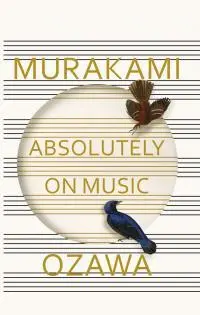
- Название:Absolutely on Music
- Автор:
- Издательство:Random House
- Жанр:
- Год:2016
- ISBN:нет данных
- Рейтинг книги:3 / 5. Голосов: 1
-
Избранное:Добавить в избранное
- Отзывы:
-
Ваша оценка:
Absolutely on Music: краткое содержание, описание и аннотация
Предлагаем к чтению аннотацию, описание, краткое содержание или предисловие (зависит от того, что написал сам автор книги «Absolutely on Music»). Если вы не нашли необходимую информацию о книге — напишите в комментариях, мы постараемся отыскать её.
Haruki Murakami's passion for music runs deep. Before turning his hand to writing, he ran a jazz club in Tokyo, and the aesthetic and emotional power of music permeates every one of his much-loved books. Now, in *Absolutely on Music,* Murakami fulfills a personal dream, sitting down with his friend, acclaimed conductor Seiji Ozawa, to talk about their shared interest.
They discuss everything from Brahms to Beethoven, from Leonard Bernstein to Glenn Gould, from record collecting to pop-up orchestras, and much more.
Absolutely on Music — читать онлайн бесплатно полную книгу (весь текст) целиком
Ниже представлен текст книги, разбитый по страницам. Система сохранения места последней прочитанной страницы, позволяет с удобством читать онлайн бесплатно книгу «Absolutely on Music», без необходимости каждый раз заново искать на чём Вы остановились. Поставьте закладку, и сможете в любой момент перейти на страницу, на которой закончили чтение.
Интервал:
Закладка:
Play the Titan
MURAKAMI: Now I’d like to listen to the same third movement of the First Symphony on a CD you recorded in 1987 with the Boston Symphony.
After the double-bass solo, the funeral march continues with an oboe solo.
MURAKAMI: The sound of the oboe is so different from the one on the Saito Kinen recording we just heard! I’m amazed.
OZAWA: Well, the Boston player doesn’t have that “Miyamoto” sound we talked about before. This one is much milder.
Not just the solo oboe but the whole orchestra sounds much milder than the Saito Kinen.
OZAWA: This part is very mild, too, isn’t it?
MURAKAMI: The sound is unified, and the quality of the playing is high.
OZAWA: Yes, but it could use a little more flavor.
MURAKAMI: I think it’s expressive, and it really sings.
OZAWA: But it’s missing a certain heaviness—a feeling from the countryside.
MURAKAMI: You mean it’s too clean and neat?
OZAWA: The Boston Symphony may have a tendency to make sounds that are too nice.
MURAKAMI: You talked before about bringing out all the little details. Maybe the sound that the Saito Kinen produces is closer to your current conception of this piece.
OZAWA: That’s true. Each individual musician of the Saito Kinen is consciously playing with that in mind. The Boston musicians are thinking about the overall sound of the orchestra.
MURAKAMI: Listening to their sound, I can see exactly what you mean. This is very good-quality, high-level teamwork.
OZAWA: No one does anything to depart from the orchestra’s overall sound. But that’s not necessarily the right way to play Mahler. Getting the proper balance between the two is extremely hard.
MURAKAMI: Maybe that’s why it seems to me so thrilling and interesting these days to hear Mahler played by the irregularly constituted orchestras such as your Saito Kinen or Abbado’s Lucerne Festival Orchestra or his Mahler Chamber Orchestra.
OZAWA: That’s because the members of such orchestras can be bolder. From the moment they get together, each individual of the Saito Kinen is showing off his or her own art: they want the others to see what they can do.
MURAKAMI: So each one is in business for himself.
OZAWA: Of course, this can have its good aspects and its bad aspects. But it fits with Mahler.
MURAKAMI: I guess when the Saito Kinen gets together, it’s like, “All right! This year we’re gonna do the Mahler Ninth!” and they’re all set to go.
OZAWA: Exactly. They arrive with a clear sense of purpose. Almost everybody has studied the score closely.
MURAKAMI: There’s no sense of the routine work of a standing orchestra doing a different program every week.
OZAWA: No, there’s none of that with the Saito Kinen. They’re always fresh. But they may be missing some of the cohesion of a standing orchestra where the members bond together as a unit and can almost read each others’ minds.
MURAKAMI: How does the whole orchestra build a consensus on a piece of music—by going over all the details?
OZAWA: Yes, of course. Most problems can be solved just by the musicians playing their instruments—especially when you’ve got outstanding musicians. An outstanding musician will have a bunch of pockets to draw from. He’ll be watching the conductor and think, “Oh, so that’s how he wants to do this part,” and pull something out of this pocket over here, and it’s kind of like he’s saying to the conductor, “Okay, then, let’s go with this. ” A young musician might not have so many pockets to draw from, of course.
MURAKAMI: Are there some orchestras that are better suited to playing Mahler than other orchestras?
OZAWA: Yes, I think there are. Some orchestras out there are just not up to it technically, where not all the members can play that well. Nowadays, though, I think there are more and more orchestras that can easily handle anything—Mahler, Stravinsky, Beethoven. It didn’t used to be like that. Back when Bernstein was doing Mahler in the sixties, there was very definitely an attitude of “What? He’s doing Mahler ? Whoa, that’s tough stuff !”
MURAKAMI: You mean technically difficult?
OZAWA: Yes. In the string sections alone, the demands made on the players push them to their technical limits. So Mahler was composing with an eye on the distant future, writing music like that even though orchestras of his day were probably not of such high quality. He saw his music as a challenge to orchestras, like, “Here, see if you can play this !” So everybody must have been sweating when they performed his music. Nowadays, though, professional orchestras have more of an attitude of “Mahler? Sure, we can play that.”
MURAKAMI: Performance skills have improved that much, have they—even compared with the 1960s?
OZAWA: Absolutely. Over the past fifty years, orchestral technique has advanced to a whole new level.
MURAKAMI: Not just instrumental performance skills but musicians’ ability to read scores closely has also improved?
OZAWA: Yes, I think so. Take me, for example. There was a very definite change in my ability to read a score after I had started reading Mahler in the early sixties, as compared to before.
MURAKAMI: So for you, reading a Mahler score was very different from reading others?
OZAWA: Yes, that’s true.
The Effectively Avant-Garde Nature
of Mahler’s Music
MURAKAMI: What is the biggest difference between reading a score by Richard Strauss, for example, and reading a score by Mahler?
OZAWA: At the risk of oversimplifying it, I’d say that if you traced the development of German music from Bach through Beethoven, Wagner, Bruckner, and Brahms, you could read Richard Strauss as part of that trajectory. Of course, he’s adding all kinds of new layers, but still you can read his music in that stream. But not Mahler. You need a whole new view. That’s the most important thing that Mahler did. There were also composers like Schoenberg and Alban Berg in his day, but they didn’t do what Mahler did.
MURAKAMI: As you said a minute ago, Mahler was opening up very different areas than twelve-tone music.
OZAWA: He was using the same materials as, say, Beethoven or Bruckner, but building a whole different kind of music with them.
MURAKAMI: Fighting his battles while always preserving tonality?
OZAWA: Right. But still, in effect he was headed in the direction of atonality. Clearly.
MURAKAMI: Would you say that by pursuing the possibilities of tonality as far as he could take them, in effect he confused the whole issue of tonality?
OZAWA: I would. He brought in a kind of multi-layering.
MURAKAMI: Like, lots of different keys in the same movement?
OZAWA: Right. He keeps changing things around. And he’ll do stuff like using two different keys simultaneously.
MURAKAMI: He doesn’t discard tonality, but he causes confusion from the inside, really shakes things up. That’s how he was, in effect, heading toward atonality. But was he striving for something different from the atonality of twelve-tone music?
OZAWA: Yes, it was different, I think. It might be closer to call what he was doing polytonality rather than atonality. Polytonality is one step before you get to atonality—it means that you use more than one key at the same time. Or you keep changing keys as the music flows. In any case, the atonality that Mahler was aiming for came out of something quite different from the atonality and twelve-tone scale that Schoenberg and Berg were offering. Later, somebody like Charles Ives pursued polytonality more deeply.
MURAKAMI: Do you think Mahler thought he was doing something avant-garde?
Читать дальшеИнтервал:
Закладка:
Похожие книги на «Absolutely on Music»
Представляем Вашему вниманию похожие книги на «Absolutely on Music» списком для выбора. Мы отобрали схожую по названию и смыслу литературу в надежде предоставить читателям больше вариантов отыскать новые, интересные, ещё непрочитанные произведения.




Обсуждение, отзывы о книге «Absolutely on Music» и просто собственные мнения читателей. Оставьте ваши комментарии, напишите, что Вы думаете о произведении, его смысле или главных героях. Укажите что конкретно понравилось, а что нет, и почему Вы так считаете.