Харуки Мураками - Absolutely on Music
Здесь есть возможность читать онлайн «Харуки Мураками - Absolutely on Music» весь текст электронной книги совершенно бесплатно (целиком полную версию без сокращений). В некоторых случаях можно слушать аудио, скачать через торрент в формате fb2 и присутствует краткое содержание. Год выпуска: 2016, Издательство: Random House, Жанр: Современная проза, на английском языке. Описание произведения, (предисловие) а так же отзывы посетителей доступны на портале библиотеки ЛибКат.
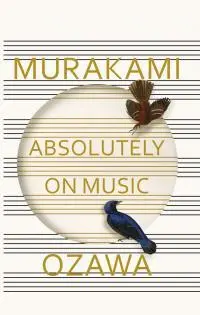
- Название:Absolutely on Music
- Автор:
- Издательство:Random House
- Жанр:
- Год:2016
- ISBN:нет данных
- Рейтинг книги:3 / 5. Голосов: 1
-
Избранное:Добавить в избранное
- Отзывы:
-
Ваша оценка:
Absolutely on Music: краткое содержание, описание и аннотация
Предлагаем к чтению аннотацию, описание, краткое содержание или предисловие (зависит от того, что написал сам автор книги «Absolutely on Music»). Если вы не нашли необходимую информацию о книге — напишите в комментариях, мы постараемся отыскать её.
Haruki Murakami's passion for music runs deep. Before turning his hand to writing, he ran a jazz club in Tokyo, and the aesthetic and emotional power of music permeates every one of his much-loved books. Now, in *Absolutely on Music,* Murakami fulfills a personal dream, sitting down with his friend, acclaimed conductor Seiji Ozawa, to talk about their shared interest.
They discuss everything from Brahms to Beethoven, from Leonard Bernstein to Glenn Gould, from record collecting to pop-up orchestras, and much more.
Absolutely on Music — читать онлайн бесплатно полную книгу (весь текст) целиком
Ниже представлен текст книги, разбитый по страницам. Система сохранения места последней прочитанной страницы, позволяет с удобством читать онлайн бесплатно книгу «Absolutely on Music», без необходимости каждый раз заново искать на чём Вы остановились. Поставьте закладку, и сможете в любой момент перейти на страницу, на которой закончили чтение.
Интервал:
Закладка:
From Chicago Blues to Shin’ichi Mori
MURAKAMI: Do you listen to any music other than classical?
OZAWA: I like jazz. Blues, too. I used to go three or four times a week to listen to blues when I was staying in Chicago for the Ravinia Festival. I was supposed to be studying scores—early to bed, early to rise—but instead I was heading out to the clubs because I liked the blues so much. They started to recognize me as a regular and let me in a side door instead of making me wait in line with everybody else.
MURAKAMI: At that time, weren’t the blues clubs located in not the safest neighborhoods in Chicago?
OZAWA: True, they’re not the best. But I never had anything unpleasant or scary happen to me. They all seemed to know I was conducting at Ravinia. I used to drive there myself, a half hour each way. After I had my fill of blues, I’d drive back to the house I was renting in Ravinia. I played a lot with Peter Serkin while I was in Chicago, and he’d come to the blues joints with me once in a while. He was still a minor in those days, though, so they wouldn’t let him in. They can be very strict about such things in America. They won’t let you in without an ID. He’d stand outside by the window the whole time I was inside listening, trying his best to hear what he could. [ Laughter. ]
MURAKAMI: Poor guy.
OZAWA: That happened a few times.
MURAKAMI: Chicago blues—that’s deep music.
OZAWA: There was a guy named Corky Siegel playing there. A harmonica player. He was the only white guy. Later, I did a recording with him. But boy, the Chicago blues back then were so great! Heavy, intense! There were lots of good players and lots of different kinds of bands. It was a fantastic experience for me. Another thing I did in Chicago was go to hear the Beatles. Somebody gave me a ticket. It was a really good seat, but I couldn’t hear a thing. It was an indoor venue, and the screams blotted out all the music. So I got to see the Beatles but not hear them.
MURAKAMI: Kind of pointless.
OZAWA: Completely pointless. It was a total shock. I enjoyed the band that opened for them, but once the Beatles came on stage, you couldn’t hear a thing.
MURAKAMI: Did you go to jazz clubs?
OZAWA: Not much. In New York, though, when I was an assistant conductor at the New York Philharmonic, one of the violinists—the only black member of the orchestra—heard that I liked jazz, so he took me to some Harlem jazz clubs a few times. They were great. There was usually a strong smell of soul food coming from the kitchen. Oh, that reminds me, we once invited Louis Armstrong—they called him Satchmo—and Ella Fitzgerald to Ravinia. This was something I pushed for. I just loved Satchmo. Until that time, Ravinia was an all-white music festival, and this was the first time jazz performers appeared. And what a great concert it was! I was so excited, I went to visit them backstage. It was tremendous fun. That special style of Satchmo’s was indescribable. You know how we talk about artistic shibumi in Japan, when a mature artist attains a level of austere simplicity and mastery? Satchmo was like that. He was already getting along in years, but his singing and trumpet playing were at their peak.
MURAKAMI: It sounds as if your blues experience left the strongest impression.
OZAWA: I’d have to agree with that. I didn’t know anything about the blues until then. Also, at Ravinia, I was getting a decent salary for the first time in my life. We could finally have proper meals, go to restaurants, live in a nice house. It just so happened I learned about the blues just as I was getting to a point where I could afford to do things for a change, and that coincidence was a major factor in the way my interest developed. Until then, I could never afford to pay to go hear music … By the way, do they still play the blues in Chicago?
MURAKAMI: They sure do! I don’t know that much about it, but I think it’s gotten very active again. Still, I suspect the first half of the 1960s was probably when the Chicago blues were at their best. That’s when they were having their greatest influence on the Rolling Stones.
OZAWA: I think there were three good blues clubs back then, all within a few blocks of each other. New bands would come to each one every two or three days, so I was going there constantly.
MURAKAMI: Oh, that reminds me, you and I went to a Tokyo jazz club together once or twice.
OZAWA: True, true.
MURAKAMI: The first time we heard Junko Onishi on the piano, and then Cedar Walton.
OZAWA: Yes, that was a lot of fun. I’m glad there are good clubs like that in Japan, too.
MURAKAMI: I’m a big fan of Junko Onishi. The quality of her playing and that of other young Japanese jazz musicians is tremendously high. Twenty years ago, there was nothing like their technical mastery.
OZAWA: You’re probably right. Now that you mention it, though, I heard Toshiko Akiyoshi sometime in the late sixties in New York. I thought she was amazingly good.
MURAKAMI: Such a clean touch! Decisive, assertive.
OZAWA: Like a man’s.
MURAKAMI: Like you, she was born in Manchuria. I think she’s a little older, though.
OZAWA: Do you think she’s still performing?
MURAKAMI: Yes, I’m pretty sure she is. She had a big band of her own for a long time.
OZAWA: A big band? Incredible! Later, when I was in Boston, I heard Shin’ichi Mori a lot. And Keiko Fuji.
MURAKAMI: No kidding? You listened to enka ?
OZAWA: They were both wonderful singers.
MURAKAMI: Keiko Fuji’s daughter is very active nowadays as a singer.
OZAWA: Oh, really?
MURAKAMI: She calls herself Hikaru Utada. When I was a student, I worked in a little record shop in Shinjuku, and one day Keiko Fuji came in. She was a small woman, very simply dressed, and didn’t stand out in any way. She introduced herself to us with a smile and thanked us for selling her records. Then she gave us a little bow and left. I remember being very impressed that such a big star would go to the trouble of making the rounds of the record stores like that. That would have been around 1970.
OZAWA: Yes, yes, it was exactly that time that I was listening to enka —Shin’ichi Mori’s “Harbor Town Blues” (“Minatomachi burūsu”), Keiko Fuji’s “Dreams: At Night They Open” (“Yume wa yoru hiraku”), that kind of thing. I had them on cassette and would listen whenever I was driving between Boston and Tanglewood. Vera and the kids were back in Japan, I was living alone, and really homesick for Japan. I used to listen to rakugo storytelling, too, whenever I had time to kill—people like Shinshō.
MURAKAMI: When you’ve been living abroad for a long time, you can build up a real hunger to hear Japanese spoken, can’t you?
OZAWA: Naozumi Yamamoto had that TV show of his, The Orchestra Is Here! [ Oukesutora ga yatte kita ], and when he asked me to appear as a guest on it I said I’d do it if they’d have Shin’ichi Mori on the same show. He really came! I conducted the orchestra accompanying him for one song, which maybe didn’t go all that well. Some famous novelist dumped all over me for that one. [ Laughter. ]
MURAKAMI: What was bothering him?
OZAWA: Well, he said, “Just because you understand classical music doesn’t mean you understand enka. ”
MURAKAMI: Aha.
OZAWA: Of course I didn’t say anything at the time, but I do have my own response to such a criticism. Everybody says that enka is unique to Japan, a form of music that only Japanese can sing and only Japanese can understand. But I don’t believe it. Basically, enka comes from Western music, and it can be fully explained using Western music’s five-line musical staff.
Читать дальшеИнтервал:
Закладка:
Похожие книги на «Absolutely on Music»
Представляем Вашему вниманию похожие книги на «Absolutely on Music» списком для выбора. Мы отобрали схожую по названию и смыслу литературу в надежде предоставить читателям больше вариантов отыскать новые, интересные, ещё непрочитанные произведения.

Обсуждение, отзывы о книге «Absolutely on Music» и просто собственные мнения читателей. Оставьте ваши комментарии, напишите, что Вы думаете о произведении, его смысле или главных героях. Укажите что конкретно понравилось, а что нет, и почему Вы так считаете.