Харуки Мураками - Absolutely on Music
Здесь есть возможность читать онлайн «Харуки Мураками - Absolutely on Music» весь текст электронной книги совершенно бесплатно (целиком полную версию без сокращений). В некоторых случаях можно слушать аудио, скачать через торрент в формате fb2 и присутствует краткое содержание. Год выпуска: 2016, Издательство: Random House, Жанр: Современная проза, на английском языке. Описание произведения, (предисловие) а так же отзывы посетителей доступны на портале библиотеки ЛибКат.
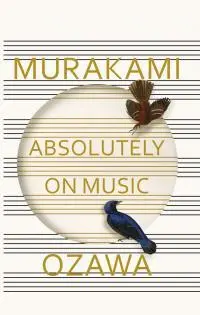
- Название:Absolutely on Music
- Автор:
- Издательство:Random House
- Жанр:
- Год:2016
- ISBN:нет данных
- Рейтинг книги:3 / 5. Голосов: 1
-
Избранное:Добавить в избранное
- Отзывы:
-
Ваша оценка:
Absolutely on Music: краткое содержание, описание и аннотация
Предлагаем к чтению аннотацию, описание, краткое содержание или предисловие (зависит от того, что написал сам автор книги «Absolutely on Music»). Если вы не нашли необходимую информацию о книге — напишите в комментариях, мы постараемся отыскать её.
Haruki Murakami's passion for music runs deep. Before turning his hand to writing, he ran a jazz club in Tokyo, and the aesthetic and emotional power of music permeates every one of his much-loved books. Now, in *Absolutely on Music,* Murakami fulfills a personal dream, sitting down with his friend, acclaimed conductor Seiji Ozawa, to talk about their shared interest.
They discuss everything from Brahms to Beethoven, from Leonard Bernstein to Glenn Gould, from record collecting to pop-up orchestras, and much more.
Absolutely on Music — читать онлайн бесплатно полную книгу (весь текст) целиком
Ниже представлен текст книги, разбитый по страницам. Система сохранения места последней прочитанной страницы, позволяет с удобством читать онлайн бесплатно книгу «Absolutely on Music», без необходимости каждый раз заново искать на чём Вы остановились. Поставьте закладку, и сможете в любой момент перейти на страницу, на которой закончили чтение.
Интервал:
Закладка:
MURAKAMI: Aha.
OZAWA: The special kobushi vocal ornamentation of enka can be written in Western musical notation as vibrato.
MURAKAMI: So you’re saying that, if written down correctly in a score, an enka song can be sung properly even by someone who has never heard one—by a Cameroonian musician, for example?
OZAWA: Exactly.
MURAKAMI: That’s a most unusual view. At least in terms of music theory, even enka can be a universal form of music. I see what you mean.
Fifth Conversation
The Joys of Opera
THIS CONVERSATION TOOK place on March 29, 2011, when both of us happened to be staying in Honolulu. It was eighteen days after the gigantic earthquake and tsunami struck the Tohoku region of Japan, when I was working in Hawaii. Unable to return to Japan, all I could do was follow the situation as it unfolded each day on CNN. The news that came in brought one painful fact after another. Discussing the joys of opera in such a situation seemed strangely out of place, but opportunities to grab the busy Seiji Ozawa for an organized discussion did not come around all that often. And so we spoke about opera, interspersing our musical conversation with such pressing questions as what would happen with the nuclear power plant breakdown and where Japan was headed.
Nobody Was Further Removed
from Opera Than I Was
OZAWA: I conducted opera for the first time in my life after I became music director of the Toronto Symphony in 1965. It was a concert performance of Rigoletto, done without stage sets. I was so happy—or should I say fulfilled—to have my own orchestra. I could perform Mahler if I wanted to. I could perform Bruckner. I could even perform opera.
MURAKAMI: I imagine that conducting opera would be very different from conducting ordinary orchestral works. Where did you study the techniques for conducting opera?
OZAWA: Maestro Karajan insisted that I conduct opera and he had me assist him when he did Don Giovanni in Salzburg in 1968. So I learned the opera well enough to play all parts of it on the piano. That was the beginning of my opera study. The next year he had me conduct Così fan tutte, which was the first stage production I conducted myself.
MURAKAMI: Where was that?
OZAWA: Salzburg again. Before that, a good friend of mine, the African-American tenor George Shirley, suggested that we do an opera together. He wanted to do Rigoletto, which is how I came to do the complete work in Toronto. That was a lot of fun. In Japan, I did Rigoletto at the Tokyo Bunka Kaikan with the Japan Philharmonic. That was a concert performance, too. Come to think of it, I still haven’t done Rigoletto as a fully staged opera.
So anyway, that’s how Così fan tutte turned out to be the first opera I conducted for the stage. The director was Jean-Pierre Ponnelle. He was a marvelous director, but tragically he fell backwards into the orchestra pit when he was working on a production in 1988. I think he injured his back or something, and he died not long afterward. Karl Böhm was supposed to have conducted Così fan tutte, but he had health problems, so I took his place. I’m pretty sure he was having eye surgery.
MURAKAMI: Catapulting the young conductor into even greater prominence.
OZAWA: Right. I think they were really worried about putting me in charge. [ Laughter. ] I mean, it was my first staged opera, after all. Both Maestro Karajan and Maestro Böhm attended a performance because they were worried about how I’d do. They also came to rehearsals. Come to think of it, Claudio Abbado conducted The Barber of Seville on the same stage in Salzburg that year. That was his Salzburg opera debut. Of course, he had probably conducted operas in Italy before that.
MURAKAMI: Abbado is a little older than you, isn’t he?
OZAWA: Yes, a year or two, I think. I worked as Lenny’s assistant just a bit before he did.
MURAKAMI: How well received was your Così fan tutte ?
OZAWA: I’m not sure, but it couldn’t have been too bad. I was invited to conduct the Vienna Philharmonic after that, and I started hearing now and then from the Vienna State Opera, too.
MURAKAMI: Did you enjoy conducting a staged opera for the first time in your life?
OZAWA: Oh, man, it was so much fun! And the cast was superb. We worked like one big, happy family. I conducted Così fan tutte again at Salzburg the following year. At Salzburg, you perform the same piece two or three years in a row. I was invited to Salzburg again, years after that, to conduct Idomeneo, another Mozart. We performed Così fan tutte in the small theater, the Kleines Festspielhaus, and Idomeneo in the Felsenreitschule, the theater they built in an old stone quarry. Come to think of it, most of my experience conducting opera took place in the Palais Garnier opera house in Paris and Milan’s La Scala. And also the Vienna opera house. Those three. I’ve never conducted opera in Berlin.
MURAKAMI: Were you conducting opera on the side while you were Boston Symphony’s music director?
OZAWA: Yes. I would take a break from my work in Boston and go to Europe. Working on an opera takes a month at the very least. So that’s how long my break from Boston would be. Which meant I could never do any new productions. They’re too time consuming. I did work on some new productions in Paris, though— Falstaff and Fidelio, for example. But the Turandot I did there was an old production. Later, I did Tosca with Domingo. And the Messiaen Saint François d’Assise, which I did in 1983, was a world premiere.
MURAKAMI: Opera has been a major part of your career for many years, hasn’t it?
OZAWA: You know, to tell you the truth, nobody was further removed from opera than I was! [ Laughter. ] By which I mean that Professor Saito never taught me a thing about opera. So as long as I stayed in Japan, I had nothing to do with it. Except, while I was still in school, Maestro Akeo Watanabe conducted Ravel’s L’Enfant et les sortilèges with the Japan Philharmonic. I’m pretty sure that was in 1958.
MURAKAMI: That’s a short opera, isn’t it?
OZAWA: Yes, short, maybe an hour-long piece. I remember they did it in concert form, not staged. I sometimes stood in for the conductor during rehearsals—Maestro Watanabe was so busy with his duties as music director. That was truly my first opera experience.
MURAKAMI: Where was it performed?
OZAWA: Hmm, I’m not sure … Sankei Hall? Maestro Watanabe used to do an opera every couple of years. I’m pretty sure he did Debussy’s Pelléas et Mélisande after I went abroad. He chose somewhat unusual pieces.
MURAKAMI: So the first time you really grappled with opera, you were conducting under Karajan?
OZAWA: That’s right. He gave me some very good advice. “The symphonic repertory and opera,” he said, “are like two wheels on a single axle. If either of the wheels is missing, you can’t go anywhere. In the symphonic repertory, you have concerti, symphonic poems, and so forth, but opera is utterly unlike such forms. If you were to die without ever having conducted an opera, wouldn’t that be like dying without ever having really known Wagner? Of course it would. That is why, Seiji, you absolutely must study opera. Puccini, Verdi: you can’t say a thing about them without touching on their operas. Even Mozart poured half his energy into operatic works.” When he told me this, I knew that I would have to do an opera.
MURAKAMI: So that’s how you made up your mind to do Rigoletto in Toronto?
Читать дальшеИнтервал:
Закладка:
Похожие книги на «Absolutely on Music»
Представляем Вашему вниманию похожие книги на «Absolutely on Music» списком для выбора. Мы отобрали схожую по названию и смыслу литературу в надежде предоставить читателям больше вариантов отыскать новые, интересные, ещё непрочитанные произведения.

Обсуждение, отзывы о книге «Absolutely on Music» и просто собственные мнения читателей. Оставьте ваши комментарии, напишите, что Вы думаете о произведении, его смысле или главных героях. Укажите что конкретно понравилось, а что нет, и почему Вы так считаете.