Харуки Мураками - Absolutely on Music
Здесь есть возможность читать онлайн «Харуки Мураками - Absolutely on Music» весь текст электронной книги совершенно бесплатно (целиком полную версию без сокращений). В некоторых случаях можно слушать аудио, скачать через торрент в формате fb2 и присутствует краткое содержание. Год выпуска: 2016, Издательство: Random House, Жанр: Современная проза, на английском языке. Описание произведения, (предисловие) а так же отзывы посетителей доступны на портале библиотеки ЛибКат.
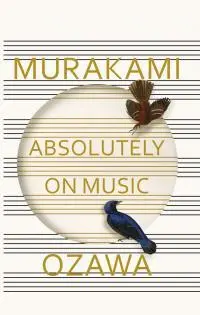
- Название:Absolutely on Music
- Автор:
- Издательство:Random House
- Жанр:
- Год:2016
- ISBN:нет данных
- Рейтинг книги:3 / 5. Голосов: 1
-
Избранное:Добавить в избранное
- Отзывы:
-
Ваша оценка:
Absolutely on Music: краткое содержание, описание и аннотация
Предлагаем к чтению аннотацию, описание, краткое содержание или предисловие (зависит от того, что написал сам автор книги «Absolutely on Music»). Если вы не нашли необходимую информацию о книге — напишите в комментариях, мы постараемся отыскать её.
Haruki Murakami's passion for music runs deep. Before turning his hand to writing, he ran a jazz club in Tokyo, and the aesthetic and emotional power of music permeates every one of his much-loved books. Now, in *Absolutely on Music,* Murakami fulfills a personal dream, sitting down with his friend, acclaimed conductor Seiji Ozawa, to talk about their shared interest.
They discuss everything from Brahms to Beethoven, from Leonard Bernstein to Glenn Gould, from record collecting to pop-up orchestras, and much more.
Absolutely on Music — читать онлайн бесплатно полную книгу (весь текст) целиком
Ниже представлен текст книги, разбитый по страницам. Система сохранения места последней прочитанной страницы, позволяет с удобством читать онлайн бесплатно книгу «Absolutely on Music», без необходимости каждый раз заново искать на чём Вы остановились. Поставьте закладку, и сможете в любой момент перейти на страницу, на которой закончили чтение.
Интервал:
Закладка:
OZAWA: Recently, though—say, in the past five or six years—a few such performances have begun to emerge. When I was in Vienna in 2006 I came down with a case of shingles and couldn’t conduct for a while, so I started listening to other people’s performances. I think it was about that time that you began to hear these more extreme performances. Maybe some conductors were doing it just to be different, adopting tempos that hadn’t been used by people who had made recordings up to that point—by Bernstein, for example, or Abbado—or by me.
MURAKAMI: But since the tempos aren’t specified, the conductor is free to choose his own.
OZAWA: That is correct.
MURAKAMI: Mahler himself was both a composer (the one who gives the instructions) and a conductor (the one who interprets them). So balancing one against the other might have been quite a struggle for him. Speaking of interpretation, the funeral march that comes at the beginning of this third movement really varies in sound, depending on who conducts it: it can be full of an emotional heaviness, or have an academic feel, or even be somewhat comical. In your performance it can feel more neutral, given your more fine-grained treatment from a purely musical standpoint. Then comes the passage of traditional Jewish music which, as I said before, Jewish musicians have tended to imbue with a kind of klezmer sound; while others have taken a cooler approach. Such questions of interpretation are also choices for the performer, I presume.
OZAWA: That traditional Jewish section uses an actual klezmer melody—so you have some conductors who strongly emphasize its Jewish sound, and others who deal with it as one motif in the context of the overall long movement. In the latter case, the conductor will give the theme a precisely nuanced performance when it first appears, and when it is developed again later, they will not add any particular flavor and will tie it in with what follows. That’s another way to do it. The score contains no instructions when it comes to making choices like these.
MURAKAMI: I seem to recall that the movement is labeled “Feierlich und gemessen, ohne zu schleppen,” which translates as “Solemnly and measured, without dragging.”
OZAWA [ looking at the score ]: Correct, that is what it says.
MURAKAMI: When you start thinking about it, those are difficult instructions.
OZAWA: Yes. [ Laughing. ] Very difficult!
MURAKAMI: It starts with a double-bass solo. But is the conductor the one who establishes the sound in this case—like “That’s a little too heavy,” or “Lighten it up a little”?
OZAWA: Well, yes, but it would be mainly the character of the bass player’s tone that would determine that. The conductor can’t say a lot where such things are concerned. Come to think of it, though, before this point, it was unheard of for a symphonic movement to begin with a long double-bass solo. The very fact of having a bass solo was unusual enough, but to put it at the very beginning of the movement! Mahler was really an oddball.
MURAKAMI: Personally, I like this part, but the way the solo is played kind of sets the mood for the whole movement, so it must be hard to perform. All alone like that for such a long passage.
OZAWA: It is hard, so often I’ll talk one-on-one with the soloist about it offstage rather than during rehearsal—like, could you play it a little softer, or raise the intensity a bit, or tone it down just a little?
MURAKAMI: This solo must be the chance of a lifetime for a bass player, I would think. Really nerve-wracking!
OZAWA: Sure, it’s a tremendous responsibility. Which is why we always have a bass player perform it during an audition. How the person plays this solo can determine whether or not he’s invited to join the orchestra.
MURAKAMI: I see!
OZAWA: Behind the double bass, the timpani are going ton-ton-ton, like this.
MURAKAMI: In fourths, counting off the same monotonous rhythm all the way through.
OZAWA: Yes, re-la-re-la —keeping up the sound of a heartbeat, so to speak, setting up a solid framework for the music. And just as the heartbeat won’t wait for anyone, the timpani won’t wait, so the double bass has to do its best to keep up, taking breaths or one thing or another to fit into the framework. Look, here’s a comma in the score.
MURAKAMI: Yes, what’s that for?
OZAWA: It means “Take a breath here.” Rii-rari-raa, raa. [ He sings the double bass’s melody. ] Things like this are all written in. Of course, you can’t actually “take a breath” on a double bass—it’s not a wind instrument—but it means that the bassist should momentarily cut the sound, as if taking a breath, rather than keep the sound going without a break. Mahler is very careful to provide these detailed directions.
MURAKAMI: Amazing.
OZAWA: So then, you see, when the oboe enters with its ryat-tatari-ran, ran [ he sings with a bouncing rhythm ], then the phrase comes to life. And then later, he writes in these accents for an instrument like the harp, whose softer sound is more difficult for the audience to hear. And then he adds a staccato mark on all of the following notes.
MURAKAMI: Oh, I see. It’s incredibly detailed. What a job it must have been to write a score with so much information in it!
OZAWA: That’s why the performers are so nervous to do this one.
MURAKAMI: I can see where they’d be kind of stressed out playing this stuff, the way it never ceases to demand that they concentrate on every little thing.
OZAWA: Exactly. There’s a lot of stress involved. Take this part, for example: you can’t play it as you ordinarily would— tori-raa-yaa-tataan —but rather toriira-ya-tta-tan. The instructions are very precise. You can’t relax.
MURAKAMI: This instruction, “mit Parodie”—does it really mean you’re supposed to play it with a sense of parody?
OZAWA: It does.
MURAKAMI: That’s another difficult bit of direction.
OZAWA: You have to have a spirit of parody here.
MURAKAMI: But I imagine you can overdo it and destroy the dignity of the music.
OZAWA: You’re right. All it takes is one teaspoon too much or too little, and you can change the whole flavor of the music. That’s what’s so interesting.
MURAKAMI: Even given all this direction, I’m sure there are still times when a musician supposedly playing it as written produces a sound that is different from what you imagined.
OZAWA: Yes, of course, that happens. When a musician produces a sound that is different from the sound I have in my head, I’ll work hard to bring the two closer together—either through verbal instruction or via hand signals.
MURAKAMI: Are there musicians who don’t get the point?
OZAWA: Yes, of course, all the time. It’s the conductor’s job, during rehearsals, to find compromises, or to keep pushing until the musicians come around.
What Makes Mahler’s Music So Cosmopolitan?
MURAKAMI: Just listening to this third movement of the First Symphony, it seems pretty clear to me that Mahler’s music is filled with many different elements, all given more or less equal value, used without any logical connection, and sometimes even in conflict with one another: traditional German music, Jewish music, fin-de-siècle overripeness, Bohemian folk songs, musical caricatures, comic subcultural elements, serious philosophical propositions, Christian dogma, Asian worldviews—a huge variety of stuff, no single one of which you can place at the center of things. With so many elements thrown together indiscriminately (which sounds bad, I know), aren’t there plenty of openings where a non-Western conductor such as yourself can make his own special inroads? In other words, isn’t there something particularly universal or cosmopolitan about Mahler’s music?
Читать дальшеИнтервал:
Закладка:
Похожие книги на «Absolutely on Music»
Представляем Вашему вниманию похожие книги на «Absolutely on Music» списком для выбора. Мы отобрали схожую по названию и смыслу литературу в надежде предоставить читателям больше вариантов отыскать новые, интересные, ещё непрочитанные произведения.



Обсуждение, отзывы о книге «Absolutely on Music» и просто собственные мнения читателей. Оставьте ваши комментарии, напишите, что Вы думаете о произведении, его смысле или главных героях. Укажите что конкретно понравилось, а что нет, и почему Вы так считаете.