Харуки Мураками - Absolutely on Music
Здесь есть возможность читать онлайн «Харуки Мураками - Absolutely on Music» весь текст электронной книги совершенно бесплатно (целиком полную версию без сокращений). В некоторых случаях можно слушать аудио, скачать через торрент в формате fb2 и присутствует краткое содержание. Год выпуска: 2016, Издательство: Random House, Жанр: Современная проза, на английском языке. Описание произведения, (предисловие) а так же отзывы посетителей доступны на портале библиотеки ЛибКат.
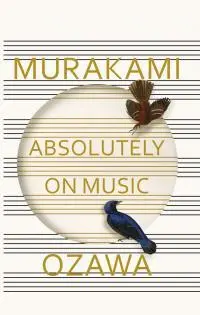
- Название:Absolutely on Music
- Автор:
- Издательство:Random House
- Жанр:
- Год:2016
- ISBN:нет данных
- Рейтинг книги:3 / 5. Голосов: 1
-
Избранное:Добавить в избранное
- Отзывы:
-
Ваша оценка:
Absolutely on Music: краткое содержание, описание и аннотация
Предлагаем к чтению аннотацию, описание, краткое содержание или предисловие (зависит от того, что написал сам автор книги «Absolutely on Music»). Если вы не нашли необходимую информацию о книге — напишите в комментариях, мы постараемся отыскать её.
Haruki Murakami's passion for music runs deep. Before turning his hand to writing, he ran a jazz club in Tokyo, and the aesthetic and emotional power of music permeates every one of his much-loved books. Now, in *Absolutely on Music,* Murakami fulfills a personal dream, sitting down with his friend, acclaimed conductor Seiji Ozawa, to talk about their shared interest.
They discuss everything from Brahms to Beethoven, from Leonard Bernstein to Glenn Gould, from record collecting to pop-up orchestras, and much more.
Absolutely on Music — читать онлайн бесплатно полную книгу (весь текст) целиком
Ниже представлен текст книги, разбитый по страницам. Система сохранения места последней прочитанной страницы, позволяет с удобством читать онлайн бесплатно книгу «Absolutely on Music», без необходимости каждый раз заново искать на чём Вы остановились. Поставьте закладку, и сможете в любой момент перейти на страницу, на которой закончили чтение.
Интервал:
Закладка:
OZAWA: Especially the finale. That and the finale of the Bruckner Ninth are really tough, the way they both quietly fade away.
MURAKAMI: You have to make the music of that piece in long units, or else you can’t really scoop out everything it has inside—to put it more or less in terms of the “direction” we talked about before.
OZAWA: Right, right. Any orchestra without those long breaths can’t play it. You could say the same thing about Bruckner.
MURAKAMI: The last Mahler Ninth you did with the Boston Symphony was breathtakingly beautiful, too. The one that’s on DVD.
OZAWA: Because we put real feeling into it. Finally, Mahler appears to be written in this very complex way—and in fact it is written in a way that is very complex for the orchestra—but the essential quality of Mahler’s music is such that (and here, I’m afraid the way I’m putting it will be misunderstood) if you do it with feeling, it’s a fairly simple thing. By “simple” I mean something like the musicality of a folk song, something that everyone can hum. Lately, I’ve come to feel that as long as you capture that quality with truly superior technique and tone color and get the feeling into it, it’s probably going to go well.
MURAKAMI: Hmm, it may be easy to say that, but isn’t it hard to actually do it?
OZAWA: Yes, well, of course it’s hard, but—look, all I want to say is that Mahler’s music looks hard at first sight, and it really is hard, but if you read it closely and deeply, with feeling, it’s not such confusing and inscrutable music after all. It’s got all these layers piled one on top of another, and lots of different elements emerging at the same time, so in effect it sounds complicated.
MURAKAMI: You get these completely unrelated motifs—sometimes motifs that move in completely opposite directions—proceeding at the same time, with practically equal emphasis.
OZAWA: And they’ll come very close to each other before moving on. When these things happen, the music sounds complicated. You can study it and still be left confused.
MURAKAMI: And it can be hard for listeners, too, almost schizophrenic, if you try to grasp the overall structure of a piece while you’re listening to it.
OZAWA: That’s true. It’s the same with a later composer like Messiaen. He’ll put in three simple melodies that proceed simultaneously and yet have absolutely nothing to do with one another. You pull out any one part and the thing itself is fairly simple. If you put feeling into it, you can perform it quite simply. Which means, in other words, that a musician performing one part just has to concentrate hard on doing that one part. A musician playing a different part puts just as much energy into that without any relation to the first. Put the two of them together at the same time, and the result is the kind of sound that we’ve been talking about.
MURAKAMI: I see what you’re saying. The other day, for the first time in quite a while, I listened to a Bruno Walter performance of the Titan on a stereo LP, and it seems to me I could scarcely hear the grasp of Mahler’s music, the separation of parts that you just described. Instead, I felt a kind of will to force the whole of Mahler’s symphony into one massive frame, to bring it closer to the structure of a Beethoven symphony. But when you do that, you end up with a slightly different sound than the so-called “Mahler sound.” Listening to the first movement of the Titan, for example, I felt that I was hearing the Beethoven Pastoral. That was the kind of sound that Bruno Walter was producing. But when I listen to your performance of the Titan, the sound is so different. Finally, in Walter’s case, it seems as if the traditional form of German music—something like the sonata form—is ingrained in him at the deepest level.
OZAWA: Uh-huh, for sure, that approach may not be very well suited to Mahler’s music.
MURAKAMI: Of course it’s very good as music, very high quality, and moving to listen to. Walter has his own idea of Mahler’s world, and he constructs it in this very solid way. But I think the sound may be just a little different from what we now look for in Mahler’s music, or what we take to be “Mahleresque.”
OZAWA: In that sense, I think that Lenny’s achievement was absolutely huge. He himself was a composer, so he was able to tell the performers, “Do this part this way. Don’t think about the other parts, just concentrate on your own.” When you perform it like that, the result is very convincing to listeners. It brings out the flow of the orchestra. Those elements were already present in the First Symphony, but they’re even more pronounced from the Second onward.
MURAKAMI: But when I listen to records of Mahler performances from the sixties, I get the sense that the approach you’re describing hadn’t formed yet—the idea that if you forge ahead with the details, then the whole will emerge. Rather, what I think I may be hearing is a tendency to carry the music forward emotionally in a traditional fin-de-siècle Viennese way, accepting chaos as chaos. Isn’t the kind of approach you’re describing a relatively recent phenomenon?
OZAWA: Well, maybe so in terms of performance. But the fact is that Mahler was writing his scores the way I’m talking about. Before Mahler, if you had two motifs going at the same time—theme A and theme B—there was a clear distinction between primary and secondary. In Mahler, though, the two are completely equal. So the musicians who are playing theme A have to put their heart and soul into playing theme A; and the musicians playing theme B have to put their heart and soul into playing theme B—with feeling, with color, everything. It’s the job of the conductor to put it all together so that the two themes proceed simultaneously. This is what you need to do with Mahler’s music because that’s how it’s written —right there in the score.
MURAKAMI: Now, let’s talk about the First Symphony, the Titan. So far, you have made three recordings of it: the first in 1977 with the Boston Symphony, then again with Boston in 1987, and the third in 2000 with the Saito Kinen Orchestra. The three recordings sound completely different from one another.
OZAWA: Oh, really?
MURAKAMI: It’s shocking how different they are.
OZAWA: Hmmm.
MURAKAMI: In the simplest terms, the first Boston performance has a very fresh feel to it overall. It’s a young man’s music that goes straight for the heart. The second Boston performance is terrific, with an added density that only the Boston Symphony could produce. But the newest one, with the Saito Kinen Orchestra, feels absolutely transparent to me—as though you can see every little detail. All the inner voices come clearly to the surface. I really enjoyed comparing the recordings and hearing these differences.
OZAWA: I myself changed, too, over that long a time. I’ve never sat down to do a comparison of the three recordings, but I’m pretty sure you’re right about how they differ.
MURAKAMI: When I listen to Abbado’s recent Mahler performances, I’m sure I feel that same kind of grasp of Mahler that you were talking about before. They give the impression of a very deep and meticulous reading of the score, as though he’s become convinced that the more deeply you burrow into the score itself, the more naturally Mahler is going to emerge. I get the same kind of feeling from a conductor like Gustavo Dudamel. Of course it’s important for the conductor to become emotionally involved with the music, but that’s strictly something that comes later, as a result of the deep study of the score.
OZAWA: Maybe so.
MURAKAMI: But when you listen to Mahler performances from the sixties, say, by someone like Rafael Kubelik, there’s still a sense of compromise, as if the shift from a romantic grounding is not yet complete.
Читать дальшеИнтервал:
Закладка:
Похожие книги на «Absolutely on Music»
Представляем Вашему вниманию похожие книги на «Absolutely on Music» списком для выбора. Мы отобрали схожую по названию и смыслу литературу в надежде предоставить читателям больше вариантов отыскать новые, интересные, ещё непрочитанные произведения.




Обсуждение, отзывы о книге «Absolutely on Music» и просто собственные мнения читателей. Оставьте ваши комментарии, напишите, что Вы думаете о произведении, его смысле или главных героях. Укажите что конкретно понравилось, а что нет, и почему Вы так считаете.