Харуки Мураками - Absolutely on Music
Здесь есть возможность читать онлайн «Харуки Мураками - Absolutely on Music» весь текст электронной книги совершенно бесплатно (целиком полную версию без сокращений). В некоторых случаях можно слушать аудио, скачать через торрент в формате fb2 и присутствует краткое содержание. Год выпуска: 2016, Издательство: Random House, Жанр: Современная проза, на английском языке. Описание произведения, (предисловие) а так же отзывы посетителей доступны на портале библиотеки ЛибКат.
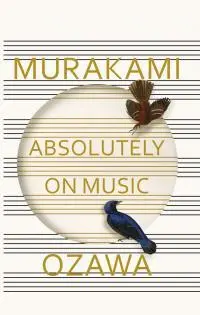
- Название:Absolutely on Music
- Автор:
- Издательство:Random House
- Жанр:
- Год:2016
- ISBN:нет данных
- Рейтинг книги:3 / 5. Голосов: 1
-
Избранное:Добавить в избранное
- Отзывы:
-
Ваша оценка:
Absolutely on Music: краткое содержание, описание и аннотация
Предлагаем к чтению аннотацию, описание, краткое содержание или предисловие (зависит от того, что написал сам автор книги «Absolutely on Music»). Если вы не нашли необходимую информацию о книге — напишите в комментариях, мы постараемся отыскать её.
Haruki Murakami's passion for music runs deep. Before turning his hand to writing, he ran a jazz club in Tokyo, and the aesthetic and emotional power of music permeates every one of his much-loved books. Now, in *Absolutely on Music,* Murakami fulfills a personal dream, sitting down with his friend, acclaimed conductor Seiji Ozawa, to talk about their shared interest.
They discuss everything from Brahms to Beethoven, from Leonard Bernstein to Glenn Gould, from record collecting to pop-up orchestras, and much more.
Absolutely on Music — читать онлайн бесплатно полную книгу (весь текст) целиком
Ниже представлен текст книги, разбитый по страницам. Система сохранения места последней прочитанной страницы, позволяет с удобством читать онлайн бесплатно книгу «Absolutely on Music», без необходимости каждый раз заново искать на чём Вы остановились. Поставьте закладку, и сможете в любой момент перейти на страницу, на которой закончили чтение.
Интервал:
Закладка:
MURAKAMI: To me it seems as if the orchestra is producing something closer to a baroque sound than the soloist. What was this “Columbia Chamber Orchestra”?
OZAWA: That was a made-up name. They were really a bunch of string players from the New York Philharmonic picked by Gomberg to make the recording. None of us had played baroque music before. As an assistant conductor of the New York Philharmonic, I was chosen to conduct.
MURAKAMI: It’s hard for me to think of you performing Telemann.
OZAWA: Yes, it might have been the only time for me. I had to work hard for this.
MURAKAMI: Did Harold Gomberg make a point of choosing you for the recording?
OZAWA: Yes, I think he liked me personally.
MURAKAMI: After this you recorded two Bartók piano concertos—nos. 1 and 3. They were recorded in July of that same year—two months after the Telemann. Peter Serkin is the soloist. This is a tremendously eye-opening performance!
OZAWA: That was the Chicago Symphony—or was it Toronto?
MURAKAMI: Chicago. And even today the performance sounds fresh and original. There was a certain reserve or uncertainty with the Telemann and Vivaldi, but this one’s pretty much wide open.
OZAWA: You think so? I don’t remember a thing about that performance. The year before, I was a surprise pick for music director of the Ravinia Festival. It caused a big stir—I even went on a TV show called What’s My Line? —something like the old NHK quiz show My Secret. So the record company came to see me right away and we arranged to make recordings every year after the concert. The next day, we’d drive the half hour to Chicago and record.
MURAKAMI: Chicago’s Ravinia Festival is like Boston’s Tanglewood …
I put the Bartók record on the turntable. The First Concerto. Breathtakingly sharp sounds come flying out of the speakers, a vivid aural image brimming with life. The performance is superb.
OZAWA: Oh, the trumpet is Herseth, Adolph Herseth. He’s a legendary trumpeter with the Chicago Symphony.
The piano solo begins.
MURAKAMI: The sound of the piano is stunning, too, completely free of uncertainty.
OZAWA: Yes, he’s really good. Peter was still in his teens.
MURAKAMI: It’s a tremendously sharp performance.
The orchestra joins in with the piano.
OZAWA: Oh, I remember this part … In those days, the Chicago Symphony’s brass section was the best in the world. Herseth and the rest of them were a stellar lineup.
MURAKAMI: Was that when Fritz Reiner was the principal conductor?
OZAWA: No, it was Jean Martinon.
MURAKAMI: But what a leap that was for you—from Telemann to Bartók! Talk about variety!
Ozawa laughs.
MURAKAMI: In December of that same year you also recorded the Mendelssohn and Tchaikovsky violin concertos.
OZAWA: I can’t quite recall the name of the fellow who played the violin on that one …
MURAKAMI: Erick Friedman.
OZAWA: And the orchestra was the London Symphony …?
MURAKAMI: Yes, the London Symphony. I also found that recording in an American used-record store. Listening to it nowadays, though, there’s something kind of old-fashioned about the violin’s performance—a little too passionate.
OZAWA: I remember doing the recording, but not much more than that.
MURAKAMI: And just about the same time, again with the London Symphony, you recorded the Schumann Piano Concerto with Leonard Pennario. Also on the record is Strauss’s Burleske. Then, the following year, yet again with the London Symphony, you recorded the Tchaikovsky Piano Concerto no. 1 with John Browning. That’s quite a number of romantic concertos you put together in London with American performers. I haven’t heard the recording with Browning, but in retrospect these performers don’t seem all that impressive. No one really listens to them anymore.
OZAWA: I’m pretty sure the record company had a massive campaign going to sell both Pennario and Friedman. But I will say this: John Browning was an absolute genius on the piano.
MURAKAMI: I haven’t heard much about him lately.
OZAWA: Yes, I wonder what he’s doing.
Murakami note: Born in 1933, John Browning was a hot young pianist in the 1960s, but he scaled back his activities in the seventies, citing “overwork” as the cause. He re-emerged in the mid-1990s, playing contemporary American music, but died in 2003.
MURAKAMI: So you go from Telemann straight to Bartók and then swing back to dead center with the romantics. I’m curious how such a wide range of recording commissions came to you. Aside from the Gomberg recording, all are with the RCA Victor label.
OZAWA: I never know where requests like that are going to materialize from. I had had some success at the Ravinia Festival and was more or less in the spotlight at the time. After all, the Chicago Symphony was said to be the strongest orchestra in the world, so the fact that they had singled me out caused quite a stir. I suppose the record company wanted to exploit the publicity surrounding me, so that’s how I ended up going to London to make all those recordings.
MURAKAMI: Looking at your discography, I can see you must have been very busy. Then that next summer, in 1966, you recorded Honegger’s oratorio Jeanne d’Arc au bûcher. Your repertory has such tremendous variety!
Ozawa laughs.
MURAKAMI: What was your policy in those days—to accept any offer that came from a record company?
OZAWA: That’s right. I was still not in any position to choose.
MURAKAMI: Was the Honegger also suggested by the record company?
OZAWA: I’m pretty sure it was. There’s no way I would have gone to them wanting to do a piece like that.
MURAKAMI: I still can’t tell from looking at your discography what the record company had in mind for you.
OZAWA: I have absolutely no idea.
MURAKAMI: Even an outside observer like me can’t help becoming a little confused looking at this lineup. Next you did Berlioz’s Symphonie fantastique with the Toronto Symphony. That was late in 1966. Were you already their principal conductor by that point?
OZAWA: Yes. It might have been that year. I recorded Takemitsu’s November Steps and Messiaen’s Turangalîla Symphony right after becoming Toronto’s music director. I was only there four years altogether.
MURAKAMI: I see both pieces were recorded in 1967. Were they your choices?
OZAWA: Yes—oh, not the Messiaen! That was the composer’s idea. I had performed it for him when he came to Japan—before I was boycotted by the NHK Symphony. He really liked my work—or should I say he was crazy about it? He said he wanted me to do everything of his. I was ready to do the complete works, but Toronto wouldn’t go along with that plan: they said they’d never sell any tickets. At least I managed to get the Turangalîla Symphony and Oiseaux exotiques recorded.
The Rite of Spring: Something Like the Inside Story
MURAKAMI: To prepare for this interview, I listened to—well, not all, but most of the recordings you made in the sixties, and if I were to choose my personal favorites, they would include the Bartók piano concertos we mentioned, the Symphonie fantastique you did with the Toronto Symphony, and Stravinsky’s Rite of Spring. I thought they were especially wonderful—just as fresh today as ever.
OZAWA: You mean the Stravinsky I did with the Chicago Symphony?
MURAKAMI: Yes.
OZAWA: There’s a story that goes along with that recording of The Rite of Spring. Stravinsky himself actually rewrote the score. In his “revised version,” he changed the bar lines. It was absolutely incredible. He made it completely different from the version we had studied so hard—a shock for the conductor and the performers alike. I figured there was no way we could do it.
Читать дальшеИнтервал:
Закладка:
Похожие книги на «Absolutely on Music»
Представляем Вашему вниманию похожие книги на «Absolutely on Music» списком для выбора. Мы отобрали схожую по названию и смыслу литературу в надежде предоставить читателям больше вариантов отыскать новые, интересные, ещё непрочитанные произведения.


Обсуждение, отзывы о книге «Absolutely on Music» и просто собственные мнения читателей. Оставьте ваши комментарии, напишите, что Вы думаете о произведении, его смысле или главных героях. Укажите что конкретно понравилось, а что нет, и почему Вы так считаете.