William Gibson - Spook Country
Здесь есть возможность читать онлайн «William Gibson - Spook Country» весь текст электронной книги совершенно бесплатно (целиком полную версию без сокращений). В некоторых случаях можно слушать аудио, скачать через торрент в формате fb2 и присутствует краткое содержание. Город: NEW YORK, Год выпуска: 2007, Издательство: G. P. PUTNAM’S SONS, Жанр: Современная проза, на английском языке. Описание произведения, (предисловие) а так же отзывы посетителей доступны на портале библиотеки ЛибКат.
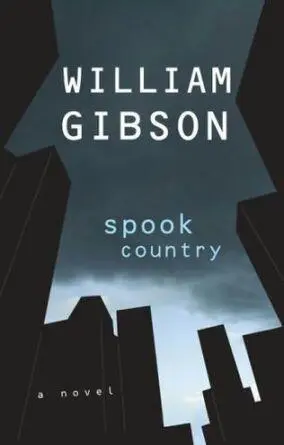
- Название:Spook Country
- Автор:
- Издательство:G. P. PUTNAM’S SONS
- Жанр:
- Год:2007
- Город:NEW YORK
- ISBN:нет данных
- Рейтинг книги:4 / 5. Голосов: 1
-
Избранное:Добавить в избранное
- Отзывы:
-
Ваша оценка:
Spook Country: краткое содержание, описание и аннотация
Предлагаем к чтению аннотацию, описание, краткое содержание или предисловие (зависит от того, что написал сам автор книги «Spook Country»). Если вы не нашли необходимую информацию о книге — напишите в комментариях, мы постараемся отыскать её.
, the challenge of writing about the present-day world drove him to create perhaps his best novel yet, and in
he remains at the top of his game. It's a stripped-down thriller that reads like the best DeLillo (or the best Gibson), with the lives of a half-dozen evocative characters connected by a tightly converging plot and by the general senses of unease and wonder in our networked, post-9/11 time.
Spook Country — читать онлайн бесплатно полную книгу (весь текст) целиком
Ниже представлен текст книги, разбитый по страницам. Система сохранения места последней прочитанной страницы, позволяет с удобством читать онлайн бесплатно книгу «Spook Country», без необходимости каждый раз заново искать на чём Вы остановились. Поставьте закладку, и сможете в любой момент перейти на страницу, на которой закончили чтение.
Интервал:
Закладка:
“What is ‘Alberta’?”
“A province. State. Of Canada. The man you’re meeting, at the Princeton Hotel, will be parked on Powell, west of the hotel, in a large black pickup with a covered bed. He’s a very large man, very heavy, with a full dark beard. He’ll put you in the bed of the truck and drive it into the container terminal. He works there. If you’re discovered in the truck, he’ll claim not to know you, and you’ll claim not to know him. We very much hope, of course, that that won’t happen. Now we’ll go over the maps again. Where he’ll park the truck. Where the stack is. If you’re apprehended after having positioned the magnets, lose the phone first, then the cards and neck tag. Be confused. Speak little English. It will be awkward for you, if that happens, but they’ll have no way of knowing what you’ve just done. Claim you were looking for work. You’ll be arrested for trespassing, then locked up on immigration charges. We’ll do what we can. As will your family, of course.” He passed Tito another bag, this with a fold of well-worn bills. “In case you get out, tonight, but for any reason can’t contact us. Stay out of sight, in that case, and contact your family. You know how.”
Tito nodded. The old man understood the protocol. “Excuse me,” Tito said, in Russian. “But I must ask you about my father. About his death. I know very little other than that he was shot. I believe he may have been working for you.”
The old man frowned. “Your father was shot,” he said, in Spanish. “The man who shot him, an agent of Castro’s DGI, was delusional, paranoid. He believed that your father was reporting directly to Castro. Actually he was reporting to me, but that had nothing to do with the suspicions of his killer, which were baseless.” He looked at Tito. “If I’d valued your father’s friendship less, I might lie to you now, and tell you that his death involved some high purpose. But he was a man who valued truth. The man who shot him died in a bar fight, not long after, and we assumed that that had been the work of the DGI, who by then had determined that he was both unstable and utterly untrustworthy.”
Tito blinked.
“You haven’t had an easy life, Tito. Your mother’s illness, as well. Your uncles see that she receives excellent care. If they weren’t able to, I would myself.”
TITO HELPED GARRETH carry the Pelican case back down to the van. “All in the wrists,” Garreth said. “Can’t be straining them tonight, wrestling with this bastard.”
“What’s in it?” Tito asked, deliberately ignoring protocol as they slid the black case into the back of the van.
“Lead, mostly,” Garreth said. “Almost solid block of lead, in there.”
THE OLD MAN sat with Bobby, speaking to him quietly, calming him. Tito listened. Bobby no longer reminded him of his mother. Bobby’s fear was on some other frequency. Tito guessed he chose to allow it to overwhelm him, invited it, used it to make things the fault of others, attempted to control them with it.
Tito’s mother’s fear, after the towers had fallen, had been a deep and constant resonance, untouchable, gradually eroding the foundations of who she had been.
He looked up at the dark skylight and tried to feel New York. Trucks were rattling over metal on Canal Street, he told himself. Trains blowing past, beneath the pavement, through a maze his family had mapped with exquisite care. Had come to own, in a sense; every corner of every platform, every line of sight, many keys, storage closets, lockers; a theater for appearances and disappearances. He could have drawn maps, written out schedules, but now he found himself starting to be unable to believe in it. Like the Russian voices on his Sony plasma set, on the wall of the room that was no longer his.
“I’m Hollis,” the woman said, extending her hand. “Garreth tells me you’re called Tito.”
She was handsome, this woman, in some simple way. Looking at her now, he understood why they would make posters of her. “You are Bobby’s friend?” he asked.
“I don’t know him very well, really,” she said. “Have you known Garreth long?”
Tito looked at Garreth, who’d swept himself a section of floor, stripped down to black underpants and T-shirt, and was doing asanas. “No,” he said.
THE OLD MAN sat reading a news site on one of Bobby’s computers.
Tito and Bobby had carried the other things down. The long gray case, a folding aluminum hand truck wrapped with bungees, a photographer’s black tripod, a heavy canvas duffel.
“We’re going now,” Garreth said.
The old man shook hands with Tito, then Garreth. Then he offered his hand to the woman. “I’m pleased with our arrangement, Miss Henry,” he said to her. She shook his hand, but said nothing.
Tito, wrapped from waist to armpits, beneath his jacket and sweatshirt, in sixty feet of black nylon climbing rope, with the rare-earth magnets down the front of his jeans, the black respirator bulging out of one side pocket of the green jacket, and the yellow hard hat under his arm, led the way downstairs.
73. SPECIAL FORCES
G oing somewhere she’d never seen, at night, in a van with two men, with equipment, reminded her of the beginning of the Curfew, minus Heidi Hyde. Who had always insisted on driving, and could do all the loading alone, if she had to.
Garreth driving now. Perfect fifty kilometers per hour, along this downscale industrial strip. Smooth, considered stops. Even acceleration. Model driver. No excuse to pull him over.
Tito in back, sitting as far from the black plastic case as he could. White iPod plugs in his ears, nodding to some rhythm only he could hear. Looking tranced. Like a kid in a chill-out room. Why had they wrapped him in that black rope? It must be uncomfortable, but he didn’t look uncomfortable. She’d watched him practice a trick with it, before Garreth and the old man had wrapped him in it. Tying one end of it quickly around a vertical pipe, pulling it tight, then standing back and flicking it. The knot tight and solid when he pulled on it, but letting go instantly when he flicked it. He did it three times. She couldn’t follow his hands, when he knotted it. He was pretty enough, at rest, almost feminine, but when he moved with purpose, he became beautiful. Whatever it was, she knew she didn’t have it herself. That had been her weakness, onstage. Inchmale had once sent her to a French movement teacher, in Hackney, in an effort to change that. The man had said he’d teach her to walk like a man, that that would make her very powerful onstage. She’d satisfied him, finally, but had never even considered trying it onstage. The one time she’d demonstrated it for Inchmale, though, after a few drinks, he said he’d paid good money to have her taught to walk like Heidi.
Garreth took a right onto a main street, heading east. One-story retail, car leasing, restaurant furniture. A few blocks later, he took a left. They headed downhill, into what once would have been a neighborhood of modest frame houses. A few were still there, but unlit, each one painted a single dark color, no trim. Placeholders in a real estate game, next to small factories, auto-body shops, a plastics fabricator. Patches of weedy grass that had once been lawns, gnarled ancient fruit trees. No pedestrians here, almost no traffic. He looked at his watch, pulled over, put out the lights, and shut off the engine.
“How did you get into this?” she asked, without looking at him.
“I heard that someone was looking for a really odd skill set,” he said. “I had a friend who’d been in the SAS, another BASE enthusiast. We’d jumped together, in Hong Kong. He was approached first, actually, and didn’t want it. He said he was too military, not unconventional enough. He recommended me, and I came down to London and he took me along to my meeting. I couldn’t believe it, but he was wearing a tie. Bastard. Amazing. Turned out it was his club tie, the only one he owned. Special Forces Club. That’s where we went. I’d no idea there was one.”
Читать дальшеИнтервал:
Закладка:
Похожие книги на «Spook Country»
Представляем Вашему вниманию похожие книги на «Spook Country» списком для выбора. Мы отобрали схожую по названию и смыслу литературу в надежде предоставить читателям больше вариантов отыскать новые, интересные, ещё непрочитанные произведения.

Обсуждение, отзывы о книге «Spook Country» и просто собственные мнения читателей. Оставьте ваши комментарии, напишите, что Вы думаете о произведении, его смысле или главных героях. Укажите что конкретно понравилось, а что нет, и почему Вы так считаете.